Best digital banks in Europe for businesses (2026)




Tired of slow, paperwork-heavy business banking? Of paying for every international wire and losing money on your bank's exchange-rate margin? Then it might be time to go digital.
Digital business accounts let you handle everything from your phone. You can open an account online in minutes, hold euros alongside dollars and pounds, and pay suppliers abroad at close to the real exchange rate, with no branch visits and no hidden fees.
Throughout this article we compare the best digital business accounts and the pros and cons of each, so you can pick the one that fits your company. If you want the short version: Revolut Business is the best option overall, Wise Business is best if you want no monthly fee and cheap currency conversion, and N26 is best for freelancers. One note upfront: some providers are licensed banks with deposit protection, while others are electronic money institutions (EMIs) that safeguard your money differently, which we flag for each option.
The best digital business accounts
- Revolut Business: the best business account overall. The most complete option: a licensed EEA bank with multi-currency accounts, expense cards, team controls and interest on cash.
- Wise Business: best if you want no fixed monthly fee, cheap currency conversion and interest on cash. Just note it is not a bank, so there is no deposit guarantee.
- bunq: best if you want a licensed bank with many sub-account IBANs and modern bookkeeping tools.
- N26 Business: best for freelancers and the self-employed, though it does not accept regular limited companies.
- Qonto: best if you want banking plus invoicing and accounting with a local IBAN.
Beyond these five, a few names are worth knowing for specific needs: Payoneer for collecting from marketplaces (Amazon, Upwork, Fiverr), and Paysera or Finom as low-cost EU alternatives, with Finom leaning into invoicing and cashback.
Initial comparison
Before we look at each option in detail, here is a table summarising some of the points that are usually critical when choosing a business account.
First, the running cost, meaning the monthly subscription (if any). Then the IBAN country, since a local IBAN avoids friction with tax authorities and some suppliers. Next, whether the account genuinely supports multiple currencies and low-cost FX, which matters if you sell or buy abroad.
The last column shows whether the provider offers a way to earn interest on your idle cash, and roughly how much. For a wider view of where to park cash, see our guide to the best euro savings accounts.
| Provider | Monthly cost | IBAN | Multi-currency and FX | Interest on cash |
|---|---|---|---|---|
| Revolut Business | From ~€10/month (Basic), no free plan | Lithuanian | Yes, multi-currency with interbank FX within limits | Up to ~2.25% (by plan) |
| Wise Business | No subscription (one-off ~€50 setup) | Belgian (EUR) plus local details in ~9 currencies | Yes, 40+ currencies at the mid-market rate | Wise interest fund (variable, capital at risk) |
| bunq | Free plan, paid from ~€7.99 | Local IBANs in several countries | ZeroFX on higher plans | EUR savings ~0.75% (USD/GBP ~2.30%) |
| N26 Business | Free plan, paid from ~€9.90 | German | No, euro and SEPA only | Up to 2.25% (top plan) |
| Qonto | From ~€9 | Local (FR, DE, IT, ES and more) | Limited, international transfers via Wise | Intro promo up to 4% to 5%, then ~2% |
Data as of 6 July 2026. Rates, prices and features are variable, so always confirm the current terms on each provider's website.
Each option brings different strengths. If you want the cheapest way to hold several currencies and pay internationally, go for Revolut Business or Wise Business.
If you want a licensed EEA bank with deposit protection and sub-accounts, bunq or Revolut Business are the strongest picks, and N26 if you are a freelancer operating under your own name.
If what you really want is banking plus invoicing and accounting in a single app, with a local IBAN, choose Qonto.
What is a digital business account?
Before getting into the pros and cons of each option, it is worth clarifying what we mean by a digital business account.
A digital account is provided by a financial institution that operates mostly online, generally without physical branches, letting you carry out all your banking through a website or mobile app. That includes opening the account itself, which does not need to be done in person.
Because these providers do not run branch networks, they save considerably on costs while still offering solid customer service. Most provide support over long hours, often in-app and, in several cases, around the clock.
On safety, the key distinction is the licence. A licensed bank (Revolut in the EEA, bunq, N26) places your eligible deposits under a national deposit-guarantee scheme, typically up to €100,000 per company. An EMI or payment institution (Wise, Qonto, Payoneer) instead keeps client money in segregated, safeguarded accounts. Your funds are ring-fenced from the provider's own money, but there is no deposit-guarantee payout if the provider fails. Both models are regulated, and you can read more in our guide to financial regulators in Europe, but that difference should shape how much cash you keep where.
A closer look at each account
Revolut Business
Revolut Business is our best overall pick. It combines strong multi-currency features with a broad set of banking and workflow tools: expense cards with spending controls, team permissions, approval flows, accounting integrations and API access. In the EEA it operates as a bank authorised by the Bank of Lithuania, so eligible deposits are covered by the Lithuanian deposit-guarantee scheme up to €100,000 per company.
.png)
There is no free plan on Revolut Business. Pricing starts with the Basic plan at around €10/month (billed monthly), then Grow, Scale and Enterprise add higher interbank-FX allowances and free transfers. Revolut also offers an instant-access business savings account, currently paying up to around 2.25% depending on plan, with interest accrued daily.
Two things to weigh: business accounts carry a Lithuanian IBAN rather than a local one, and onboarding can be stricter, since Revolut Business is only available to companies registered in the UK, EEA or US and asks you to prove real presence there. New users can also grab a Revolut welcome bonus.
Pros
- Multi-currency plus strong expense, team and accounting tools
- Licensed as a bank in the EEA, with deposits protected up to €100,000
- Instant-access business savings, interest accrued daily
- 24/7 in-app support
Cons
- No free plan, every tier is paid
- Lithuanian IBAN, not a local one
- Only for companies registered in the UK, EEA or US
Wise Business
Wise Business (founded in Tallinn, Estonia, in 2011, and formerly known as TransferWise) is a global financial platform rather than a traditional bank. It is the best fit if you do not want a fixed monthly fee and mainly need to hold and convert several currencies cheaply, letting you hold 40+ currencies and receive money like a local through account details in around nine of them.
.png)
There is no monthly subscription. You pay a one-off setup fee of about €50 to unlock receiving payments and local account details, then pay per transaction. Conversions use the mid-market rate with a transparent fee starting from roughly 0.33% depending on the pair, batch payments handle up to 1,000 recipients, and there is 0.5% cashback on eligible card spending. Idle cash can be placed in Wise's interest-earning fund (variable return, capital at risk), a useful way to earn interest on cash.
The key caveat: Wise is an electronic money institution regulated in Europe by the National Bank of Belgium, not a bank, at least for now. Your money is safeguarded in segregated accounts rather than covered by a deposit-guarantee scheme, and there is no lending or overdraft.
Pros
- No monthly fee, with pay-as-you-go pricing
- 40+ currencies with local account details, at the mid-market rate
- Low-cost international transfers and 0.5% card cashback
- Optional interest on idle cash
Cons
- One-off setup fee to receive payments
- Not a bank, so no deposit guarantee (funds are safeguarded)
- No lending, overdraft or cash deposits
bunq
bunq is an Amsterdam-based, fully licensed Dutch bank available across the EEA, which means deposits are protected up to €100,000 by the Dutch deposit-guarantee scheme. It is a strong pick if you want a licensed bank with modern tooling: up to 25 sub-accounts each with its own IBAN, local IBANs in several countries, ZeroFX spending on higher plans, automated bookkeeping and VAT tools, and Tap to Pay for card acceptance.
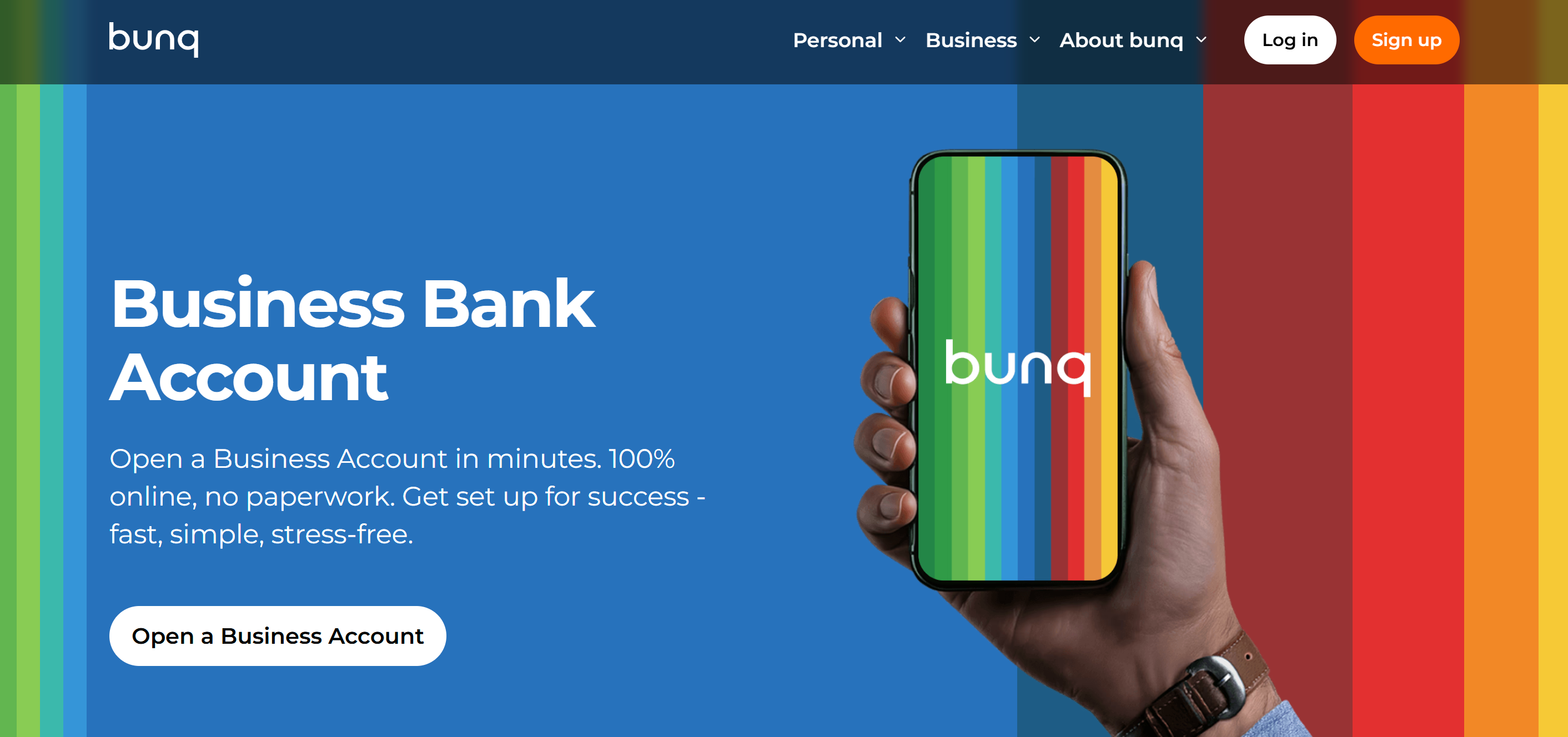
Business plans range from a free tier through Core (~€7.99/month), Pro (~€13.99/month) and a premium tier (~€23.99/month). A EUR business savings account currently pays around 0.75% (with USD and GBP savings at about 2.30%), and cash can be deposited at partner shops.
Pros
- Fully licensed Dutch bank, with deposits protected up to €100,000
- Up to 25 sub-accounts, each with its own IBAN
- ZeroFX spending on higher plans and automated bookkeeping
Cons
- Cards are prepaid Mastercards that require top-ups
- Business savings limited to companies registered in a set of EEA countries
N26 Business
N26 is a licensed German bank (deposits protected up to €100,000) with one of the cleanest apps around, and it is the best pick for freelancers and the self-employed. The catch is important: N26 Business is designed only for people operating under their own name, so it does not accept regular limited companies (outside a German-only pilot). You cannot put a company name on the account or card.
Plans run from a free Standard account up to Smart, Go (~€9.90/month) and Metal, all with 0.1% cashback (higher on premium tiers), Spaces sub-accounts with their own IBANs, and interest up to 2.25% on the top plan. The account is euro-only with a German IBAN and SEPA payments, so there is no true multi-currency holding. New users can claim a bonus with our N26 promo code.
Pros
- Licensed German bank, with deposits protected up to €100,000
- Free Standard plan, clean app and Spaces sub-accounts
- Interest up to 2.25% on the top plan
Cons
- Only for freelancers and sole traders, not regular limited companies
- German IBAN, euro and SEPA only, with no multi-currency
- Possible fee on balances above €50,000 on some plans
Qonto
Qonto is built for European SMEs and freelancers that want banking and back-office admin in one place. Alongside the account it bundles invoicing, expense management, receipt capture, accounting exports, sub-accounts with dedicated IBANs and integrated financing. Crucially, it issues local IBANs (French, German, Italian, Spanish and more), which avoids the foreign-IBAN friction some competitors create.
.png)
Plans start around €9/month and scale up with team size and quotas. Qonto is a French payment institution (it applied for a banking licence in 2025 but is not yet a bank), so funds are safeguarded rather than deposit-insured. International transfers are handled via a Wise partnership, and it does not offer true multi-currency holding.
Pros
- Banking plus invoicing, accounting and expense tools in one app
- Local IBANs (FR, DE, IT, ES and more) and sub-accounts
- Intro interest promo on cash balances
Cons
- Payment institution, not yet a bank, so no deposit guarantee
- No true multi-currency holding (international via Wise)
- Fees can climb as you add team members and quotas
Best account for an Estonian e-Residency company
Estonia's e-Residency programme lets you incorporate and run an EU company entirely online, which makes banking one of the first practical questions founders hit. Two points clear up most of the confusion: e-Residency does not come with a bank account, and your Estonian company does not need an Estonian bank. Since 2019 you can pay share capital and run the business through an account at any licensed bank or payment institution in the EU/EEA.
In practice, most e-resident companies use a two-step setup. They start with a fintech: Wise Business is the most popular first account, listed on the e-Residency Marketplace, opening fully online, with no substantial connection to Estonia required, and it handles multi-currency operations well. Revolut Business is a common alternative once the company has real activity, and Payoneer suits businesses that mainly collect from marketplaces.
Then they add a traditional Estonian bank later, if they need one. LHV is the most e-resident-friendly local bank and issues an Estonian (EE) IBAN, but it applies enhanced due diligence, usually expects a genuine connection to Estonia (or a reference from a service provider such as Xolo or 1Office), charges a monthly fee, and often requires an in-person visit.
Pros:
- Opens online in days to weeks, with no Estonia connection required
- Multi-currency from day one, ideal for cross-border companies
- Enough to pay share capital and run day-to-day operations
Cons:
- No local EE-IBAN, which some local processes prefer
- As an EMI, funds are safeguarded rather than deposit-insured (Wise offers opt-in Estonian Guarantee Fund cover up to €20,000)
So the honest answer to the question of the best account for an e-Residency company in Estonia is usually a combination: a fintech account (Wise or Revolut) for day-to-day operations from day one, with an LHV account added later once your company has built up activity and Estonian ties, if you need a local EE-IBAN at all.
Which account should you choose?
The best digital business account depends on what you value most: a banking licence, low FX costs, local admin tools, or where your company is registered. Weigh the pros and cons above against how your business actually operates.
For most companies, Revolut Business is our best overall pick: a licensed EEA bank that combines multi-currency, expense tools and interest on cash. If you would rather avoid a monthly fee and mainly convert currencies, Wise Business is the cheaper route, as long as you are comfortable that it is not a bank.
Prefer a licensed EEA bank with sub-accounts? bunq is a great pick. Are you a freelancer under your own name? N26 is the simplest option. Want banking, invoicing and accounting in one app with a local IBAN? Qonto is the natural fit. And if you run an Estonian e-Residency company, start with Wise (or Revolut) and add LHV later if you need a local EE-IBAN.
Finally, if you are looking for a personal account rather than a business one, see our guide to the best online banks in Europe.
Frequently asked questions
What is the best digital bank for a business in Europe?
Revolut Business is the best overall for most companies, thanks to its EEA banking licence, multi-currency accounts and expense tools. Wise Business is the cheapest for holding and converting currencies with no monthly fee, bunq is a strong licensed bank with sub-accounts, Qonto stands out for banking plus invoicing with a local IBAN, and N26 is the simplest option for freelancers under their own name.
What is the best bank account for an e-Residency company in Estonia?
Most e-residents start with Wise Business, which is fast, online, multi-currency and needs no connection to Estonia, then add LHV later if they need a local EE-IBAN. Revolut Business and Payoneer are common alternatives depending on your business model.
Do I need an Estonian bank account for my Estonian company?
No. Since 2019 an Estonian company can pay its share capital and operate through any licensed bank or payment institution in the EU/EEA. An Estonian EE-IBAN is useful for some local processes but is not mandatory.
Which providers are actual banks, and which are not?
Revolut (in the EEA), bunq and N26 are licensed banks with deposit-guarantee cover up to €100,000. Wise, Qonto and Payoneer are EMIs or payment institutions that safeguard client funds in segregated accounts without a deposit guarantee.
Does Revolut Business have a free plan?
No. In the UK and EEA, Revolut Business has no free tier. The entry Basic plan costs around €10/month (billed monthly), and Grow, Scale and Enterprise cost more but add larger fee-free allowances. The free Standard plan you may have seen is the personal Revolut account, not the business one.
Can I open a European business account without visiting a branch?
Yes. Wise, Revolut, bunq, N26 and Qonto all open fully online. Traditional Estonian banks such as LHV are the main exception, as they often require an in-person meeting and a genuine connection to Estonia.
Do these accounts pay interest on business cash?
Some do. Revolut Business pays up to around 2.25% on its savings account depending on plan, bunq pays around 0.75% on EUR business savings (more on USD and GBP), N26 up to 2.25% on its top tier, and Wise offers a variable interest-earning fund (capital at risk). Rates are variable, so always check the current figure.
This article is for informational purposes only and does not constitute financial advice. Pricing, interest rates, eligibility and features change frequently and vary by country. Confirm the current terms on each provider's website before opening an account.