Interactive Brokers exchange codes: full list for European markets (2026)

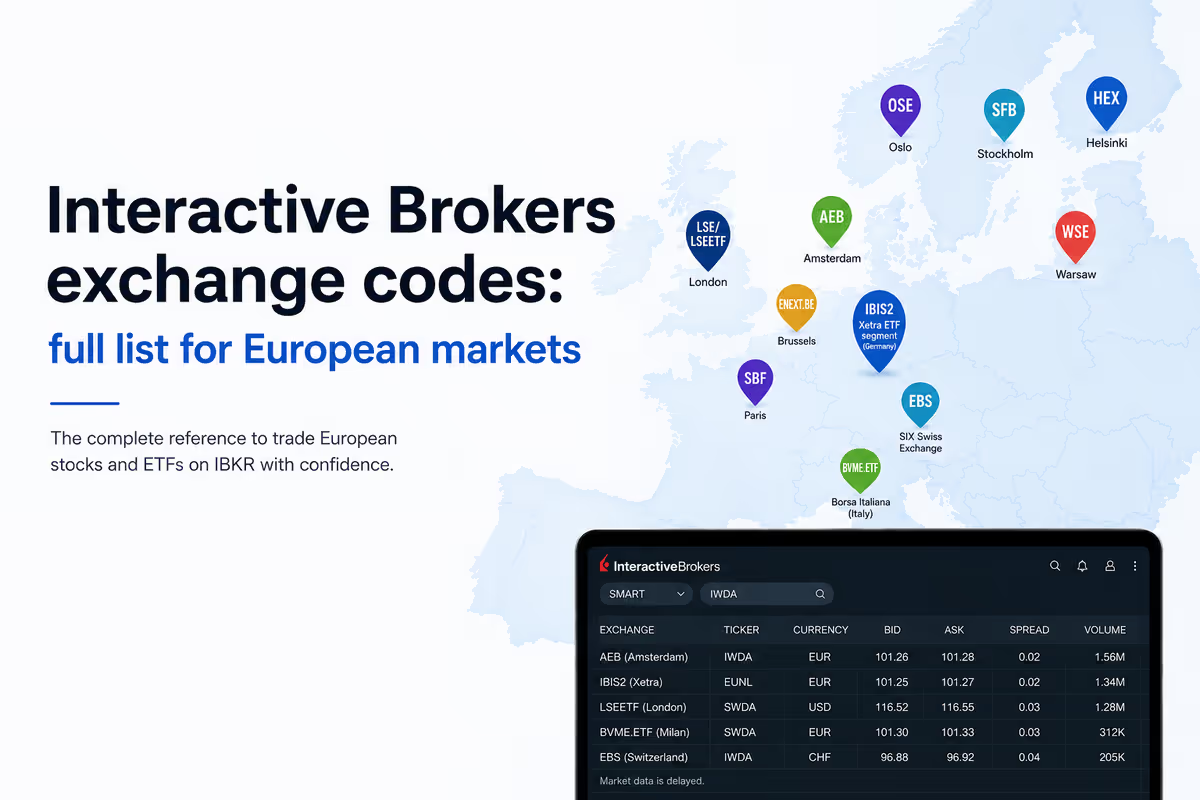



If you've ever searched for an ETF on Interactive Brokers and got 6 different listings with strange codes like IBIS2, LSEETF, or EUIBSI, this guide is for you. We use IBKR daily for our personal and business accounts, and we've put together this reference to help you pick the right European exchange every single time you place a trade.
IBKR is the largest broker in Europe by assets under management and one of the best European brokers for ETFs, but its global reach also means a steep learning curve when navigating exchange codes.
Disclosure: EU Personal Finance has an affiliate relationship with Interactive Brokers. We hold personal and business accounts with IBKR and use the platform daily. The opinions in this article are entirely our own.
Summary: full list of IBKR exchange codes for Europe
Here's the complete reference table. Bookmark this section if you only need the codes.
| IBKR code | Exchange | Country | Currency | Best for |
|---|---|---|---|---|
| IBIS | Xetra (Deutsche Börse, equities) | Germany | EUR | German stocks |
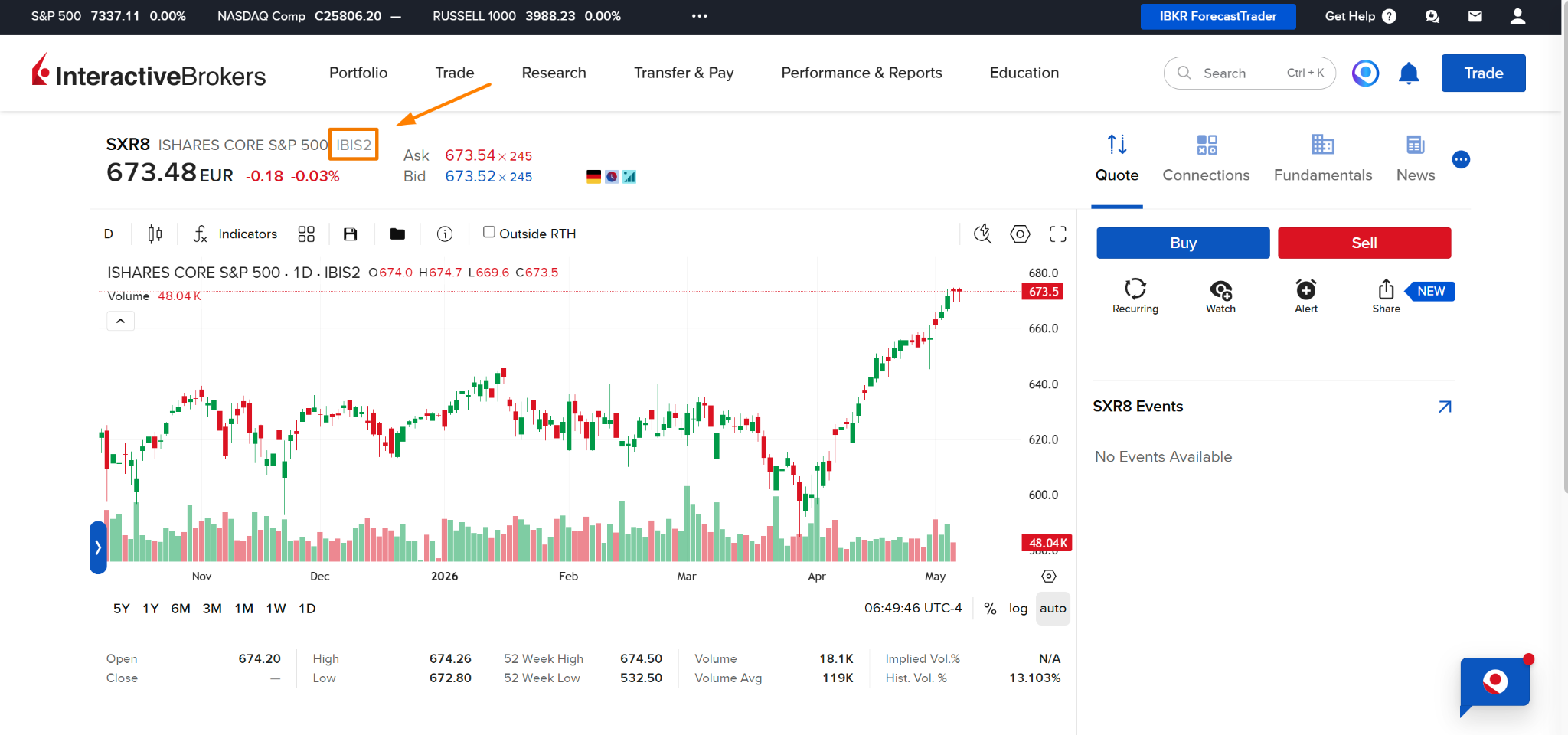
| IBIS2 | Xetra ETF segment | Germany | EUR | EUR-denominated ETFs (highest liquidity) |
| LSE | London Stock Exchange (equities) | UK | GBP, USD | UK stocks |
| LSEETF | LSE ETF segment | UK | GBP, USD | GBP/USD-denominated ETFs |
| AEB | Euronext Amsterdam | Netherlands | EUR | Dutch stocks, popular ETFs (IWDA, EMIM) |
| SBF | Euronext Paris | France | EUR | French stocks, Amundi ETFs |
| ENEXT.BE | Euronext Brussels | Belgium | EUR | Belgian stocks |
| BVL | Euronext Lisbon | Portugal | EUR | Portuguese stocks |
| OSE | Euronext Oslo Børs | Norway | NOK | Norwegian stocks |
| BVME | Borsa Italiana / Euronext Milan (equities) | Italy | EUR | Italian stocks |
| BVME.ETF | Borsa Italiana ETF segment | Italy | EUR | Italian ETF listings |
| EBS | SIX Swiss Exchange | Switzerland | CHF | Swiss stocks and ETFs |
| GETTEX | Gettex (Börse München) | Germany | EUR | Off-hours trading (single market maker) |
| TGATE | Tradegate | Germany | EUR | Off-hours trading (single market maker) |
| SWB | Börse Stuttgart | Germany | EUR | Niche listings |
| FWB | Frankfurt Stock Exchange (floor) | Germany | EUR | Mostly retired - use IBIS/IBIS2 |
| VSE | Vienna Stock Exchange | Austria | EUR | Austrian stocks |
| WSE | Warsaw Stock Exchange | Poland | PLN | Polish stocks |
| HEX | Nasdaq Helsinki | Finland | EUR | Finnish stocks |
| SFB | Nasdaq Stockholm | Sweden | SEK | Swedish stocks |
| CPH | Nasdaq Copenhagen | Denmark | DKK | Danish stocks |
| PRA | Prague Stock Exchange | Czech Republic | CZK | Czech stocks |
| BUX | Budapest Stock Exchange | Hungary | HUF | Hungarian stocks |
| BM | Bolsa de Madrid (BME) | Spain | EUR | Spanish stocks |
| EUIBSI | IBKR Systematic Internaliser | EU | Various | IBKR internalisation (must be enabled) |
Source: IBKR's Products & Exchanges page. Codes and exchange names checked on 7 August 2026.
⚠️ Common confusion: IBIS and IBIS2 are not the same. IBIS is Xetra's main equity board; IBIS2 is the ETF-specific segment on Xetra. When you trade ETFs in Germany, you almost always want IBIS2.
Why the exchange code actually matters
The same UCITS ETF can be listed on 5 or more European exchanges, often in different currencies. For example, the iShares Core MSCI World UCITS ETF (ISIN IE00B4L5Y983) trades as IWDA on Amsterdam (AEB) in EUR, SWDA on London (LSEETF) in USD, and again on Xetra (IBIS2), Borsa Italiana (BVME.ETF), and SIX Swiss (EBS).
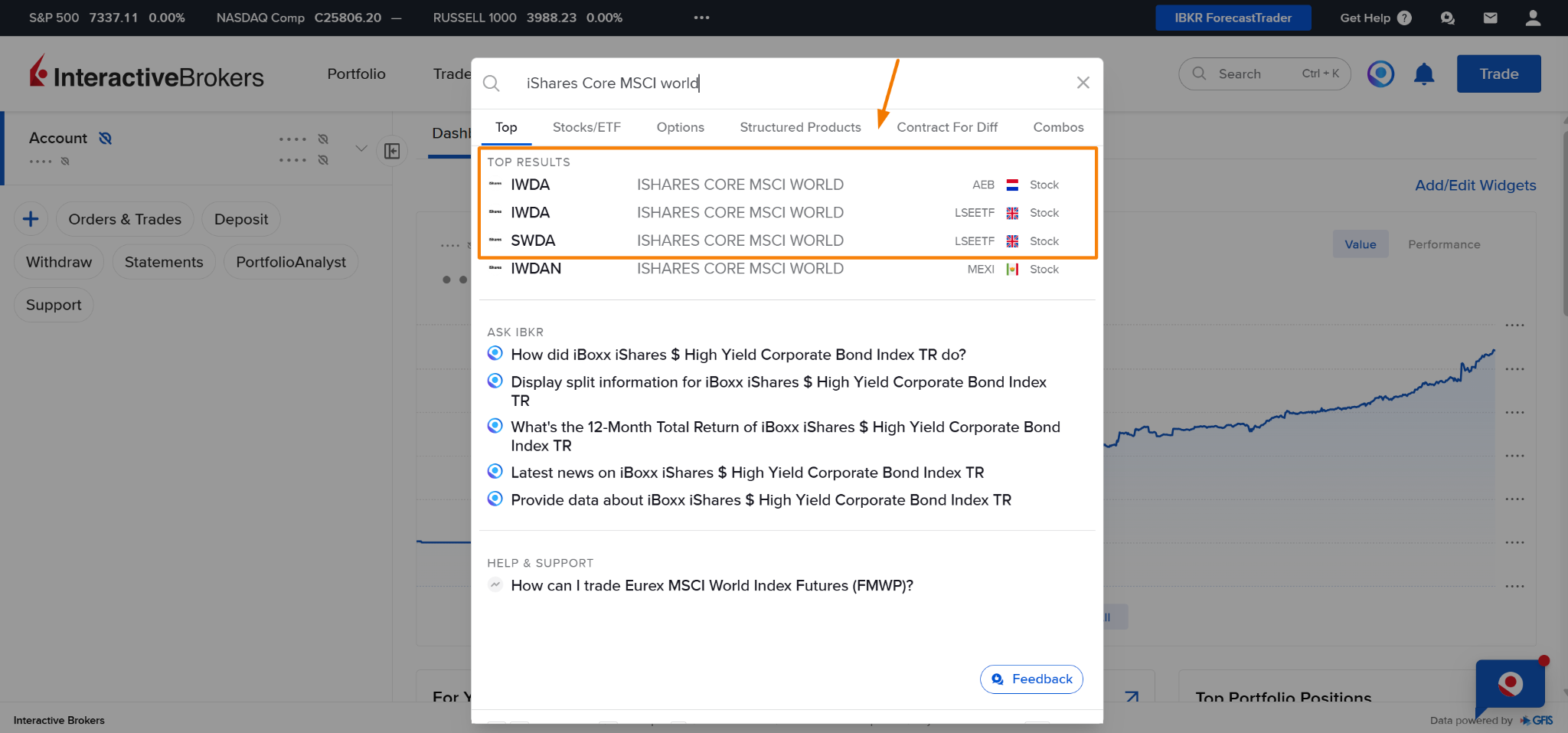
Picking the wrong exchange can cost you in three ways:
- FX conversion fees if the listing currency doesn't match your account base currency
- Wider spreads on less liquid venues (small spread differences add up over years)
- Higher minimum commissions on certain segments under IBKR's fee schedule
For European investors using IBKR, this single decision often makes the difference between paying €1.25 and €5+ per trade on the same ETF.
The big four exchanges every European investor should know
Xetra (IBIS / IBIS2) - the EUR liquidity king
Xetra, operated by Deutsche Börse, is the most liquid European venue for EUR-denominated UCITS ETFs. Almost every major issuer (iShares, Vanguard, Amundi, Xtrackers, SPDR) lists on Xetra.
- IBIS is the equities board (use it for German stocks like SAP, Allianz, Siemens)
- IBIS2 is the ETF segment (use it for ETFs)
- Core continuous trading: 09:00 to 17:30 CET, with opening and closing auctions. Since 1 December 2025 Deutsche Börse also runs an Extended Xetra Retail Service from 08:00 to 22:00 CET, but access to the early and late windows depends on your broker taking part
- IBKR commission: 0.05% of trade value (Tiered plan), minimum €1.25, capped at €29
London Stock Exchange (LSE / LSEETF)
The London Stock Exchange is the home of the most liquid GBP and USD-denominated ETF listings. If you hold USD as a base currency or want to avoid double-conversion (e.g. buying a USD-denominated S&P 500 ETF with EUR), the LSEETF segment is often the cheapest path.
- LSE is for equities
- LSEETF is the ETF segment
- Same ETF often trades in both GBP and USD on LSE - check the currency carefully

Euronext (AEB, SBF, ENEXT.BE, BVL, OSE)
Euronext operates a federated set of exchanges across Amsterdam, Paris, Brussels, Lisbon, Dublin, Milan, Oslo and, since the Athens Stock Exchange was rebranded in April 2026, Athens. Amsterdam (AEB) is particularly important for ETFs - many iShares Core ETFs (including IWDA and EMIM) are primarily listed there.
SIX Swiss Exchange (EBS)
The Swiss venue, denominated in CHF. Less relevant for most EUR investors, but if you want CHF exposure or trade Swiss equities (Nestlé, Roche, Novartis), this is the place.
Quote-driven venues: GETTEX, TGATE, and when to be careful
Not every "exchange" on IBKR is a traditional order-driven market. Gettex (Börse München) and Tradegate are effectively single-market-maker venues - one designated provider quotes both sides of the spread.
When they help:
- Extended hours (Tradegate trades 08:00 to 22:00 CET)
- Very small orders on liquid ETFs
When they hurt:
- Larger orders (you're at the mercy of one market maker)
- Less liquid instruments where the spread can widen significantly
Our rule of thumb: for orders above €5,000 on liquid ETFs, route to Xetra (IBIS2) or LSE (LSEETF) instead.
SMART routing and EUIBSI explained
SMART is IBKR's proprietary routing algorithm. When you place an order with the destination set to SMART, IBKR scans available venues for the best execution price at that moment. For most retail orders on liquid European ETFs, SMART is a sensible default:
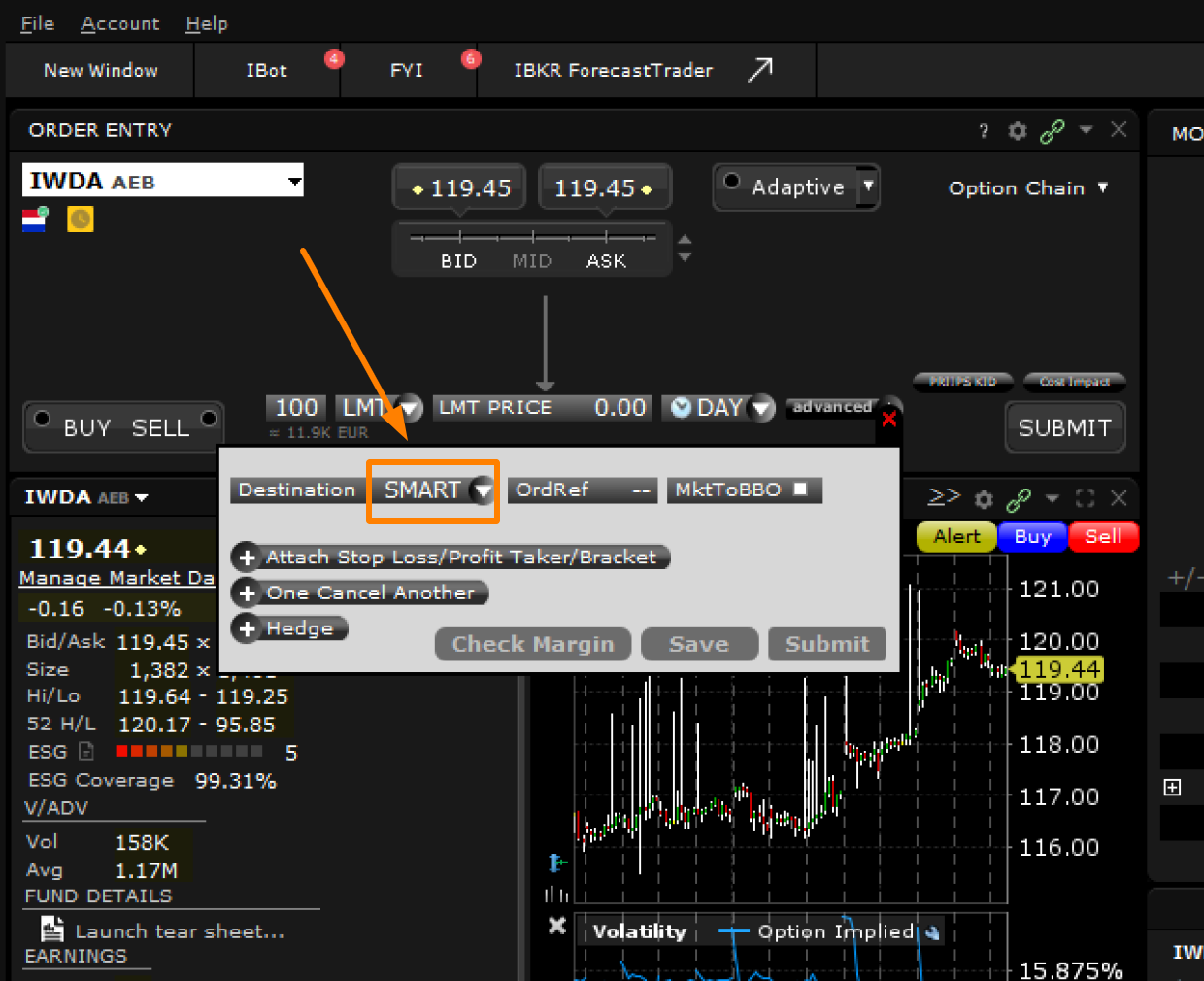
EUIBSI is IBKR's Systematic Internaliser - effectively, IBKR acts as the counterparty to your order. It is designed to improve execution and lower costs but has to be enabled manually in your account settings (it is off by default for most clients).
Worked example: how to trade IWDA the right way
Let's take the iShares Core MSCI World UCITS ETF (IWDA, ISIN IE00B4L5Y983) - probably the single most popular ETF among European DIY investors.
| Listing on IBKR | Exchange code | Currency | Typical spread |
|---|---|---|---|
| IWDA | AEB (Amsterdam) | EUR | Tight, deep book |
| SWDA | LSEETF | USD | Tight |
| EUNL | IBIS2 (Xetra) | EUR | Tight, deep book |
| SWDA | BVME.ETF (Milan) | EUR | Acceptable |
| IWDA | EBS (Switzerland) | CHF | Wider |
Source: listings and trading currencies as shown in Interactive Brokers TWS and Client Portal; spread descriptions are our own observation. Checked on 7 August 2026.
How to choose:
- EUR-based investor → AEB (IWDA) or IBIS2 (EUNL). Both are excellent. We typically use AEB.
- USD-based investor → LSEETF (SWDA in USD) to avoid FX
- CHF-based investor → EBS
When in doubt, search by ISIN in TWS or the Client Portal rather than by ticker. IBKR will show you all listings, and you can pick the one that matches your currency and venue preference. You can also research listings on justETF before placing the trade.
How to enable European exchange permissions on IBKR
You cannot trade on these exchanges if you haven't enabled the corresponding trading permissions. This is the single most common reason new European users get a "no data" error when searching for an ETF.
To enable them:
- Log in to Client Portal → Settings (gear icon)
- Open Account Settings → Trading → Trading Permissions
- Select the European markets you want ("All Europe" or country by country: Germany, UK, France/Netherlands/Belgium via Euronext, Italy, Switzerland, Nordics, etc.)
- Read and accept the disclosures
- Submit. Permissions usually update within a few hours; sometimes up to 24 hours

If you only invest in UCITS ETFs, the markets that matter most are Germany (Xetra), the UK (LSE), Euronext (Amsterdam, Paris) and Switzerland.
Common pitfalls we've seen
After years of using IBKR, these are the mistakes we see most often:
- Buying on the wrong currency listing. Buying SWDA in USD on LSEETF when your account base currency is EUR triggers an automatic FX conversion (cheap on IBKR, but it adds friction).
- Using GETTEX or TGATE for large orders. Single market maker, wider spreads when it matters.
- Forgetting to enable trading permissions. No permission, no listing visible.
- Ignoring the venue when the ETF is rebalanced. Some niche listings have very thin volume around month-end.
Frequently asked questions
What is the difference between IBIS and IBIS2?
IBIS is the Xetra equities board (German stocks). IBIS2 is the dedicated Xetra ETF segment. For UCITS ETFs in Germany, you almost always want IBIS2.
Which European exchange has the best ETF liquidity?
Xetra (IBIS2) for EUR-denominated UCITS ETFs and the London Stock Exchange (LSEETF) for GBP and USD-denominated UCITS ETFs are the two deepest pools of liquidity in Europe.
How do I see all listings of an ETF on IBKR?
Search by the ETF's ISIN (a 12-character code starting with the country of fund domicile, e.g. IE for Ireland) in TWS or Client Portal. IBKR will return every available listing across all exchanges where you have permissions. You can also cross-check on justETF before placing the trade.
Should I always use SMART routing?
For most retail orders on liquid ETFs, yes. SMART scans available venues and typically finds the best price. For larger orders (€10,000+) on specific ETFs, it can sometimes pay to route directly to IBIS2 or LSEETF and use a limit order.
Are GETTEX and Tradegate safe to use?
They are regulated venues, but they are single-market-maker exchanges, meaning one provider quotes both bid and ask. For small orders on liquid ETFs they're fine, especially during off-hours. For larger orders or less liquid instruments, prefer a traditional order book like Xetra or LSE.
Do I pay different commissions depending on the exchange?
Yes. IBKR's commission structure varies slightly by venue, and the minimum commission can make a meaningful difference for small orders. On the Tiered plan, European ETF trades are 0.05% of value with a €1.25 minimum and a €29 cap on Xetra. On the Fixed plan, the minimum is €3 with SMART routing and €4 if you route directly to an exchange, with no cap in either case. Since June 2026, IBKR also offers more than 500 iShares UCITS ETFs from BlackRock with no trading commission inside its Recurring Investment feature (from €10 per contribution); one-off trades in those same ETFs still pay the standard schedule. You can review the full schedule on IBKR's commission page, and we cover this in detail in our Interactive Brokers review.
Can I move an ETF position from one exchange to another?
Generally no. The position is tied to the specific listing where you bought it. To switch venues, you'd typically need to sell and rebuy on the desired exchange (which has tax implications you should consider).
What is EUIBSI and should I enable it?
EUIBSI is IBKR's Systematic Internaliser - IBKR acts as your counterparty rather than routing the order to a public exchange. It can offer price improvement on certain orders, but it has to be enabled in account settings. For most retail investors, the simpler default of SMART routing without EUIBSI is fine.
Bottom line
Picking the right IBKR exchange code is one of the highest-leverage 30-second decisions a European DIY investor can make. The defaults that work for almost everyone:
- EUR investor, EUR-denominated UCITS ETF → AEB (Euronext Amsterdam) or IBIS2 (Xetra)
- USD-denominated UCITS ETF → LSEETF
- Single stock → use the primary listing exchange of that company
For the long tail of less-common listings, search by ISIN, check the currency, and let SMART do the routing.
If you're still deciding whether IBKR is right for you, we cover the platform in depth in our full Interactive Brokers review for Europeans, and we compare it with the main alternatives in our guides on Trading 212 vs IBKR, DEGIRO vs IBKR and XTB vs IBKR. For a broader overview of the European market, see our roundups of the best trading platforms in Europe and best investing apps in Europe.
Disclaimer: This article is for informational purposes only and does not constitute investment advice. Investing involves risk, including loss of capital. Always do your own research before placing a trade. EU Personal Finance has an affiliate relationship with Interactive Brokers; we may earn a commission if you open an account through our links, at no extra cost to you.