Prediction markets in Europe: is it legal? Best platforms





Prediction markets have become one of the fastest-growing corners of the trading world. According to the 2026 Digital Asset Outlook Report by The Block, Polymarket and Kalshi alone processed more than $37 billion (€31.5 billion) in trading volume during 2025.
The catch for European users is that the legal status of prediction markets across Europe is fragmented and, in most cases, restrictive. Until mid-2026 there was no EU-level position at all. That changed on 3 July 2026, when ESMA stated that event contracts whose underlying falls within Annex I of MiFID II are financial instruments, and that the national bans on selling binary options to retail clients already apply to them. Everything outside that perimeter is still governed by national gambling law, which differs from country to country and has no single regulator overseeing it.
The practical result is that the door has been closing, not opening. As of August 2026, Spain has blocked both Polymarket and Kalshi, France has ordered an ISP-level block on Polymarket, the Czech Republic and Romania have added Polymarket to their unlicensed-gambling blacklists, and Interactive Brokers has excluded clients in Belgium, France, Liechtenstein, Portugal and Slovenia from its Forecast Contracts.
This guide explains, in plain English, where prediction markets stand legally in Europe in 2026, which platforms are realistically accessible to European retail investors, and what your alternatives look like if you are based in the EU, the UK, or Switzerland.
Disclaimer: This article is for informational and educational purposes only and does not constitute financial, legal, or tax advice. Prediction markets are speculative products with a high risk of total loss of capital. Most of the platforms discussed here hold no EU licence, and no EU investor compensation scheme covers losses on these products. Regulations change quickly - always verify the current legal status in your country before opening an account.
What are prediction markets, in plain English?
A prediction market is a marketplace where you trade a contract tied to a yes-or-no question about a future event. For example:
- "Will the ECB cut rates at its July meeting?"
- "Will US CPI come in above 3% next month?"
- "Will Real Madrid win the Champions League?"
Each contract is priced between $0.01 and $0.99 (or 1¢ and 99¢). The price reflects the market's implied probability: a contract trading at 65¢ means the crowd believes there is roughly a 65% chance the event happens.
If you are correct at settlement, the contract pays $1.00. If you are wrong, it settles at $0.00. Your maximum loss is what you paid - there is no leverage in the traditional CFD sense, but you can lose 100% of every position.

This is the structural feature that creates the regulatory headache: the product looks like a futures contract to a financial regulator and looks like a fixed-odds bet to a gambling regulator.
Both views are defensible, and in Europe both are now being applied at once: gambling regulators have gone after the platforms under national gaming acts, while ESMA has confirmed that the financially-themed contracts are also caught by MiFID II. As Euronews put it in late 2025, "the business of predicting the future is booming, but EU regulators remain uneasy".
The legal landscape in Europe in 2026
The single most important thing to understand is this: there is still no single EU prediction market licence, but there is now an EU-level position on part of the product. On 3 July 2026 ESMA published a statement confirming that event contracts with an underlying listed in Section C(4) to (10) of Annex I of MiFID II - interest rates, currencies, commodity prices, financial indices, and economic or climatic variables such as inflation - are derivatives, whatever the platform calls them. Because they pay out on a binary basis, they fall inside the national product intervention measures that have banned the marketing, distribution and sale of binary options to retail clients across the EU since 2018.
ESMA also closed the most obvious workaround: it said that adding a coupon, reward or interest-like payment on user funds does not change the binary structure of the product. That point matters directly for Interactive Brokers' Forecast Contracts, which pay exactly such a coupon.
Contracts outside that MiFID perimeter - sports, elections, pop culture - are not covered by the ESMA statement. They remain a matter for national gambling law, and that is where the second front is. On 17 June 2026, nine gambling regulators from Belgium, France, Germany, Italy, the Netherlands, Poland, Portugal, Spain and Switzerland signed a joint declaration to coordinate enforcement and information-sharing against unlicensed prediction market platforms.
In practice, three regulatory approaches are visible across the continent:
- Gambling-law approach (most common): National gambling regulators classify prediction markets as unlicensed online gambling and order ISP-level blocks or impose fines. This is the path taken by France's ANJ, Belgium's Gaming Commission, the Netherlands' KSA, Portugal's SRIJ, Spain's DGOJ, Romania's ONJN, the Czech Ministry of Finance, Hungary's regulatory authority, Bulgaria, and others.
- Financial-instrument approach (new since July 2026): Where the contract is a MiFID derivative, the existing retail binary options ban applies. This does not require any new law - it is an application of rules that already exist in every member state.
- Regulated experimentation: Gibraltar has licensed Europe's first regulated prediction market operator, ADI Predictstreet, in April 2026, and Malta has stated it is exploring a dedicated framework. These are the exceptions, not the rule.
Two pieces of EU-level regulation are also worth flagging:
- MiCA (Markets in Crypto-Assets): MiCA does not regulate prediction markets as such. What it does regulate is the crypto-asset services around them. The grandfathering period ended in July 2026, so crypto-based platforms like Polymarket that handle USDC for EU users need a Crypto-Asset Service Provider (CASP) licence. None of the major prediction market operators hold one.
- DAC8: From 2026, EU member states receive automatic reporting on crypto wallet activity, which makes underground use of platforms like Polymarket significantly more visible to tax authorities.
Country-by-country summary
The table below summarises the legal status of the main prediction market operators (Polymarket and Kalshi) in the largest European jurisdictions.
Note: this is a rapidly moving area - always confirm current status before depositing funds.
| Country | Polymarket | Kalshi | Notes |
|---|---|---|---|
| United Kingdom | Blocked | Restricted | UK Gambling Commission has not licensed Polymarket; FCA's 2019 binary options ban also applies. UK on Kalshi's restricted list. |
| France | Blocked | Restricted | The National Gaming Authority (ANJ) ordered French ISPs to block Polymarket on 16 July 2026, after an earlier transaction-level geoblock failed. France is on Kalshi's restricted list. |
| Germany | Trading prohibited | Restricted in practice | Existing Polymarket positions can be held to resolution but no new trades. GGL warns participation is illegal. Germany signed the June 2026 joint regulator declaration. |
| Italy | Trading restricted | Restricted | Users can view markets but cannot trade on Polymarket. Italy on Kalshi's restricted list. |
| Spain | Blocked | Blocked | The Spanish gambling regulator DGOJ ordered both platforms blocked on 26 May 2026 for operating without a gambling licence. IBKR Ireland's Forecast Contracts remain a regulated alternative for Spanish residents. |
| Netherlands | Blocked | Restricted | Dutch KSA threatened Polymarket with €420,000/week in fines in February 2026. |
| Belgium | Blocked | Restricted | On the Belgian Gaming Commission blacklist since February 2025. IBKR Ireland fully prohibits Belgian clients. |
| Portugal | Blocked | Blocked | SRIJ ordered nationwide ISP block on Polymarket in January 2026. Kalshi has also withdrawn from Portugal, citing local prohibition of prediction markets. |
| Switzerland | Blocked | Restricted | On both platforms' restricted lists. Switzerland signed the June 2026 joint regulator declaration. |
| Poland | Close-only | Restricted | On Polish Ministry of Finance blacklist since January 2025; can only close positions. |
| Romania | Blocked | Unverified | The gambling regulator ONJN blacklisted Polymarket as unlicensed gambling; Polymarket's court appeal was rejected in April 2026 and ISPs are required to block access. |
| Czech Republic | Blocked | Unverified | The Ministry of Finance added Polymarket to its List of Unauthorised Internet Games on 13 July 2026, giving ISPs 15 days to block it. |
| Ireland | Accessible | Unverified | No national gambling ban in place. IBKR Ireland's Forecast Contracts launched here in 2025 and remain available to Irish retail clients, within retail position limits. Kalshi's Irish status is reported inconsistently - verify directly. |
Sources: national gambling regulator announcements (ANJ, KSA, SRIJ, DGOJ, ONJN, Czech Ministry of Finance, Belgian Gaming Commission, GGL), ESMA's public statement of 3 July 2026, and the platforms' own restriction pages. Compiled 7 August 2026. "Unverified" means we could not confirm the status from a primary source and you should check with the platform before depositing.

The Kalshi situation is particularly telling. Although Kalshi's published Member Agreement still lists only a handful of EU countries as restricted, in practice the platform has been progressively withdrawing from EU member states, and national regulators have started blocking it directly, as Spain did in May 2026.
Why is Europe so restrictive?
The pattern across European bans is consistent. National gambling regulators have framed Polymarket and similar platforms as unlicensed online gambling operators under each country's existing gaming act. As reported by IBTimes, "European regulators have been more uniform: France's ANJ, Germany's GGL, the Netherlands' KSA, Portugal's SRIJ, and Switzerland's Gespa have all classified prediction-market activity as unlicensed gambling."
Since July 2026 there is a second, financial-services layer on top of that. ESMA's statement means that a platform offering, say, a contract on euro area inflation to an EU retail client is distributing a binary option, which is prohibited regardless of whether the platform also holds a gambling licence.
In the UK specifically, there is an extra layer: the FCA's 2019 ban on the sale of binary options to retail consumers. Because Polymarket contracts settle at either $1.00 or $0.00 - a binary outcome - they are frequently classified under this restricted category.
Recent enforcement actions illustrate the trend:
- Portugal (January 2026): The Portuguese gambling regulator ordered Polymarket to shut down within 48 hours after roughly $120 million in trading volume during the presidential election.
- Netherlands (February 2026): The Dutch gambling regulator KSA threatened fines of €420,000 per week if Polymarket continued serving Dutch users without a licence.
- Spain (May 2026): The DGOJ ordered both Polymarket and Kalshi blocked as a precautionary measure, saying unauthorised operators lack the identity verification, minor-protection and self-exclusion safeguards Spanish law requires.
- France (July 2026): The ANJ ordered ISP-level blocking of Polymarket on 16 July 2026, after an earlier payment-level geoblock failed to keep French users out.
- Czech Republic (July 2026): The Ministry of Finance added Polymarket to its List of Unauthorised Internet Games on 13 July 2026, triggering a 15-day ISP blocking clock.
What about VPNs?
A common question is whether you can simply use a VPN to access a blocked platform. The honest answer is: technically possible, legally and practically risky.
- Polymarket's Terms of Service explicitly prohibit circumventing geographic restrictions. The platform uses geo-detection beyond simple IP checks and can freeze accounts and funds.
- For Kalshi, using a VPN to create an account in an unauthorized jurisdiction may result in account closure and asset seizure. There is also no legal protection for users in unauthorized jurisdictions.
- From a tax and compliance standpoint, you would still need to self-report any gains, and DAC8 makes wallet-level activity increasingly traceable from 2026 onward.
We do not recommend trying to bypass geographic restrictions. If a platform is blocked in your country, the safer option is to accept that you do not have access.
Prediction market platforms and European access in 2026
The realistic universe of regulated, retail-accessible prediction market platforms for European users in 2026 is very small: essentially Interactive Brokers, and only in eligible countries. Below we walk through the platforms most-discussed by European traders and explain what each one actually offers today.
Quick comparison
Plus500 Futures (US-only product) and Robinhood prediction markets (US-only, not yet launched in Europe) are covered further down the article for completeness, but they are not options for EU/UK retail investors.
| Platform | EU/EEA access | UK access | Regulator | Settlement currency |
|---|---|---|---|---|
| Interactive Brokers (ForecastTrader) | Retail and professional clients, excluding Belgium, France, Liechtenstein, Portugal and Slovenia | Varies by IBKR entity - check permissions | CFTC (ForecastEx); CBI (IBKR Ireland) | USD |
| Polymarket | Blocked or restricted in most member states | Blocked | None in EU; CFTC for separate US entity | USDC (crypto) |
| Kalshi | Increasingly restricted; blocked in Spain and Portugal | Blocked | CFTC | USD |
Sources: IBKR Ireland ForecastTrader disclosures, Polymarket and Kalshi restriction pages, and national regulator announcements. Compiled 7 August 2026.
1. Interactive Brokers - the regulated route for most European retail clients
Interactive Brokers (IBKR) used to be the most realistic regulated entry point for European retail investors. Since July 2025, Forecast Contracts have been available to eligible clients of Interactive Brokers LLC, Interactive Brokers Ireland Limited, Interactive Brokers Canada Inc., Interactive Brokers Hong Kong Limited and Interactive Brokers Singapore Pte. Ltd.
Availability depends on where you live. According to IBKR's current disclosures, Forecast Contracts are available to EEA clients, excluding those in Belgium, France, Liechtenstein, Portugal and Slovenia.
In other words, if you are a retail client in an eligible EEA country, you can trade Forecast Contracts through IBKR Ireland, up to the lesser of 1% of your net asset value or USD 1.0 million. If you are resident in Belgium, France, Liechtenstein, Portugal or Slovenia, this route is closed to you.
Through IBKR ForecastTrader, eligible clients can trade Forecast Contracts listed on ForecastEx, IBKR's own CFTC-regulated Designated Contract Market.

What eligible clients can trade:
- US economic indicators (CPI, Fed Funds Rate, GDP, unemployment)
- Climate and CO₂ indicators
- CME event contracts on equity indices, energy, metals, and FX
- Not available to EEA clients: US election contracts (US residents only)
Key features:
- Zero commission on ForecastEx contracts (a $0.01 per contract fee applies)
- Around-the-clock trading, seven days a week, subject to maintenance windows
- An interest-like incentive coupon paid on open positions - currently 3.13% APY on USD positions, and subject to change with benchmark rates
- Defined-risk profile: max loss is what you paid; payout is $1 if correct
- Trade through TWS, IBKR Desktop, IBKR Mobile, Client Portal, GlobalTrader, the API, or the dedicated ForecastTrader web interface
The practical recommendation: if you are an EEA retail client outside the five excluded countries, this is the most defensible route to prediction markets in Europe: a CFTC-regulated exchange (ForecastEx), accessed through a broker regulated by the Central Bank of Ireland, with clear position limits. If you live in Belgium, France, Liechtenstein, Portugal or Slovenia, this route is closed to you.
2. Polymarket - the largest, but mostly blocked in Europe
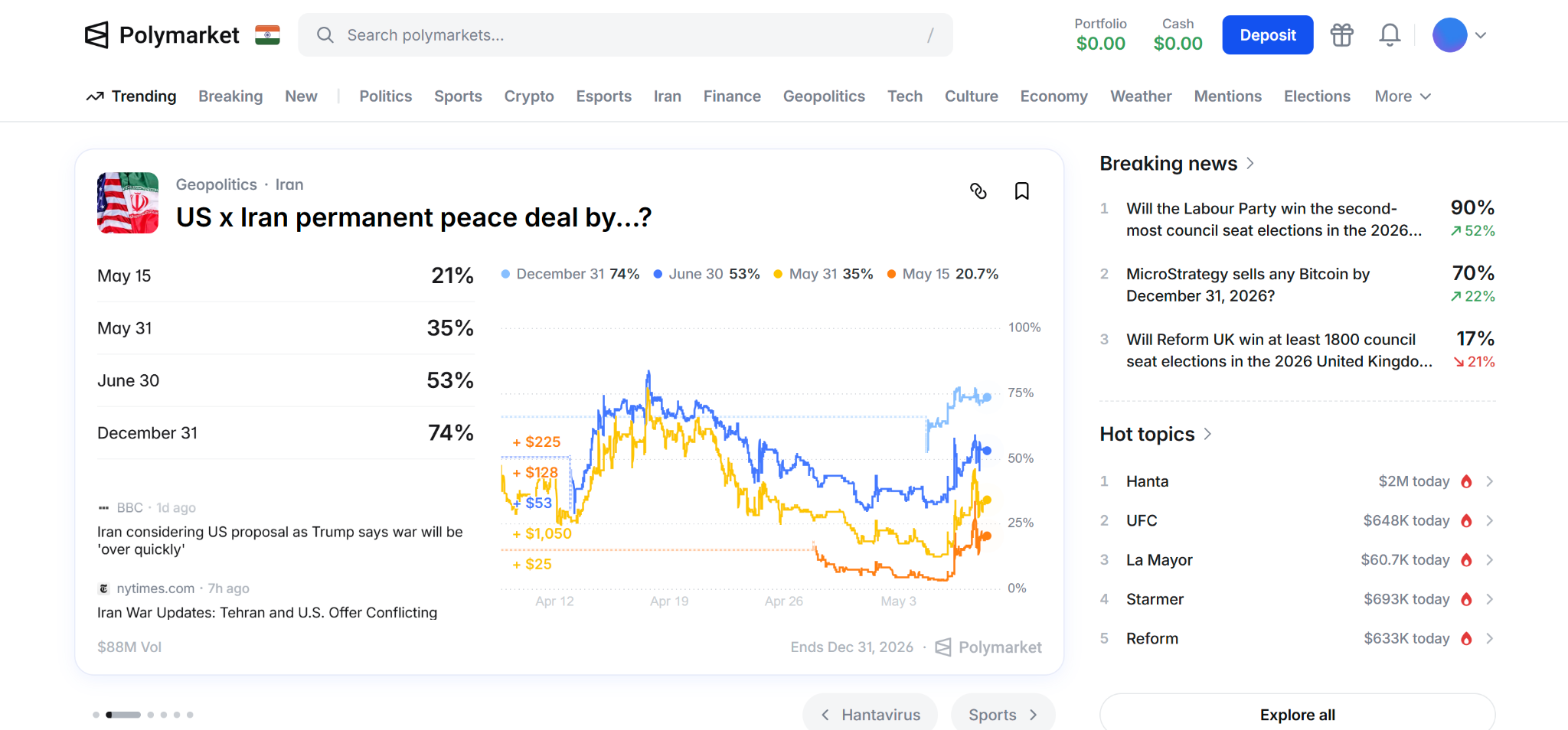
Polymarket is the world's largest prediction market by volume. It is a decentralised exchange built on the Polygon blockchain and uses USDC (a US-dollar stablecoin) for all trading. In October 2025, Polymarket secured up to a $2 billion investment from Intercontinental Exchange (ICE), the owner of the New York Stock Exchange, valuing the company at $8 billion.
How it works:
- You connect a crypto wallet, deposit USDC (via card, bank transfer, or crypto), and trade Yes/No shares directly on-chain.
- Market resolution relies on UMA's optimistic oracle.
- Markets cover everything from US politics to crypto prices, geopolitical events, sports, and pop culture.
Legal status in Europe:
Polymarket is the platform that has attracted the most regulatory attention in Europe. According to its official geographic restrictions page and recent enforcement actions:
| Status | Countries (selected) |
|---|---|
| Fully blocked | UK, France, Belgium, Netherlands, Portugal, Hungary, Bulgaria, Switzerland, Spain, Romania, Czech Republic |
| Trading prohibited (existing positions can resolve) | Germany |
| Trading restricted (view-only) | Italy |
| Close-only | Poland |
| Reported as accessible, but unverified | Ireland, Austria, Denmark, Sweden, Norway, Finland, Greece |
Sources: Polymarket's geographic restrictions page plus national regulator announcements from Spain (26 May 2026), France (16 July 2026), the Czech Republic (13 July 2026) and Romania (appeal rejected April 2026). Compiled 7 August 2026. Countries in the last row are not confirmed by a primary source - check before depositing.
The trend is clearly toward more bans, not fewer. Polymarket started 2026 the same way it ended 2025: facing new bans while simultaneously trying to expand.
In a single week in January 2026, Portugal's gambling regulator ordered Polymarket to shut down within 48 hours after $120 million flowed through the platform on the country's presidential election. Hungary followed the same day with its own nationwide block. Spain, France, the Czech Republic and Romania have all followed since.
Risks specific to Polymarket:
- No EU regulatory protection: there is no compensation scheme if the platform fails or your funds are frozen.
- No CASP licence: with MiCA grandfathering now over, serving EU users with USDC-denominated products without a Crypto-Asset Service Provider licence is itself a regulatory problem.
- Insider trading concerns: the platform has been scrutinised for trades that appear to use non-public information, particularly around geopolitical events.
- USDC exposure: you are taking implicit credit risk on the stablecoin issuer.
- Tax complexity: even if classified as gambling locally, converting USDC back to euros is a disposal event that may trigger capital gains reporting under DAC8.
3. Kalshi - regulated in the US, increasingly closed off to Europe
Kalshi is the first federally approved event contracts exchange in the US, regulated by the CFTC as both a Designated Contract Market and a Derivatives Clearing Organization. Unlike Polymarket, Kalshi runs on traditional financial infrastructure, settles in USD, and accepts standard bank deposits or debit cards. In October 2025, Kalshi raised over $300 million led by Sequoia and a16z, with a stated goal of expanding to over 140 countries. By July 2026, CoinDesk reported the company was valued at around $22 billion.

In practice, that international expansion is being walked back in Europe. Throughout 2026, Kalshi has progressively withdrawn from EU member states whose regulators have classified prediction markets as gambling, and Spain's DGOJ blocked it outright in May 2026 alongside Polymarket.
Legal status in Europe (Kalshi):
| Status | European countries |
|---|---|
| Restricted (per Member Agreement) | Belgium, Bulgaria, France, Italy, Monaco, Poland, UK, Belarus, Russia, Ukraine (occupied territories) |
| Blocked or withdrawn during 2026 | Spain (DGOJ blocking order, 26 May 2026), Portugal (confirmed via direct user notice) |
| Everywhere else in the EEA | Treat as unverified. ESMA's July 2026 statement means MiFID-scope contracts cannot lawfully be sold to EU retail clients, whatever the platform's own list says. |
Sources: Kalshi Member Agreement, Spanish DGOJ blocking order of 26 May 2026, ESMA public statement of 3 July 2026, and direct user notices. Compiled 7 August 2026.
Concrete user-side evidence: users in Portugal who had previously opened Kalshi accounts have received emails reading: "Thank you for your interest and early adoption of Kalshi. Unfortunately, we are no longer available in your country as the region in which you are from prohibits prediction markets. We are no longer able to accept new deposits or trades from your account. Any existing account balances remain available for withdrawal at this time."
In short: Kalshi's published restricted-country list is no longer a reliable guide for the European user. The platform appears to be making case-by-case decisions to exit jurisdictions where local prohibition makes service untenable, and national regulators are now moving against it directly. If you are in any EU country where prediction markets are classified as gambling, you should assume Kalshi may not be reliably available, even if your country is not on the public restricted list.
How access works (where still available):
- Sign-up requires identity verification and a country-of-residence declaration.
- International users can fund accounts via debit card (Visa/Mastercard), wire transfer (minimum $1,000), or cryptocurrency.
- ACH bank transfers, PayPal, and Venmo are not available outside the US.
Important caveats for European users:
- Kalshi holds no European licence. Outside the US, your activity is not protected by EU investor compensation schemes or by CFTC investor protections that apply only to US persons.
- Kalshi expressly disclaims providing legal or eligibility advice for international jurisdictions - it is your responsibility to determine local legality.
- Crypto withdrawals back to the EU may trigger DAC8 reporting from 2026 onward.
What about Plus500 and Robinhood?
Two other names that European traders frequently ask about are Plus500 and Robinhood. Both have launched prediction markets, but neither is currently available to European retail investors:
- Plus500 Futures launched prediction markets in late 2025 via a partnership with Kalshi. The product is offered exclusively through Plus500's US entity. The European Plus500 platform continues to offer CFDs and (in selected countries) futures access, but does not offer event contracts to EU/UK retail clients. Plus500 also acts as a clearing partner for FanDuel's prediction market product in the US, again not available in Europe.
- Robinhood launched its US Prediction Markets Hub in early 2025, with event contracts cleared through Kalshi and ForecastEx. Just one year after launch, more than nine billion contracts had been traded. Robinhood has confirmed it is in talks with the UK FCA and EU regulators about a possible international launch, but no European product exists today, and the ESMA statement of July 2026 makes a retail launch considerably harder.
If you see articles claiming you can use these platforms from Europe, treat them with caution - they are almost always written from a US perspective.
A focus on Polymarket: how it works, and why Europe doesn't trust it
Because Polymarket attracts so much retail interest, it is worth a deeper look at exactly how it works and why European regulators have been so aggressive.
How Polymarket works mechanically
- Connect a wallet: You sign up with an email and Polymarket creates a smart-contract wallet for you on the Polygon network.
- Deposit USDC: You can buy USDC directly with a debit card via MoonPay, transfer it from Coinbase, or bridge it from Ethereum, Base, Arbitrum, or Solana.
- Trade Yes/No shares: For every market, you can buy "Yes" or "No" shares at the live order-book price. Prices update in real time as new trades come in.
- Hold to resolution or close early: At resolution, winning shares pay $1.00. You can also close a position early by selling at the current market price.
- Withdraw: Convert USDC back to fiat through MoonPay or send it to an external exchange.
Why European regulators are uncomfortable
There are five recurring concerns:
- No local licence: Polymarket is not authorised by any EU national gambling or financial regulator.
- Binary payoff structure: EU jurisdictions classify $1/$0 binary contracts as either gambling or as the kind of binary options banned by ESMA in 2018 - a link ESMA made explicit in July 2026.
- Sensitive event contracts: Markets on war outcomes, conflicts, and political assassinations have triggered ethical concerns. Users who had placed large bets related to an Iranian missile strike in March 2026 are alleged to have harassed and threatened Israeli journalist Emanuel Fabian of The Times of Israel in an attempt to influence the market's outcome.
- Insider trading risk: Several incidents have suggested that participants with non-public information (for example, around the Nobel Peace Prize selection in October 2025) traded ahead of public announcements.
- Crypto-asset classification: With MiCA grandfathering over since July 2026, USDC-based platforms operating in the EU need a CASP licence. None of the major prediction markets have one.
For a European retail investor, the combined effect is that even in the handful of countries where Polymarket has not yet been blocked, there is meaningful regulatory uncertainty about whether it will remain accessible.
A focus on Kalshi: how it works, and where you stand as a European
Kalshi has the cleanest regulatory story of any prediction market in the United States. The challenge for European users is figuring out what that regulation does and does not protect, and whether you can keep using the platform at all.
How Kalshi works mechanically
- Account opening: Provide email, basic personal information, and identity documents. International users go through an ID verification flow.
- Funding: Outside the US, fund via debit card (Visa/Mastercard), wire transfer, or crypto.
- Trade: Each contract trades between $0.01 and $0.99. You can use Quick Orders (market) or Limit Orders. The order book is fully transparent.
- Settlement: At expiry, contracts pay either $1.00 (correct outcome) or $0.00 (incorrect outcome). Fees are variable, generally under 2% per trade based on potential earnings.
- Withdrawal: International users can withdraw via debit card or crypto.
What CFTC regulation does and does not mean for you
Being CFTC-regulated means Kalshi has to operate transparent markets, segregate US customer funds, and clear trades through a registered clearinghouse. It does not mean European users are protected by EU investor protection schemes, have meaningful recourse to the CFTC, or that Kalshi is licensed in your country - you are simply being allowed to use its US platform if your jurisdiction isn't currently restricted.
In practice, if something goes wrong - account frozen, dispute over a market resolution, withdrawal delayed - your legal recourse as a European is limited.
And as the Portuguese and Spanish cases show, access can disappear either because Kalshi withdraws unilaterally or because your national regulator blocks the site, leaving you able only to close existing positions and withdraw funds.
Risks to take seriously before trading prediction markets
Prediction markets sit in a category of their own when it comes to risk. They are speculative products, most of the venues offering them to Europeans are unregulated in Europe, and no investor compensation scheme covers you if the platform fails, freezes your account, or is shut down by a regulator. Treat any money you put in as money you can afford to lose entirely.
As a London Business School study cited recently in the press found, only around 3% of prediction market participants make consistent profits, while close to 70% lose money over time.
Capital risk: Every contract can settle at $0. A position that looks like "near-certain" at 95¢ still carries a 5% chance of total loss. People who size positions as if losses are unlikely tend to learn this lesson expensively.
Legal risk: Since July 2026, selling MiFID-scope event contracts to EU retail clients is prohibited. If you are trading them anyway through an offshore venue, you are outside the protective perimeter entirely, and the platform is the one breaching EU rules on your behalf.
Liquidity risk: Headline markets (US elections, Fed decisions) are deep. Niche markets often trade thinly, with wide bid/ask spreads. Closing a losing position early can be much harder than opening it. EU retail bans also thin the order book further.
Resolution risk: Markets can be ambiguously worded, especially around geopolitical events. You may be technically right and still lose if the resolution rules disagree.
Behavioural risk: The yes/no, binary structure of these markets is psychologically similar to fixed-odds betting. Several regulators and academics have raised concerns that prediction markets can encourage compulsive trading patterns more than traditional financial products.
Regulatory risk: As the Portugal, Spain, France and Czech cases show, a country can move from "accessible" to "blocked" within days. If you have open positions when that happens, you may be limited to closing them and withdrawing - sometimes with operational delays.
Tax risk: Tax treatment of prediction market gains varies dramatically by country. In some jurisdictions they may be taxed as gambling winnings (sometimes 0%, sometimes a flat tax), in others as capital gains, and in others as miscellaneous income. With DAC8 reporting in the EU from 2026, the era of unreported crypto-based gains is ending. Always consult a local tax professional.
Counterparty and infrastructure risk: For Polymarket, you are also taking smart-contract and oracle risk. For Kalshi-based products, you are taking US-broker risk without EU compensation coverage.
So, can a European actually trade prediction markets legally in 2026?
The short answer, for a retail investor: yes in much of Europe, through Interactive Brokers, but the offshore platforms are increasingly off-limits.
Interactive Brokers remains the cleanest regulated route: Forecast Contracts are available to EEA clients except those in Belgium, France, Liechtenstein, Portugal and Slovenia, with retail position limits of the lesser of 1% of NAV or USD 1.0 million. ESMA's statement of 3 July 2026 confirmed that event contracts on economic, financial or climatic underlyings are financial instruments, so expect scrutiny of these products to keep tightening. Contracts on sports, elections and pop culture fall outside ESMA's statement, but they are squarely inside national gambling law, and the nine-regulator declaration of June 2026 makes coordinated enforcement more likely, not less.
If you live in one of the excluded countries, there is no reliable paperwork that reopens the IBKR route. Opting up to professional client status means giving up retail protections, and it is not a step to take in order to access a speculative product.
If you live in a country where Polymarket and Kalshi have not yet been blocked, you can technically still open an account on the international version of either. You would be using a non-EU-regulated platform, subject to that platform's terms and your own country's tax rules, with no recourse to EU investor protection and no compensation scheme. That is not the same thing as it being legal or safe.
If you live in a country where the major offshore operators are blocked or have withdrawn (the UK, France, Belgium, the Netherlands, Portugal, Spain, Romania, the Czech Republic, Hungary, Switzerland, Bulgaria, with the list still growing), your only potential regulated option is IBKR's ForecastTrader, and only if your country is not on its exclusion list. For readers in Belgium, France and Portugal, there is currently no regulated retail option for prediction markets at all. ADI Predictstreet (Gibraltar-licensed) may become an alternative for certain markets such as the 2026 FIFA World Cup, but it is too early to evaluate.
A final reminder: this is a fast-moving area. The picture in August 2026 may well change again before the end of the year, in either direction. The direction of travel in Europe so far has been consistently toward less retail access, not more.
Disclaimer: This article is for informational purposes only and does not constitute financial, legal, or tax advice. Prediction markets are speculative products with a high risk of total loss of capital, most venues serving Europeans hold no EU licence, and no EU investor compensation scheme applies. Always verify the current legal status in your jurisdiction before opening an account.