



Gold and silver are two of the oldest assets in financial history and continue to play a central role in global markets.
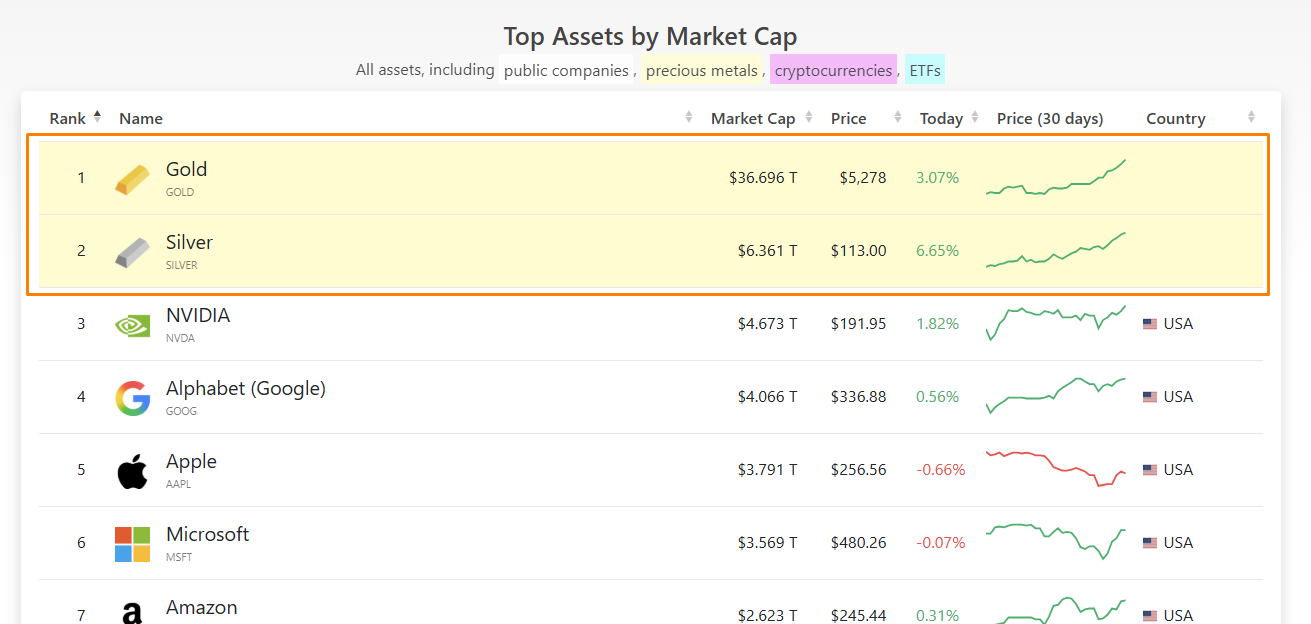
At the start of 2026, the combined market capitalisation of gold and silver had already surpassed that of the so-called "Magnificent Seven" (Apple, Microsoft, Google, Amazon, Nvidia, Meta, and Tesla) by a wide margin, despite these companies dominating the media narrative.
Although it is possible to invest directly in gold or silver (for example, by purchasing physical gold), this may not be the most practical, efficient, or accessible way to do so. Issues such as storage, security, liquidity, and costs can make this option less convenient.
For this reason, many investors choose to use specific financial instruments, such as ETFs or ETCs, which provide exposure to these metals in a simple, transparent, and cost-effective way.
What is a gold or silver ETF (or ETC)?
An ETF is an exchange-traded fund whose purpose is to closely track the performance of a given asset or index. However, when it comes to physical commodities such as gold and silver, the most common instrument in Europe is not technically an ETF, but rather an ETC (Exchange-Traded Commodity).
In the European Union, ETFs must comply with the UCITS Directive, which does not allow a fund to invest directly in a single commodity such as physical gold. Therefore, products that replicate gold alone cannot be UCITS ETFs and are structured as ETCs.
In practice, for investors, the experience is very similar: they trade on stock exchanges like shares, have low annual costs, and provide exposure to the price of gold or silver without the need to buy or store the physical asset.
The ETCs featured in this article are physically backed, meaning they are fully collateralised with physical metal. This means the issuer holds real gold or silver, stored in vaults of independent entities, as collateral for the product. As a result, the ETC's value closely reflects the market price of the metal, and counterparty risk is significantly reduced.
Best gold ETFs/ETCs
Based on our research and the methodology explained below, some of the best products for investing in gold include (sorted by assets under management):
| Name | ISIN | Ticker | TER |
|---|---|---|---|
| iShares Physical Gold ETC | IE00B4ND3602 | EGLN | 0.12% |
| Invesco Physical Gold ETC | IE00B579F325 | SGLD | 0.12% |
| Xetra-Gold* | DE000A0S9GB0 | 4GLD | 0.00% |
| Amundi Physical Gold ETC | FR0013416716 | GLDA | 0.12% |
*Does not charge a traditional TER, but includes implicit costs in the spread and product structure.
Note: the WisdomTree Physical Gold ETC was not considered due to its high TER (0.39%).
TER as of August 2026, source justETF and issuer factsheets.
In the chart below, you can see a comparison between the ETCs over the past year (from 28 January 2025 to 28 January 2026):
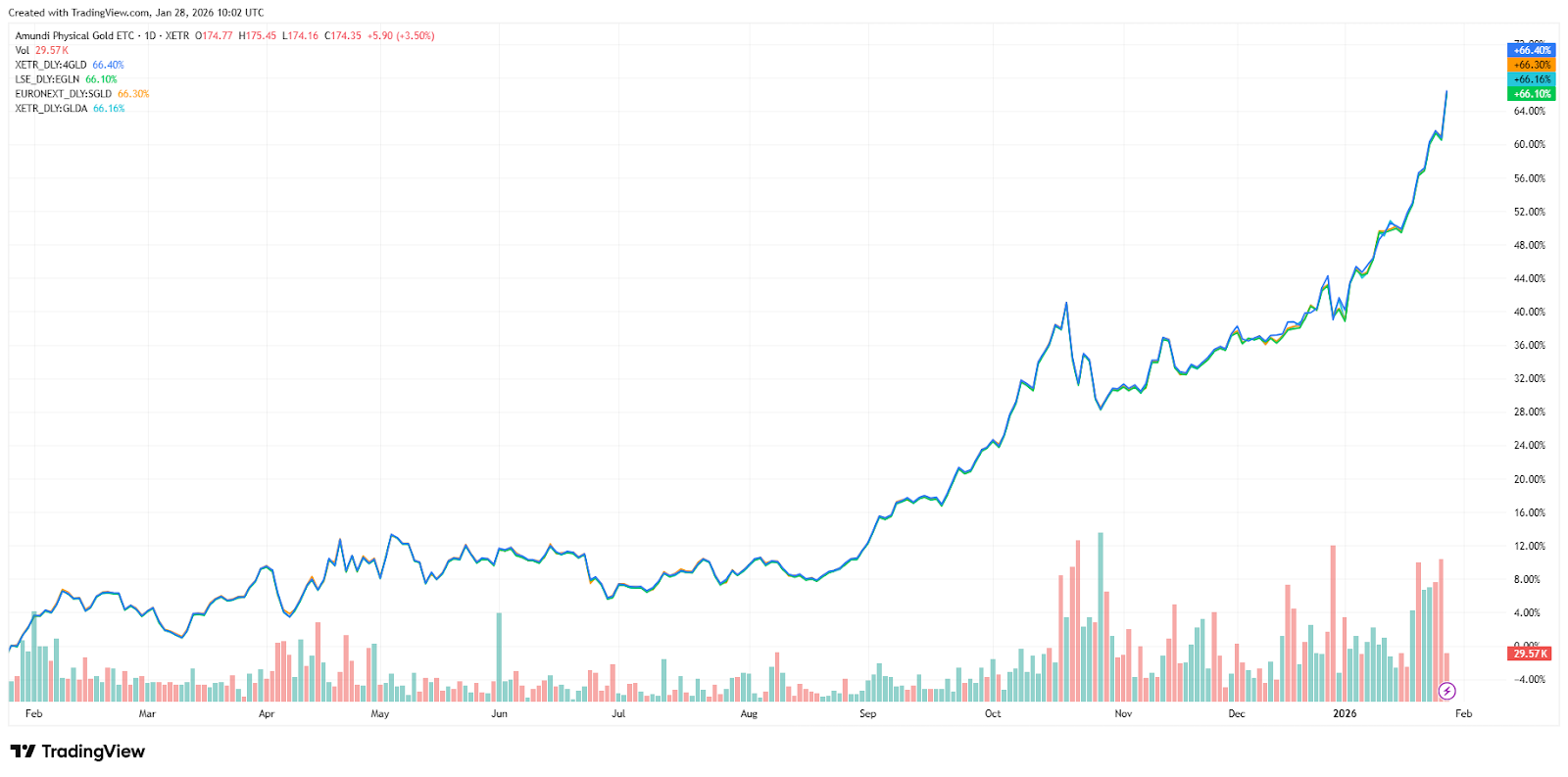
The ETC with the best return was Xetra-Gold (66.40%), while the one with the worst return was iShares Physical Gold ETC (66.10%). As you can see, the difference between them was minimal. Therefore, based on historical data, the choice between them should not make a significant difference to your portfolio.
Additional characteristics
| Name | Asset type | Replication | Assets under management |
|---|---|---|---|
| iShares Physical Gold ETC | Physical gold | Physical | €29.9 billion |
| Invesco Physical Gold ETC | Physical gold | Physical | €22.9 billion |
| Xetra-Gold* | Physical gold | Physical | €19.6 billion |
| Amundi Physical Gold ETC | Physical gold | Physical | €9.6 billion |
Assets under management as of August 2026, source justETF and issuer factsheets.
Best silver ETFs/ETCs
Based on our research and the methodology presented, some of the best products for investing in silver include (sorted by assets under management):
| Name | ISIN | Ticker | TER |
|---|---|---|---|
| iShares Physical Silver ETC | IE00B4NCWG09 | PPFD | 0.20% |
| WisdomTree Physical Silver | JE00B1VS3333 | PHAG | 0.49% |
| Invesco Physical Silver | IE00B43VDT70 | 8PSB | 0.19% |
| WisdomTree Core Physical Silver | JE00BQRFDY49 | WSLV | 0.19% |
TER as of August 2026, source justETF and issuer factsheets.
In the chart below, you can see a comparison between the ETCs over the past year (from 28 January 2025 to 28 January 2026):
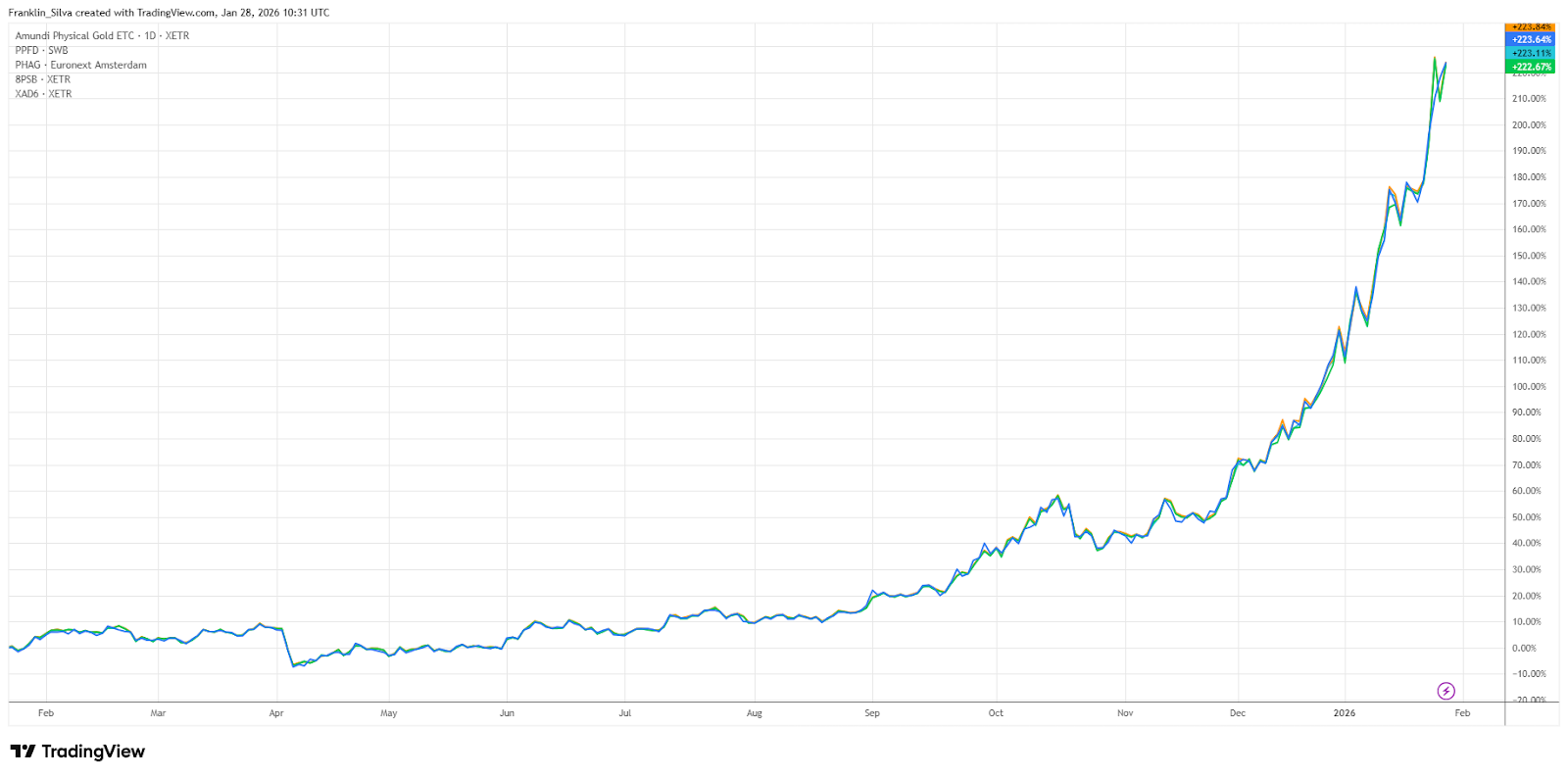
The ETC with the best return was Invesco Physical Silver (223.84%), while the one with the worst return was WisdomTree Physical Silver (PHAG, 222.67%). As with the gold ETCs, the difference between them was also very small. Therefore, the choice between them should not make a significant difference to your portfolio.
Additional characteristics
| Name | Asset type | Replication | Assets under management |
|---|---|---|---|
| iShares Physical Silver ETC | Physical silver | Physical | €2.6 billion |
| WisdomTree Physical Silver | Physical silver | Physical | €2.4 billion |
| Invesco Physical Silver | Physical silver | Physical | €830 million |
| WisdomTree Core Physical Silver | Physical silver | Physical | €783 million |
Assets under management as of August 2026, source justETF and issuer factsheets.
Where do the return differences come from?
1. Costs (TER, total expense ratio)
The TER is the annual fee charged by the ETF to cover: metal custody, audits, management, and legal structure.
2. Tracking error
The tracking error measures how well the ETF tracks the price of the metal. The higher it is, the worse the ETF's ability to replicate the metal's price. It can arise due to: operational costs, how the ETF manages capital inflows and outflows, and other small inefficiencies in replication. Well-structured physical ETFs tend to have low tracking error.
3. Liquidity and spreads
The higher the trading volume, the easier it is to buy and sell at the fair price. Highly liquid ETFs tend to better reflect the real value of the metal.
Thinly traded ETFs have wider spreads. This is an invisible but real cost, especially for those who make frequent entries.
For long-term investors, this matters less. For those who buy and sell frequently, it can matter significantly.
Glossary of table terms
- ISIN: a unique 12-character code that identifies a financial instrument internationally. Each ETF/ETC has its own ISIN, like a "registration number".
- Ticker: an abbreviation used to identify an asset on the exchange where it is traded. For example, the ticker for the "iShares Physical Gold ETC" may be "EGLN" on the London Stock Exchange, but also "PPFB" on the Gettex exchange. It can vary depending on the exchange.
- TER (Total Expense Ratio): the annual cost rate of the ETF, expressed as a percentage. It includes management fees and other expenses. A TER of 0.07% means that for every €1,000 invested, you pay €0.70 per year in fund maintenance costs. The lower, the better.
- Replication type: describes how the ETF replicates the index it aims to follow:
- Physical: the ETF/ETC directly holds the precious metals.
- Synthetic: the ETF/ETC does not hold the precious metals but uses derivative contracts (swaps) to replicate performance. Physical ETFs/ETCs are preferred for their transparency and because you are buying real assets.
- Assets under management: refers to the total value that investors have invested in a given ETF/ETC. A high value indicates greater liquidity.
Our selection criteria
For this article, we selected only ETFs/ETCs that meet the following criteria:
- Physical replication of the index (rather than synthetic);
- Low TERs: below 0.50%;
- High assets under management: above €500 million, indicating good liquidity and stability;
- Unhedged ETFs. This means the investment value may fluctuate with exchange rate movements between the euro and the dollar. Nevertheless, these unhedged products tend to have lower costs, and in the long term, currency fluctuations tend to balance out, which is why many investors prefer this option.
If you want to explore a currency-hedged product, you have, for example:
How to find the best ETFs/ETCs?
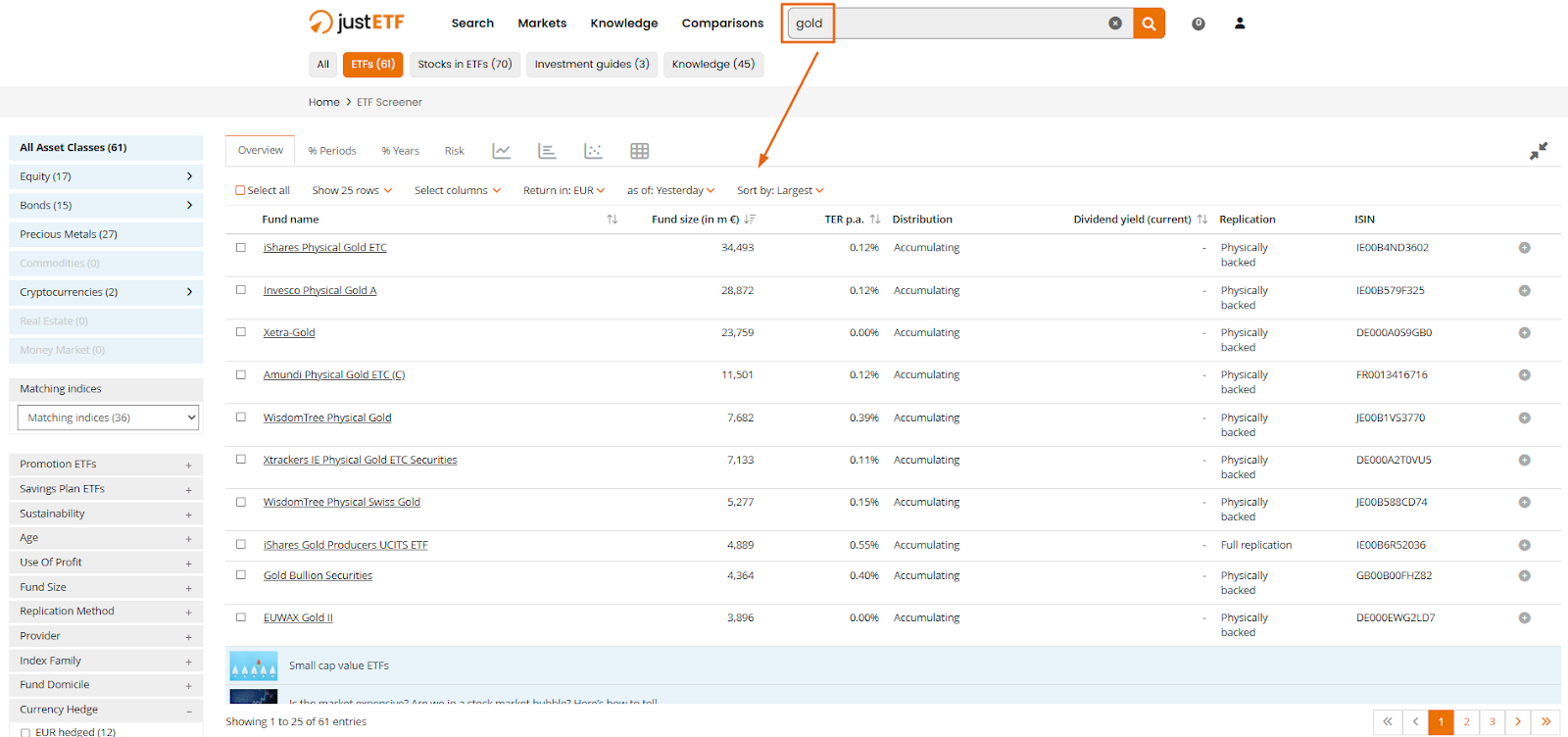
One of the most comprehensive platforms for comparing ETFs/ETCs is justETF.com. On this website, you can filter products by replication type (physical or synthetic), costs (TER), assets under management volume, among others:
Where to buy gold and silver ETFs/ETCs?
These ETFs/ETCs are available on several brokers accessible to European investors.
For a complete list of the best options, check our article "Best Brokers for ETFs in Europe".
What role do gold and silver play in an investment portfolio?
One of the biggest misconceptions about gold (and, to a lesser extent, silver) is viewing them as "primary" investments or speculative bets. In reality, their greatest value emerges when used as a complement to a well-diversified portfolio, rather than as its central pillar.
Gold and silver behave differently from stocks and bonds. They do not generate income (such as dividends or interest), but they also do not depend directly on economic growth, corporate profits, or an issuer's solvency.
In practice, this translates into three main benefits:
- Low long-term correlation with stocks and bonds
- Protection in prolonged stress scenarios, such as geopolitical crises, extreme inflationary regimes, or currency devaluation
- Reduced overall portfolio volatility, when used in small proportions
It is important to note that, in the short term, gold can fall at the same time as stocks (for example, during forced liquidations). However, over medium and long horizons, it tends to recover its stabilising role.
The goal is not to have 30%, 40%, or 50% of the portfolio in gold or silver. Excessively high allocations tend to reduce expected returns and increase overall risk, precisely because these assets do not generate income over time.
What do theory and academic evidence say?
When we analyse portfolios considered "conventional", "academic", or even optimal from a risk/return perspective (such as those inspired by Modern Portfolio Theory), gold frequently appears with a modest but non-zero allocation.
Studies from firms such as Robeco show that:
- Allocations between 5% and 15% in gold tend to improve the risk/return profile of a traditional stock and bond portfolio
- Less than 5% has limited impact
- More than 15% begins to penalise expected returns
In other words, even in portfolios considered "optimal", gold does not replace stocks or bonds, but rather complements them.
And silver?
Silver shares some characteristics with gold but is generally more volatile, due to its greater industrial use. For this reason, it is typically used in even smaller proportions or as a complement to gold, rather than as a direct substitute.
Conclusion
Gold and silver continue to prove that they are far from being relics of the past. On the contrary, they maintain a relevant role in building diversified portfolios, especially as protection against economic instability and geopolitical risks.
For most investors, physically backed gold and silver ETFs/ETCs can be a simple, efficient, and transparent way to gain this exposure, avoiding the drawbacks of investing in physical metal. As we have seen throughout the article, when dealing with well-structured products with physical replication, low costs, and high liquidity, the return differences between them tend to be very small.
Thus, choosing the "best" ETF/ETC is less about trying to predict which will have the highest performance and more about objective criteria: low TER, good liquidity, high assets under management, and trust in the issuer. We believe that any of the selected products meets these requirements and can effectively play its role in a long-term portfolio.
Finally, it is worth remembering that gold and silver should not be seen as speculative bets but integrated in a balanced way into a global strategy, which can help reduce portfolio volatility and make it more resilient over time.
Disclaimer: this article is for informational purposes only. Investing involves risks and you should ensure you understand the product before investing your money.