Saxo review 2026: is it the best European broker for you?




In this article, we review Saxo, a Danish investment bank founded in 1992, to help you decide whether it is the right broker for your investment goals in Europe.
Over the last few years, Saxo has transformed itself from a trading-first platform into one of Europe's most compelling brokers for long-term investors. In 2024 and 2025, the company rolled out a deep pricing overhaul: custody fees were removed across core European markets, inactivity fees disappeared entirely, and trading commissions dropped to levels that are now competitive with, and sometimes lower than, Interactive Brokers (read our full IBKR review). In parallel, Saxo launched the SaxoInvestor interface, which gives passive ETF investors a cleaner experience than IBKR's platform.
Two other developments matter for European investors. First, J. Safra Sarasin is taking full ownership of Saxo: the Swiss private banking group closed its acquisition of a ~71% majority stake on 2 March 2026 (replacing the previous Chinese majority owner), and in July 2026 it agreed to buy founder Kim Fournais' remaining ~28.69% stake, moving to 100% once the deal clears customary regulatory approvals. As part of the March 2026 completion, Fournais stepped down as CEO to become chairman of the board, with Daniel Belfer appointed CEO. Second, S&P Global Ratings reaffirmed Saxo's A- long-term rating with stable outlook in March 2026. For European investors, this combination (Swiss ownership, Danish regulation, A- rating, SIFI status in Denmark) offers genuine counterparty diversification away from US-domiciled platforms. In an era of trade tensions, that is not a minor consideration.
Saxo gives you access to over 71,000 instruments across ~50 global exchanges: stocks, ETFs, mutual funds, bonds, options, futures, CFDs, forex, and commodities. The product breadth and the depth of regulatory backing are difficult to match in the European retail brokerage space.
Disclosure: This article is for informational purposes only and does not constitute financial advice. We have no active commercial partnership with Saxo at the time of writing.
Overview
Saxo was founded in 1992 in Copenhagen by Kim Fournais and Lars Seier Christensen, originally as Midas Fondsmæglerselskab. In 2001, the company obtained a banking licence and rebranded as Saxo Bank. Today, the legal entity is Saxo Bank A/S, but the commercial brand has been simplified to just "Saxo".
Saxo ended 2025 with 1,523,000 clients and record client assets of EUR 133 billion, up from EUR 114 billion a year earlier. It is licensed and regulated in 11 jurisdictions across Europe, the Middle East and Asia, and employs more than 2,600 people.
Unlike many multi-asset brokers that offer only CFDs across asset classes, Saxo provides direct access to the underlying securities themselves:
- Stocks on 50+ exchanges (including hard-to-access markets like Malaysia)
- ETFs, more than 7,400 of them from 30+ exchanges (with automatic savings plans in some countries)
- Mutual funds and managed portfolios
- Government and corporate bonds (5,200+)
- Options and futures on multiple exchanges
- Forex and CFDs
- Commodities
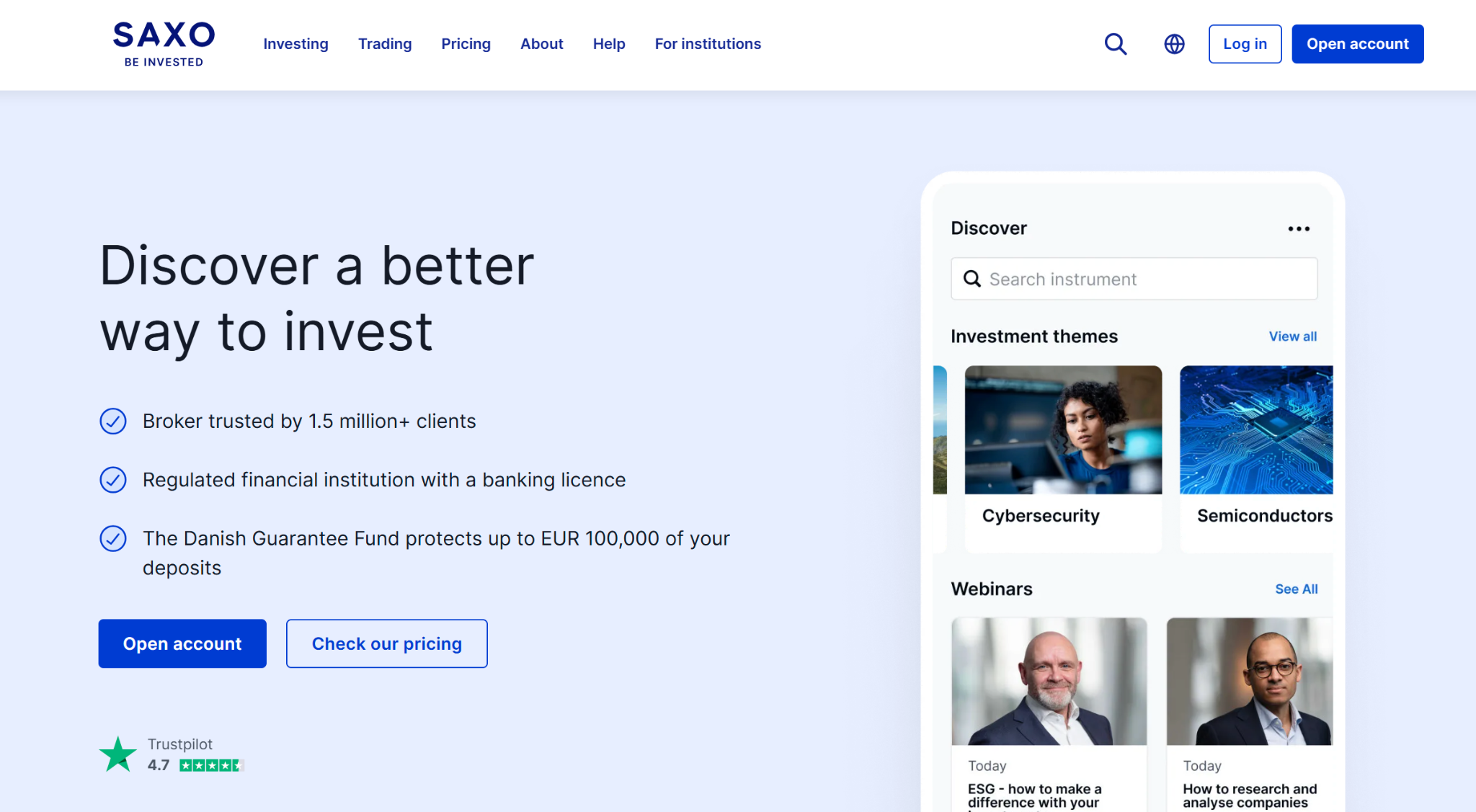
In June 2023, Saxo Bank A/S was designated a Systemically Important Financial Institution (SIFI) in Denmark by the Danish FSA. This is not a guarantee of state intervention in case of difficulties, but it implies higher capital requirements, enhanced regulatory oversight, and a higher probability of state involvement should it ever be needed.
Highlights
Sources: Saxo pricing, licences and protection of client funds pages, verified 7 August 2026. Interest rates as of 6 August 2026.
Pros and cons
Pros
- Bank-licensed in Denmark and Switzerland, with EU branches passported from Saxo Bank A/S
- A- credit rating from S&P (stable outlook) and SIFI status in Denmark
- Swiss ownership via J. Safra Sarasin Group (majority since March 2026; full 100% ownership agreed in July 2026, pending regulatory approval)
- Huge product breadth (71,000+ instruments, ~50 exchanges)
- Two purpose-built platforms (SaxoInvestor for passive investors; SaxoTrader for active traders)
- Competitive trading commissions after the 2024-2025 pricing overhaul
- Stock lending program available across most markets with 50/50 revenue split
- No inactivity fees
- Custody fees removed in most core European markets
- Long track record (founded in 1992)
Cons
- Pricing structure is complex - varies significantly by country, exchange, and account tier
- FX conversion fee (0.25%) is well above Interactive Brokers (~0.002%)
- Custody fees still apply in non-core markets (e.g., Portugal, Norway, UK on ETFs), and EU-resident individuals pay 25% Danish VAT on top
- Interest on cash is 0% for Classic and Platinum tiers - only VIP (USD 1,000,000 initial funding, or 500,000 reward points) earns meaningful rates
- High minimum deposit in some countries (e.g., €100,000 in Spain and Portugal)
- PRIIPs restrictions on US-listed ETFs (no workaround unless you qualify as elective professional)
- Does not accept US residents
- SaxoTrader can feel intimidating for absolute beginners
Where Saxo is most competitive: the core markets
Saxo's 2024-2025 pricing overhaul was not applied uniformly across all countries. The company defined a list of core markets, countries where it competes hardest for retail clients, and removed custody fees there entirely. In non-core markets, custody fees of 0.09% to 0.15% per year may still apply.
This means your experience as a Saxo client depends materially on where you live. Here is the current map:
Compiled from Saxo's country websites and pricing pages in May 2026. Saxo states that custody fees and other conditions vary by country of residence: confirm the exact rate for your account in the platform's Trading Conditions window before opening an account.
If you live in one of the green core markets (Belgium, France, Italy, Netherlands, Poland, Switzerland, Denmark, or with a sec. lending opt-in in Czech Republic), the Saxo direct experience is substantially better than in non-core markets. For investors in Spain, Portugal, or the UK, the cost gap with Interactive Brokers widens significantly due to ongoing custody fees.
Trading platforms
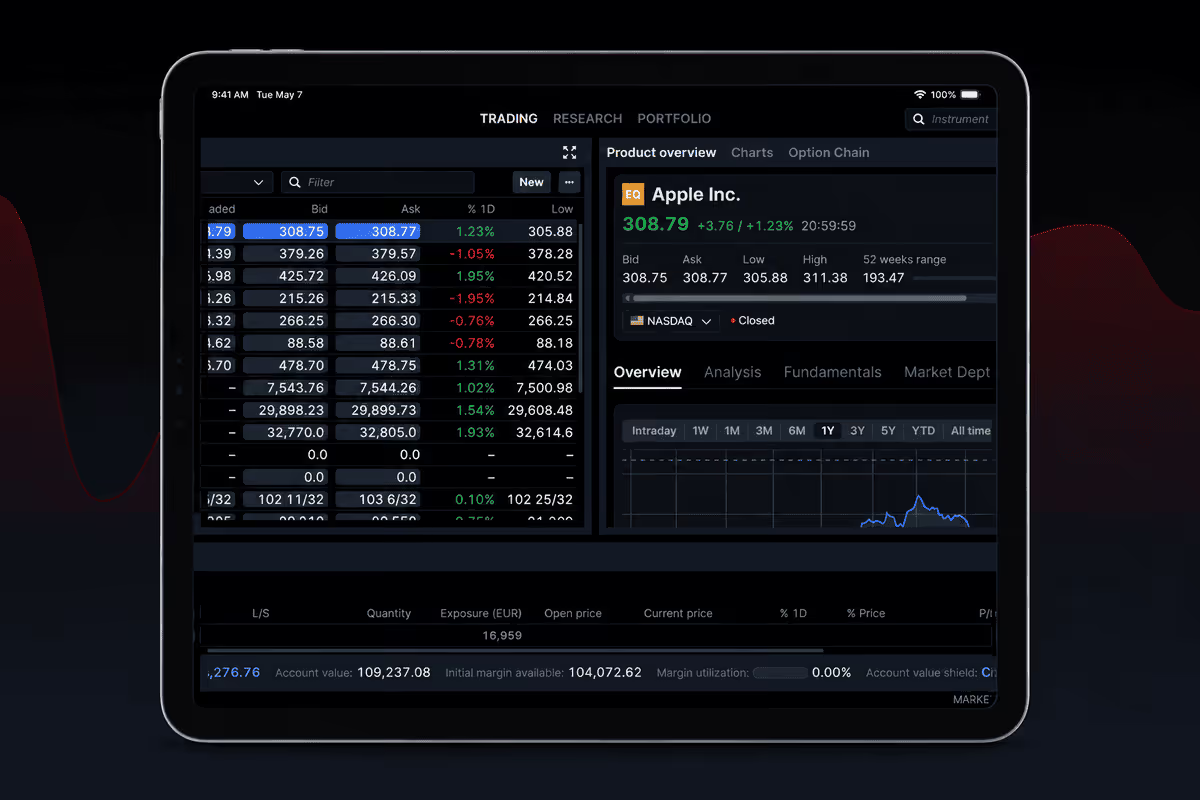
Important clarification: Saxo used to offer three platforms - SaxoTraderGO, SaxoTraderPRO, and SaxoInvestor. In 2025-2026, the company unified the brand into two platforms:
- SaxoInvestor - simple, focused on long-term investors
- SaxoTrader - advanced, available on web, mobile, and desktop (replaces both SaxoTraderGO and SaxoTraderPRO)
With a single Saxo account, you get access to both and can switch freely between them.
SaxoInvestor
The SaxoInvestor platform is built for the passive investor - someone buying ETFs or mutual funds on a monthly or quarterly schedule who does not need advanced charting. Features include:
- Access to stocks, ETFs, mutual funds, and bonds
- Clean, portfolio-focused interface
- Web and mobile versions
- Simple portfolio analysis and performance reports
- No access to derivatives (options, CFDs, futures) - by design

For ETF-focused long-term investors, this is the right interface. The absence of derivatives is actually a feature, not a bug - it removes temptation.
SaxoTrader
The SaxoTrader platform is the advanced platform, available on web, mobile, and desktop. It replaces the older SaxoTraderGO and SaxoTraderPRO branding. Features include:
- Access to the full product range (including options, futures, CFDs, and forex)
- Advanced charting and technical analysis
- Multi-screen layouts on desktop
- Risk management tools
- API access for algorithmic trading and integrations
- Margin trading and Lombard loans (where available)
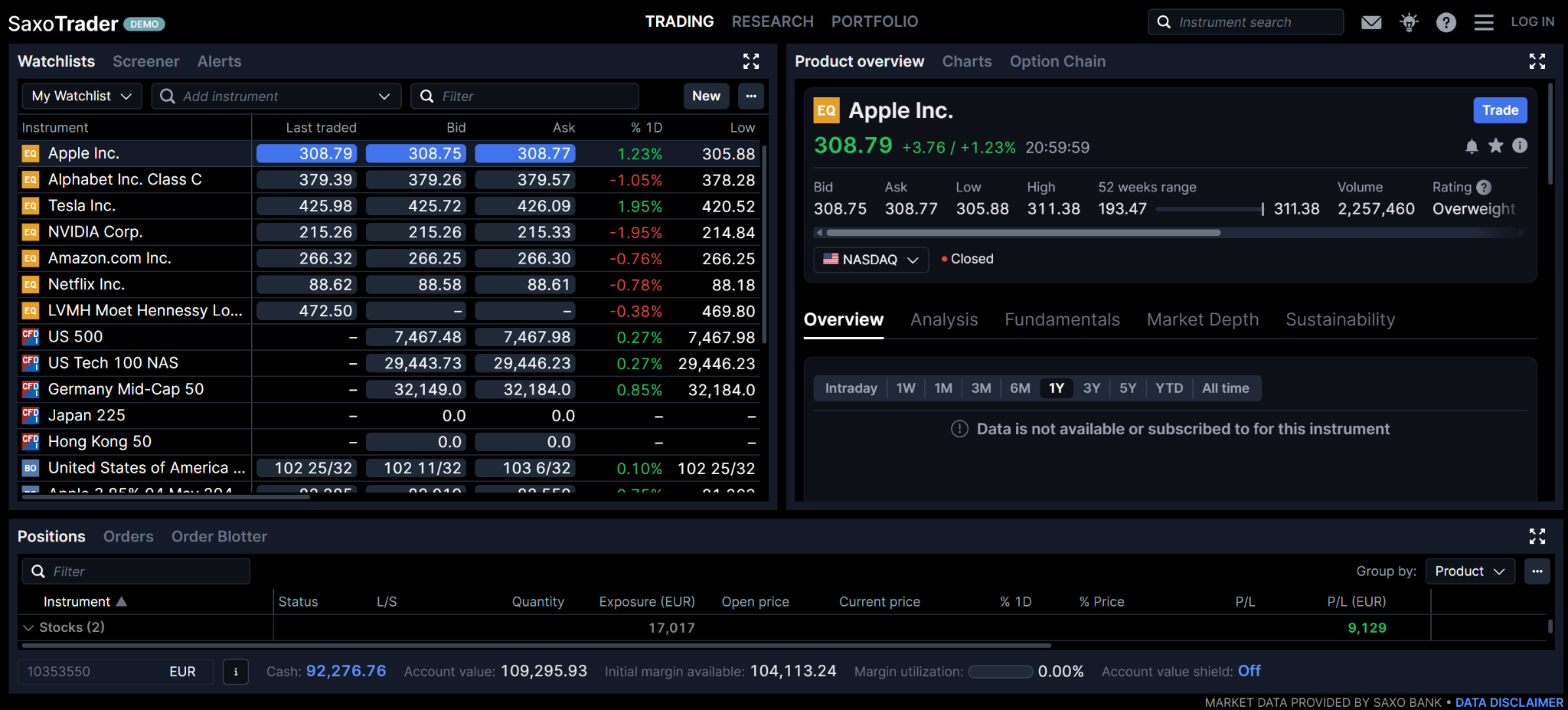
In our testing, the SaxoTrader desktop platform is one of the best professional-grade platforms in the European market - comparable to Interactive Brokers' TWS, but generally considered more polished in terms of visual design and information hierarchy.
Third-party platforms
Saxo can also be accessed via TradingView, which appeals to chart-focused retail investors. Other third-party integrations (MetaTrader, FIX/API) are oriented towards professional and institutional clients.
Demo accounts
Saxo offers free 20-day demo accounts for both platforms. We recommend testing both before opening a funded account, especially because the right platform choice depends heavily on your investment style.
Products and markets
Saxo's product breadth is one of its strongest differentiators. Depending on your country of residence, you can access over 71,000 instruments, including:
- Stocks across 50+ exchanges worldwide (23,000+ instruments)
- ETFs, more than 7,400 from 30+ exchanges (UCITS for European retail investors)
- ETCs (Exchange-Traded Commodities)
- Listed options on 20 exchanges (3,100+ contracts)
- Futures contracts across asset classes (250+)
- Government and corporate bonds (5,200+)
- Mutual funds and managed portfolios
- Forex spot and forwards
- CFDs across stocks, indices, commodities, FX, and crypto
US-listed ETFs and PRIIPs
As a European broker, Saxo follows PRIIPs regulations strictly. This means that, as a retail client, you cannot buy most US-listed ETFs (like VOO, VTI, or VTSAX) due to the lack of translated KID documents. The same restriction applies to all PRIIPs-compliant brokers in Europe (see also our guide to UCITS ETFs vs US ETFs).
There are two workarounds. First, in smaller CEE markets (Bulgaria, Croatia, Greece, Hungary, Lithuania, Romania, Slovakia, Slovenia), ETF issuers like Xtrackers offer equivalents to popular Vanguard ETFs. Second, qualifying as an elective professional client unlocks access to US ETFs and higher leverage. The "2 out of 3" test requires:
- A portfolio of financial instruments above €500,000
- An average of 10 significant trades per quarter over the last 12 months
- At least one year of professional experience in the financial sector requiring knowledge of the relevant products
Important: opting for elective professional status means you give up some retail investor protections (lower leverage caps, negative balance protection, investor compensation thresholds in some cases). Understand the trade-off before applying.
Tax wrappers
In several European markets, Saxo supports local tax-advantaged accounts:
Compiled from Saxo's country websites in May 2026.
Earn extra income with stock lending
Saxo offers a stock lending program that lets you generate additional passive income by lending out the stocks and ETFs in your portfolio. This feature is increasingly common among premium brokers, and Saxo's implementation is well thought out for retail investors.
How it works
When you activate stock lending, Saxo lends out your eligible securities to other market participants, typically hedge funds or institutional traders who want to short the stock, hedge existing positions, or meet delivery deadlines. In return, the borrower pays interest, and Saxo splits the revenue with you on a 50/50 basis.
Example: if you own shares of a stock currently in high demand with a 24% annual borrow rate, Saxo lends them out and you receive 12% per year (50% of the 24%) while your shares are lent. The income is credited to your account at the end of each month, and you can track everything in the stock lending dashboard.
In several markets where a custody fee would otherwise apply, opting into stock lending also waives that fee. That is the case in the Czech Republic, for example.
Recent examples
As an illustration, here are the annualised interest rates Saxo clients earned on selected high-demand stocks in January 2026:
Source: Saxo stock lending programme examples, January 2026. Illustrative only, not a forecast.
Important caveats: the lending rate varies stock by stock based on market demand, and the actual lending of your shares is not guaranteed, it depends on whether anyone is willing to borrow them. Past returns are not a reliable indicator of future income. For the majority of broad-market ETFs and large-cap stocks, lending rates tend to be very low (often below 0.5% annualised).
Key features
- Activate or deactivate the service at any time from your Portfolio overview
- Your shares remain in your portfolio and you can sell them at any moment
- You receive payments equivalent to applicable dividends while shares are lent
- Saxo posts collateral of at least 102% of the value of the open loan to protect you
- Earnings appear in your account at the end of each month
- All eligible stocks/ETFs in your account become available when you activate the service (you cannot cherry-pick)
Risks to understand
Stock lending is not free of risk. There are three key considerations:
- Voting rights: while your shares are lent out, you forfeit voting rights and the ability to attend shareholder meetings
- Market risk: you still bear the full market risk of the securities lent (your account value still moves with the share price)
- Counterparty risk: in the unlikely event of Saxo's bankruptcy, there is a period between insolvency and collateral distribution where the value of the open loan could exceed the collateral. The 102% minimum collateral reduces but does not eliminate this risk
Saxo publishes the full terms in the Securities Lending Agreement. For most long-term passive investors, the upside of activating stock lending generally outweighs the risks - particularly because the income is uncorrelated with market returns. But you should read the terms before opting in.
How it compares to competitors
Saxo's 50/50 revenue split is identical to Interactive Brokers' Stock Yield Enhancement Program (SYEP). The key difference is that Saxo has no minimum account size for activation, whereas IBKR's program requires at least $50,000 in equity. For smaller portfolios, this makes Saxo's stock lending more accessible than IBKR's.
Fees and commissions
Saxo operates a three-tier pricing system. New clients start in the tier matching their initial funding, and can then move up by collecting Saxo Rewards points on qualifying trades and assets:
- Classic - no minimum initial funding at group level (country minimums still apply, and are €0 in most core markets)
- Platinum - 120,000 reward points or minimum initial funding of USD 200,000 - up to 30% lower prices
- VIP - 500,000 reward points or minimum initial funding of USD 1,000,000 - lowest commissions and priority service
The higher your tier, the lower your trading fees. For most retail investors, Classic is the starting point. Above these three pricing tiers sits Saxo Elite, a service level rather than a separate price list, aimed at clients with over EUR 5 million in assets or EUR 200 million in annual trading volume.
Stock and ETF commissions
Source: Saxo stock and ETF commission schedules (home.saxo), verified 7 August 2026. Saxo notes that published prices are indicative and vary by country of residence; the exact figure appears in the platform trade ticket.
These commissions are competitive across all major European exchanges. For Euronext, the most relevant exchange for many European long-term ETF investors, Saxo's €2 minimum fee is lower than Interactive Brokers' fixed plan minimum of €3, though IBKR's tiered plan can still be slightly cheaper for very small orders.
Bonds, options, futures and funds
Beyond stocks and ETFs, Saxo's headline rates are:
- Bonds: from 0.05%, across 5,200+ government and corporate bonds
- Listed options: from $0.75 per contract, across 3,100+ contracts on 20 exchanges
- Futures: from $1 per contract, across 250+ contracts
- Mutual funds: no commission, no custody fee and no platform fee
FX conversion fees
Saxo charges 0.25% on currency conversions in most countries, applied to the FX spot mid-price. In the UK, the FX fee is tiered by account level: 0.6% (Classic) / 0.4% (Platinum) / 0.2% (VIP).
This is significantly higher than Interactive Brokers' ~0.002% (with a $2 minimum), but in line with most other European brokers. If you frequently trade in non-EUR currencies, consider holding cash balances in those currencies on the platform to avoid repeated conversions.
Custody fees
As covered in the core markets section above, custody fees were removed from most core European markets in 2024-2025. Where they still apply, Saxo's published schedule is 0.15% per year for Classic, 0.12% for Platinum and 0.09% for VIP, on stocks, ETFs, ETCs and bonds, calculated daily and charged monthly.
Two details are easy to miss. First, custody is a VAT-liable service, so individuals resident in the EU pay 25% Danish VAT on top: an effective 0.1875% per year rather than 0.15%. Second, in most markets where the fee applies, opting into the stock lending programme waives it.
Quick rule of thumb: if you live in Belgium, France, Italy, the Netherlands, Switzerland, Denmark, or Poland, you typically do not pay custody fees. If you live in Portugal, Spain, the UK (for ETFs), or Norway, you do.
Other fees
- Inactivity: €/$/£0 (removed in 2024)
- Deposits: €/$/£0
- Withdrawals: €/$/£0
- Manual orders placed by phone, chat or email: €50 per order
- Reporting fee (Classic only): $50 for online reports delivered by email
- Transfer out of stocks: €25 per ISIN for Danish stocks (max €100), €50 per ISIN for other stocks (max €160)
- Terminated account administration: €15 per month if assets are not withdrawn by the termination date
- CFD financing: spread + overnight interest
- Forex spread: variable by pair and account tier
Interest on uninvested cash
Saxo pays interest on uninvested cash, but the rates depend heavily on your account tier. As of 6 August 2026, on a balance of 150,000 in the relevant currency:
Source: Saxo interest calculator (home.saxo), rates as published by Saxo on 6 August 2026, calculated on a balance of 150,000 in the relevant currency. The rates are variable and track ESTR (EUR), SOFR (USD) and SONIA (GBP). Availability and terms vary by country of residence.
On that 150,000 balance, the VIP rates work out at roughly EUR 1,395, USD 3,600 and GBP 3,720 of interest per year. Saxo does not publish a static rate card: the calculator quotes live figures that are updated daily against ESTR (EUR), SOFR (USD) and SONIA (GBP), so check the live number in Saxo's calculator before relying on the figures above.
.png)
The practical takeaway: for Classic and Platinum clients, interest on uninvested cash is zero. Only VIP clients receive meaningful interest. If earning interest on your cash balance is important to you, Interactive Brokers is still the stronger option for most investors: IBKR pays interest on EUR balances above €10,000, currently 1.723% on IBKR Pro and 0.723% on IBKR Lite. Saxo's VIP EUR rate of 0.93% now sits slightly above IBKR Lite, but it remains well below IBKR Pro and it is only available once you reach the VIP tier.
Total cost simulation: Saxo vs Interactive Brokers vs Swissquote
To make the cost comparison concrete, consider a typical long-term passive investor: €100,000 initial investment + €1,000/month into a UCITS ETF on Euronext over 10 years. Assuming no custody fees (core market scenario):
EU Personal Finance calculation based on each broker's published commission schedules, verified 7 August 2026. Assumes a €100,000 lump sum plus €1,000 per month into a Euronext-listed UCITS ETF over 10 years, Classic tier, core market with no custody fee, and excludes FX conversion.
In core markets, Saxo edges out IBKR thanks to the lower €2 minimum on Euronext (vs IBKR's €3 fixed-plan minimum, or the percentage-based tiered fee). Over 10 years, the difference between Saxo and IBKR is around €89, meaningful but not transformative. The gap to Swissquote, on the other hand, is nearly €1,600.
Important caveat: if you live in a non-core market (UK ETFs, Portugal, Spain, Norway), Saxo's 0.09%-0.15% annual custody fee, plus 25% Danish VAT for EU residents, would add roughly €1,500-€2,500 to the 10-year cost on a €100,000 portfolio, making IBKR substantially cheaper in those markets.
Regulation and safety
Saxo's regulatory profile is one of the strongest among European retail brokers. Three points stand out.
European banking licences and branches
Saxo holds banking licences in two European jurisdictions:
- Denmark - Saxo Bank A/S, a licensed credit institution supervised by the Danish FSA (licence no. 1149). This is the contracting entity for most EU clients
- Switzerland - Saxo Bank (Schweiz) AG, regulated by FINMA
The Dutch business is no longer a separate bank. BinckBank N.V. surrendered its Dutch banking licence and was legally merged into Saxo Bank A/S, so the Netherlands, Belgium, France, the Czech Republic and the UAE now operate as branches of Saxo Bank A/S under the Danish licence, with local conduct oversight from authorities such as DNB and the AFM. This matters for investor protection: clients of those branches sit under the Danish guarantee scheme, not the Dutch one.
Beyond the two banking licences, the Saxo Group holds separate financial licences in the United Kingdom (FCA), Italy (CONSOB, through BG SAXO SIM), Singapore (MAS) and Japan (JFSA). In total, Saxo describes itself as licensed and regulated in 11 jurisdictions across Europe, the Middle East and Asia. The full list is available on the Saxo Licences and regulation page.
SIFI status and A- credit rating
In June 2023, the Danish FSA designated Saxo Bank A/S as a Systemically Important Financial Institution (SIFI) in Denmark. This carries three practical implications:
- Higher minimum capital requirements (total capital ratio of 24.8% at the end of 2025)
- Enhanced regulatory supervision
- Higher probability of state intervention in case of distress (though not a guarantee)
In addition, S&P Global Ratings reaffirmed Saxo's A- long-term rating with stable outlook in March 2026. Historically, A- rated financial institutions have an estimated 10-year probability of default of around 1-2% - a very low risk level. For comparison, Interactive Brokers Ireland Limited holds the same A- rating.
Investor protection
The investor protection scheme depends on the Saxo entity holding your account:
Source: Saxo licences page and protection of client funds page (home.saxo), verified 7 August 2026.
Beyond these schemes, all client assets are segregated from Saxo's own assets, as required by EU regulation. Even in a Saxo insolvency, your securities are not part of the bankruptcy estate.
Ownership structure
On 2 March 2026, the Swiss private banking group J. Safra Sarasin completed its acquisition of a majority stake (~71%) in Saxo Bank A/S, buying out the holdings previously owned by China's Geely (49.9%), Mandatum, and other shareholders. As part of that transaction, founder Kim Fournais stepped down as CEO to become chairman of the board, and Daniel Belfer - previously CEO of Bank J. Safra Sarasin - took over as Saxo's chief executive. Fournais retained a stake of roughly 28% at the time.
In July 2026, J. Safra Sarasin agreed to acquire that remaining ~28.69% stake as well, exercising a call option under the shareholders' agreement. Once the deal closes - it remains subject to customary regulatory approvals - J. Safra Sarasin will own 100% of Saxo. Fournais exits the shareholder base but stays on as chairman, and Saxo will continue to operate as a separate entity. Financial terms were not disclosed.
From a European investor's perspective, this matters for three reasons:
- Geographic risk diversification - full Swiss ownership reduces exposure to US-China geopolitical tensions (the previous largest shareholder was China's Geely)
- Stronger European identity - aligns Saxo with the Swiss tradition of conservative private banking
- Operational continuity - Fournais stays involved as chairman, minimising disruption to strategy and culture, while Belfer leads day-to-day execution
Financial transparency
Although a private company, Saxo publishes detailed financial reports on its Investor Relations page. Here is a snapshot of the Saxo Bank Group 2025 results:
Source: Saxo Bank Group Annual Report 2025 and the results announcement of 14 April 2026.
Saxo reports the same results in euro: total income EUR 664 million (2024: EUR 626 million), net profit EUR 72 million (EUR 135 million), adjusted net profit EUR 120 million (EUR 144 million), total equity EUR 837 million (EUR 839 million) and record client assets of EUR 133 billion (EUR 114 billion), across 1,523,000 clients (1,286,000).
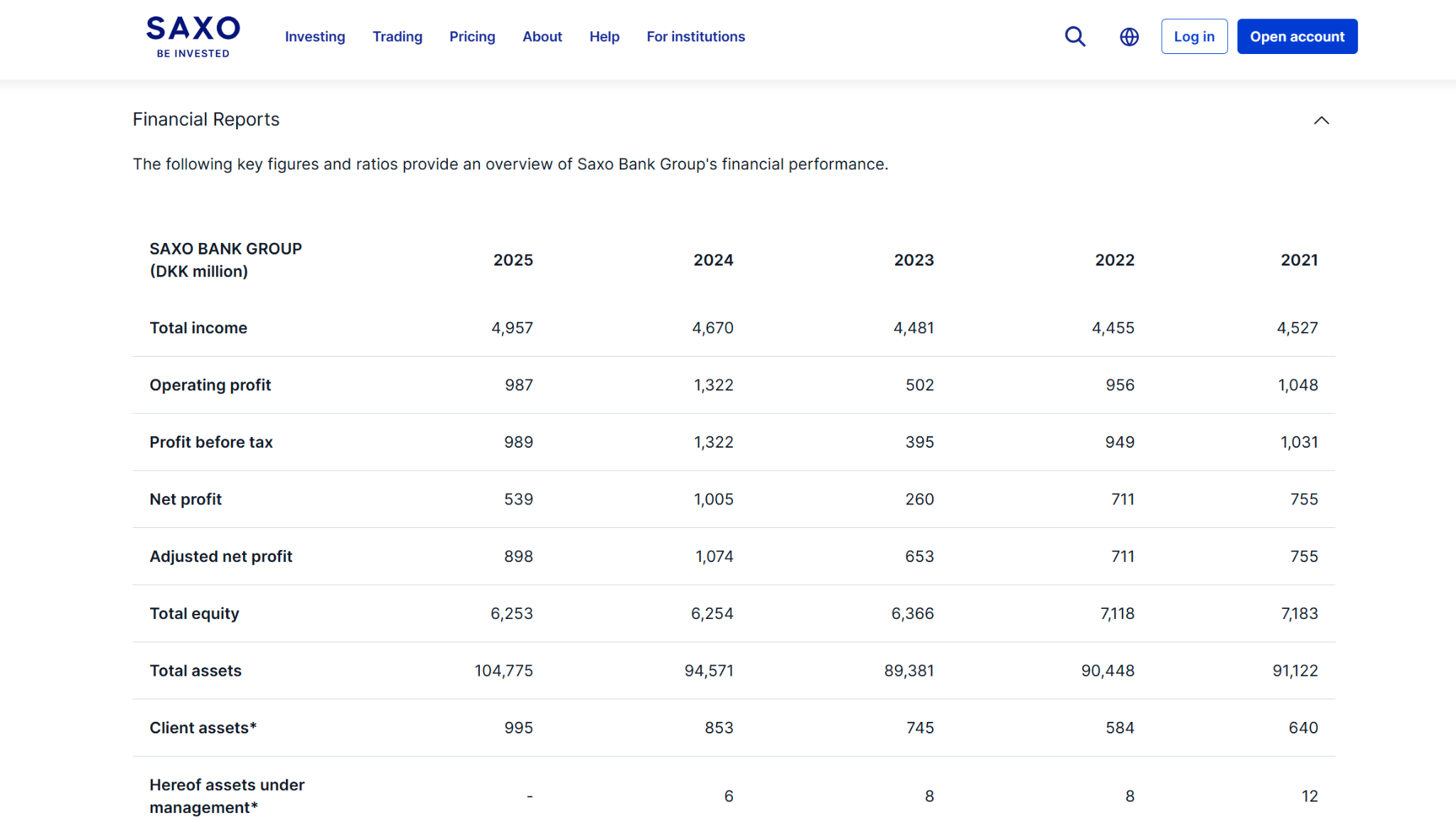
The 2025 numbers show continued top-line growth (revenue +6.1% YoY) alongside a compression in net profit, reflecting both transition costs from the ownership change and ongoing investment in platform infrastructure. The total capital ratio of 24.8% remains well above regulatory minimums.
Account opening
Opening an account with Saxo is straightforward and entirely online. The process typically takes around 15 minutes for the application, followed by a verification period of 1-3 business days.
Step-by-step
- Go to home.saxo and click "Open account"
- Select your country of residence
- Complete the personal data section (name, address, tax ID, employment)
- Complete the MiFID II knowledge and experience questionnaire
- Upload verification documents (passport or ID + proof of address)
- Wait for account approval (1-3 business days)
- Fund your account via wire transfer (no credit/debit cards in most markets)
- Access SaxoInvestor and SaxoTrader with the same login
Minimum deposit by country (illustrative): €0 in most core markets (Belgium, France, Italy, Netherlands, Poland, Switzerland, Denmark, Singapore, UK); €5,000 in MENA countries (UAE, Qatar, Saudi Arabia); €100,000 in Spain and Portugal.
Customer support
Customer support quality at Saxo is generally well-regarded, particularly compared to lower-cost competitors. Support is available via:
- Phone (during European business hours)
- Live chat (during business hours)
- Help centre with detailed articles
Languages: English is the default for international clients. Local-language support is available in core markets (French, Italian, Dutch, Danish, Polish, German, etc.). Note: Portuguese is only available for VIP clients.
In our experience, response times via phone are usually under 5 minutes, and email queries are typically resolved within one business day. This is markedly better than the support experience reported by IBKR users, particularly for non-technical questions.
Who is Saxo for?
Saxo makes the most sense for three investor profiles in Europe:
Profile 1: long-term ETF investor in a core market
If you live in Belgium, France, Italy, the Netherlands, Switzerland, Denmark, or Poland, the Saxo direct experience is excellent. You get a clean SaxoInvestor interface, competitive Euronext or Xetra commissions, no custody fees, and access to local tax wrappers (PEA, Aktiesparekonto, regime amministrato, etc.). For passive ETF investors in these countries, Saxo is often the best all-rounder available.
Profile 2: investor seeking counterparty diversification
If you already have an account at Interactive Brokers, Trading 212, or DEGIRO, adding Saxo to the mix gives you genuine counterparty diversification. Swiss ownership, Danish regulation, A- rating, and SIFI status form a profile that is structurally different from US-domiciled platforms. In stressed market scenarios, this diversification matters more than it appears in calm times.
Profile 3: semi-active or professional trader
If you trade options, futures, CFDs, or forex alongside long-term holdings, the SaxoTrader desktop platform competes with the best in Europe. The product breadth (71,000+ instruments, ~50 exchanges) and the ability to qualify as elective professional client unlock features that most retail-focused brokers simply do not offer.
Who Saxo is not for
- Investors in non-core markets (Portugal, Spain, UK ETFs, Norway) who prioritise low total cost over institutional solidity - IBKR is generally cheaper after factoring in custody fees
- Investors who frequently convert between currencies (the 0.25% FX fee adds up)
- Investors who want meaningful interest on uninvested cash without reaching VIP tier (Classic and Platinum earn 0%)
- US residents (not accepted)
- Beginners who feel intimidated by complex pricing structures and three-tier account systems
Alternatives to Saxo
If Saxo doesn't quite fit your needs, three other European brokers are worth comparing. See also our overview of the best trading platforms in Europe for a broader view.
Final verdict: is Saxo worth it in 2026?
Saxo is one of the most institutionally solid retail brokers in Europe. A Danish banking licence with EU branches passported from it, a Swiss banking licence, an A- credit rating with stable outlook, SIFI status in Denmark, and the move to full Swiss ownership under J. Safra Sarasin form a profile that is genuinely hard to match in the European retail space. The 2024-2025 pricing overhaul has eliminated most of the historical cost disadvantages, the SaxoInvestor and SaxoTrader platforms are excellent, and the stock lending program adds a meaningful income stream for long-term holders.
That said, Saxo is not the right broker for every European investor. The answer depends on three questions:
- Do you live in a Saxo core market? If yes (Belgium, France, Italy, Netherlands, Switzerland, Denmark, Poland), Saxo direct is excellent and often beats IBKR on Euronext minimums. If no (Spain, Portugal, UK on ETFs, Norway), custody fees materially erode Saxo's cost competitiveness vs IBKR
- Do you value institutional solidity above pure cost minimisation? Saxo wins on the safety-and-platform-quality axis. IBKR wins on cost, FX, and interest on uninvested cash
- Do you trade more than just ETFs? If you use options, futures, CFDs, or forex alongside long-term holdings, SaxoTrader is one of the best platforms in Europe and the product breadth justifies the platform choice on its own merits
Our recommendation: for long-term ETF investors in Saxo core markets, Saxo is a strong default choice and often the best all-rounder. For investors in non-core markets focused on cost minimisation, Interactive Brokers remains hard to beat. And for investors building a multi-broker setup for counterparty diversification, Saxo is one of the few European-regulated, bank-licensed options that genuinely complements US-domiciled platforms.
Disclaimer: This article is for informational purposes only and does not constitute financial advice. Investing involves risk, including the potential loss of your invested capital. Do your own research and consider seeking advice from a qualified financial professional before making investment decisions.