Robinhood Europe review 2026: is it really a broker?

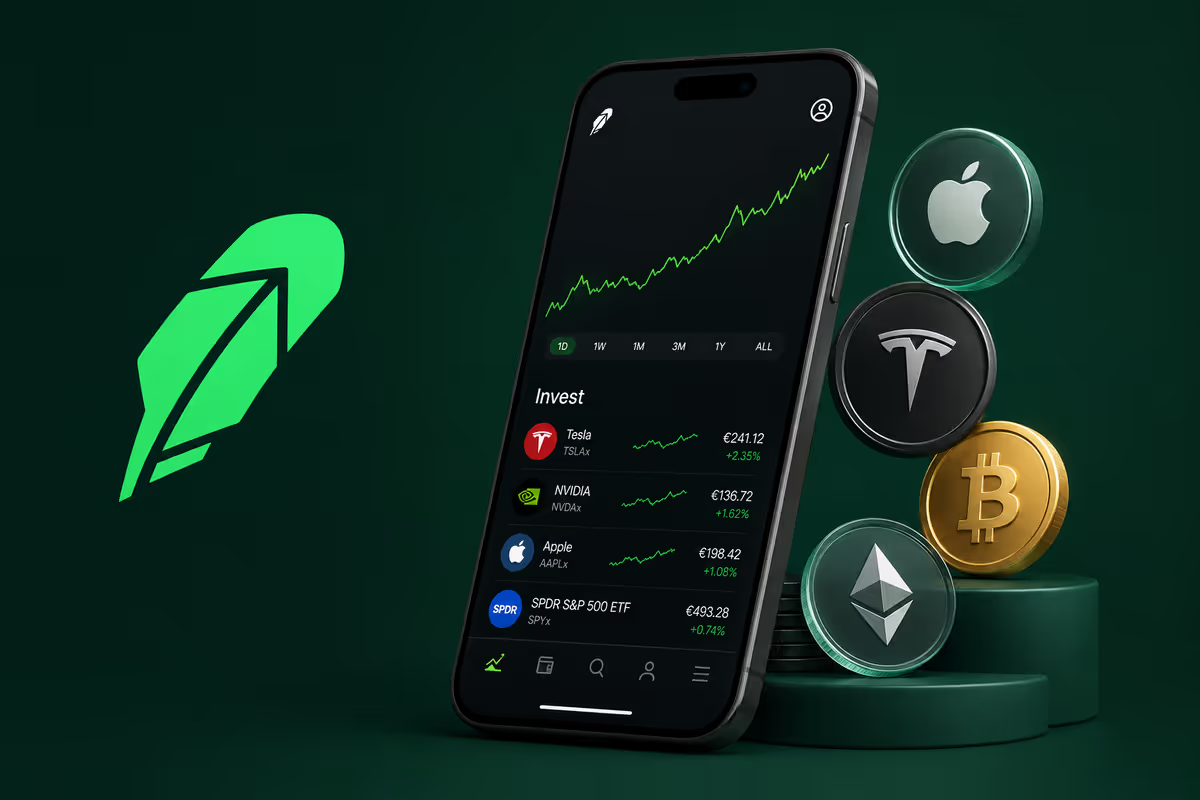



In this article, we review Robinhood Europe, the European arm of the well-known US trading app Robinhood, to help you decide whether it makes sense for your investment goals as a European investor.
Robinhood Europe is a fundamentally different product from the US Robinhood that most people have heard of. In the United States, Robinhood is a broker-dealer that gives clients ownership of actual stocks, ETFs, and options. In Europe, the company operates under a completely different legal entity (Robinhood Europe UAB, based in Vilnius, Lithuania) and offers a completely different product set: crypto, perpetual futures, staking, a self-custody Wallet, and the headline novelty of the European launch, Classic Stock Tokens.
A note on the name. Until July 2026 this product was simply called Stock Tokens. On 1 July 2026 Robinhood launched a second, separate product line that now carries that name (tokenised debt securities issued by Robinhood Assets (Jersey) Limited, traded through the Robinhood Wallet on the Robinhood Chain, and not part of the Robinhood Europe app), and renamed the original product Classic Stock Tokens. This review is about the Classic Stock Tokens you actually get inside the Robinhood Europe app.
Classic Stock Tokens are the part of the offering that gets the most attention, and they require careful framing. Despite the name, they are not stocks. They are derivative contracts between you and Robinhood Europe UAB, minted as tokens on a blockchain, that track the price of US-listed stocks and ETFs without giving you any ownership of the underlying securities. The distinction is similar to the one we cover in our guide Are you really buying an ETF or just trading a CFD?.
If you are looking for a traditional European broker, this is not it. There are no UCITS ETFs, no real shares, no bonds, no options on equities, no tax wrappers, no ISIN-traded securities you actually own. What Robinhood Europe does offer is a polished mobile experience, very low explicit fees, and exposure to US equity prices that would otherwise be unavailable to European retail investors due to PRIIPs restrictions (see our UCITS ETF vs US ETF guide for the background). That trade-off is the entire story of this review.
New users who sign up via a referral link currently get €50 worth of crypto (split across BTC, EIGEN, AVNT, PAXG, and HYPE) after depositing at least €50 and starting to trade. You can use our Robinhood Europe referral link to claim the bonus - full terms apply and the offer is subject to change.
Video review
Overview
Robinhood Markets, Inc., the US parent company, was founded in 2013 by Vlad Tenev and Baiju Bhatt and became famous (and infamous) for popularising commission-free trading and for its role in the 2021 GameStop short squeeze. The company went public on NASDAQ in 2021 and now serves nearly 28 million customers across 38 countries. We covered the launch of the European arm in our earlier piece Is Robinhood available in Europe?.
Robinhood Europe UAB is the European subsidiary, headquartered in Vilnius and authorised by the Bank of Lithuania as a financial brokerage firm, crypto-asset service provider, and payment institution. The European rollout started with crypto in 2024 and progressively added Classic Stock Tokens, perpetual futures, staking, and an interest-bearing money market fund through 2025-2026. In July 2026, Robinhood extended EU perpetual futures beyond crypto to commodities, ETFs and FX.
Robinhood Europe UAB serves 30 European countries: the 27 EU member states plus Iceland, Liechtenstein and Norway. The United Kingdom is not one of them. UK residents are served by a separate entity, Robinhood U.K. Ltd (authorised by the FCA, FRN 823590), which introduces clients to Robinhood Securities LLC in the US and offers a genuinely different product: real shares, options, futures, margin and stock lending, but no crypto trading as of August 2026. US residents use the separate US entity. Product availability also varies country by country within the EEA, so check what is enabled for your country of residence before opening an account.
Highlights
| Metric | Details |
|---|---|
| Supported regions | 30 EU/EEA countries (27 EU + Iceland, Liechtenstein, Norway). The UK is served by a separate entity, Robinhood U.K. Ltd |
| Minimum deposit | €0 |
| Funding methods | SEPA bank transfer, crypto deposit |
| Classic Stock Tokens trading fee | 0% commission, 0.10% FX fee per transaction (EUR↔USD) |
| Crypto trading fee | 0.50% on euro value (€0.01 min), EURC is fee-free |
| Perpetual futures (crypto, commodities, ETFs, FX) | 0.02% maker / 0.02% taker (Robinhood) + 0.02% taker (venue) |
| Staking commission | 15% of rewards (ETH and SOL only) |
| Interest on uninvested cash | 5% headline APY via a J.P. Morgan EUR money market fund (fund yield plus a Robinhood promotional boost, no announced end date) |
| MMF service fee | 0%: Robinhood does not charge a fee on the annual yield |
| Inactivity fee | €0 |
| Deposit / withdrawal fee | €0 (SEPA) |
| Investor protection | Up to €22,000 (Lithuanian Liabilities to Investors Insurance Fund) |
| Regulator | Bank of Lithuania (BoL) |
| Legal entity | Robinhood Europe UAB, Vilnius, Lithuania |
| Parent company | Robinhood Markets, Inc. (NASDAQ: HOOD) |
Source: Robinhood Europe fee schedule, help centre and product pages (robinhood.com/eu), verified 7 August 2026.
Pros and cons
Pros
- 0% commission on Classic Stock Tokens, with only a 0.10% FX fee per leg
- Token-based exposure to US-listed ETFs (VOO, VTI, QQQ, SPY) that European retail investors cannot buy directly due to PRIIPs restrictions - you hold a derivative referencing the ETF, not the ETF itself
- 24/5 trading on Classic Stock Tokens, from Monday 02:00 CET to Saturday 02:00 CET (vs regulated market hours on traditional brokers)
- Fractional investing from €1
- Competitive crypto offering with over 65 coins and tight spreads
- 5% headline APY on uninvested EUR cash via a J.P. Morgan money market fund, with no Robinhood fee on the yield
- Perpetual futures on crypto and, since July 2026, on commodities, ETFs and FX, with up to 10x leverage (advanced product, not for beginners)
- Staking on ETH and SOL from €1
- No inactivity fees, no deposit/withdrawal fees, no custody fees
- Offers a signup bonus for new users in Europe
Cons
- Classic Stock Tokens are derivatives, not stocks - you do not own the underlying shares, you have a contractual claim on Robinhood Europe UAB
- Significant counterparty risk to Robinhood Europe UAB, which is a non-bank investment firm (not a credit institution)
- Investor protection capped at €22,000, materially lower than typical EU schemes (€20k securities + €100k cash at most European brokers)
- No UCITS ETFs, no real shares, no bonds, no equity options, no margin lending, no securities lending, no tax wrappers
- Cash-settled only - Classic Stock Tokens cannot be redeemed for the underlying stock or ETF
- No voting rights, no shareholder meeting access (because you do not own the stock)
- 0.5% crypto fee is competitive but not the lowest in Europe
- Customer support is exclusively digital, no phone line
What are Classic Stock Tokens? The mechanics explained
This is the most important section of this review because it is what most people get wrong about Robinhood Europe. We will keep it precise.

What a Classic Stock Token actually is
A Classic Stock Token, per Robinhood Europe's own Description of Services document, is a derivative contract between you and Robinhood Europe UAB, referencing the price of a US-listed stock or ETF. When you "buy" an Apple Classic Stock Token, you are not buying a share of Apple Inc. You are entering into a bilateral contract with Robinhood Europe UAB that obligates them to pay you (or for you to pay them) based on how Apple's share price moves.

Robinhood mints a new token on a blockchain to represent that contract, and burns it when you close the position. The token is non-transferable and non-assignable - you cannot send it to an external wallet or to another user. Despite the blockchain wrapper, this is essentially a CFD-like product, offered under MiFID II as a derivative, settled in cash, with Robinhood Europe UAB as your counterparty. Robinhood states that it owns the underlying securities and holds them with a US-licensed institution, but those holdings belong to Robinhood, not to you.
What you give up vs owning the stock
Compared to owning a real share through a traditional broker:
| Aspect | Real share (e.g. via IBKR) | Robinhood EU Classic Stock Token |
|---|---|---|
| Legal ownership | Yes, you own the share | No, derivative contract only |
| Voting rights | Yes | No |
| Dividends | Yes, paid directly by issuer | Cash equivalent paid by Robinhood (discretionary timing) |
| Shareholder meetings | Yes, you can attend | No |
| Counterparty risk | Limited (CSDs, segregation) | Direct exposure to Robinhood Europe UAB |
| Transferable to another broker | Yes (ACATS / portfolio transfer) | No |
| Investor protection | €20k securities + €100k cash (typically) | €22k total (Lithuanian scheme) |
| Tax treatment | Standard equity rules | Likely derivative income, varies by country |
Source: Robinhood Europe Description of Services and Key Information Document, plus each broker's published terms. Verified 7 August 2026.
What you gain
- Token-based exposure to US-listed ETFs that are otherwise blocked in Europe. VOO, VTI, QQQ, SPY, VEA, and similar US ETFs are restricted to retail investors in the EU/UK under PRIIPs because issuers do not provide translated KIDs. Classic Stock Tokens sidestep that restriction because they are not the ETFs themselves - they are derivative contracts that reference the ETF price. Robinhood Europe publishes its own KID for each Classic Stock Token, satisfying PRIIPs. Most European investors get equivalent exposure via UCITS alternatives like CSPX, VUAA, or SXR8 (see our Best S&P 500 ETFs in Europe guide); Classic Stock Tokens are the only mass-market way to hold a token that tracks the actual US-listed name.
- 24/5 trading. Classic Stock Tokens can be traded from Monday 02:00 CET/CEST to Saturday 02:00 CET/CEST, well outside US regular market hours, with the caveat that liquidity is thinner and spreads are wider in extended sessions. Orders placed outside that window are queued for the reopen.
- Fractional from €1. No minimum order size beyond €1.
- Zero commission. No commission per trade. The only fee is a 0.10% FX conversion (EUR↔USD) applied on the executed amount, on both buy and sell.
The catches
- Counterparty risk to Robinhood Europe UAB. Robinhood hedges its Classic Stock Token book by buying the underlying US stocks and ETFs 1:1 for its own account, held with a US-licensed institution. That is the right risk management practice. But in a bankruptcy scenario, your claim is against Robinhood Europe UAB as a contractual creditor, protected only up to the €22,000 Lithuanian compensation scheme cap. There is no transfer to another broker, no CSD-segregated holding of the underlying that you can claim.
- Discretionary dividend handling. Robinhood passes dividend equivalents to Classic Stock Token holders, but it says explicitly that these are "not considered dividends in the usual sense", and the exact timing and tax treatment depend on Robinhood's discretion and on local tax rules. With a real share, the dividend flows directly from the issuer and the withholding tax rules are well established.
- Order collaring. Orders are collared at ±0.5% of the last Nasdaq trade price for the underlying. This protects you from extreme prints but can also mean orders fail to execute in fast-moving markets.
The bottom line: Classic Stock Tokens are a clever piece of financial engineering that unlocks token-based exposure to otherwise-blocked US ETFs, at the cost of layering derivative risk, counterparty risk, and tax uncertainty on top of what would otherwise be a simple equity holding.
For an investor whose entire long-term portfolio is going through Robinhood EU, this is a meaningful risk concentration. For an investor using Robinhood EU as a small satellite position alongside a real broker, the trade-off is more reasonable.
Products and markets
Robinhood offers Classic Stock Tokens, crypto, perpetual futures, staking and a money market fund:

Classic Stock Tokens
Robinhood EU offers 2,000+ Classic Stock Tokens covering large- and mid-cap US-listed stocks and a meaningful slice of US-listed ETFs. The ETF list is particularly interesting because it includes the household names that European retail investors typically cannot access on traditional brokers: Vanguard S&P 500 ETF (VOO), iShares Core S&P 500 (IVV), SPDR S&P 500 (SPY), etc.
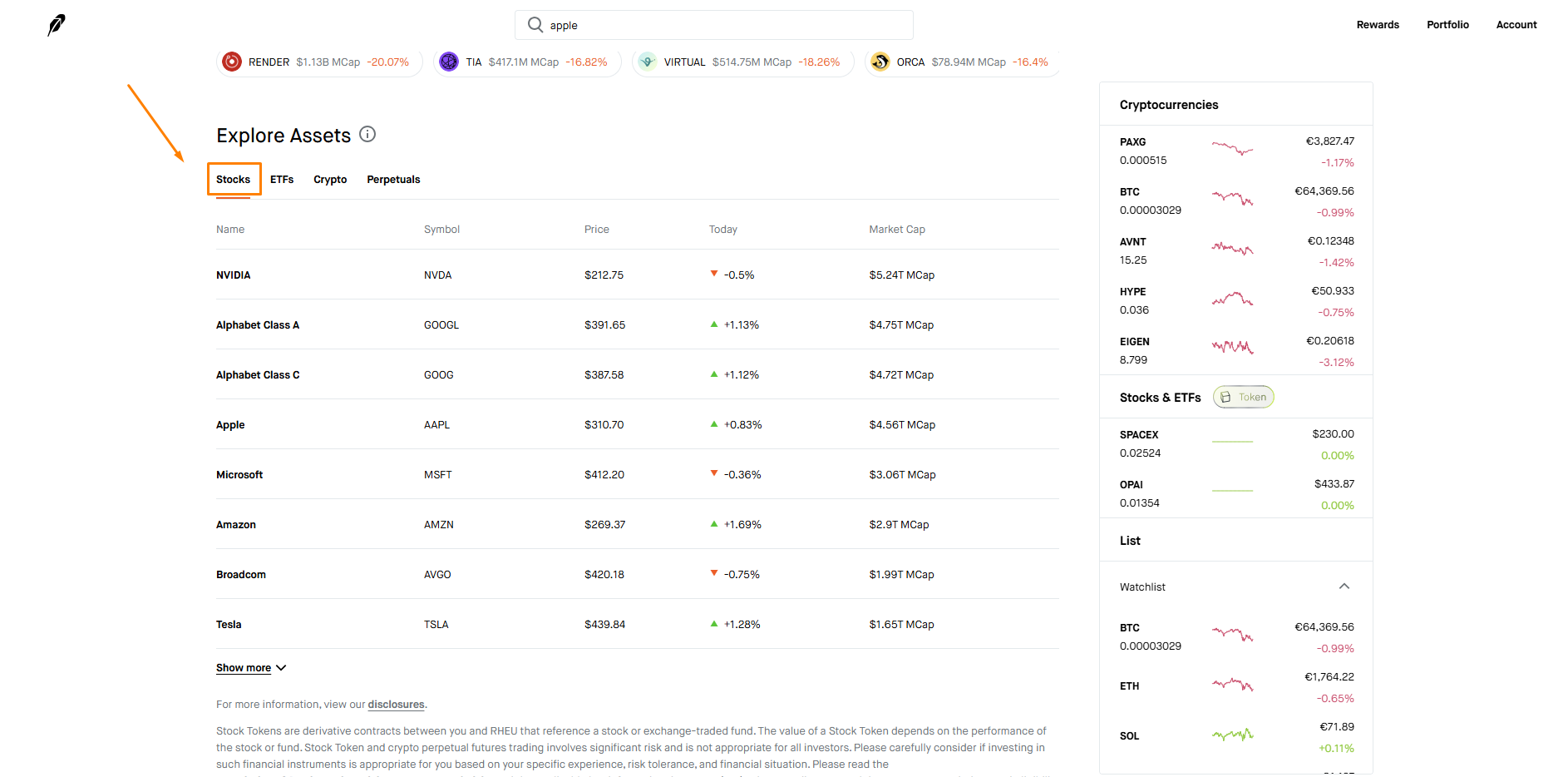
There are no UCITS ETF tokens (VWCE, IWDA, SXR8, etc.) - the entire concept of the product is to give European investors exposure to US-listed products that are normally PRIIPs-blocked, so the UCITS universe is not part of the offering. If you want VWCE or IWDA, you need a real broker (see our comparison VWCE vs IWDA).
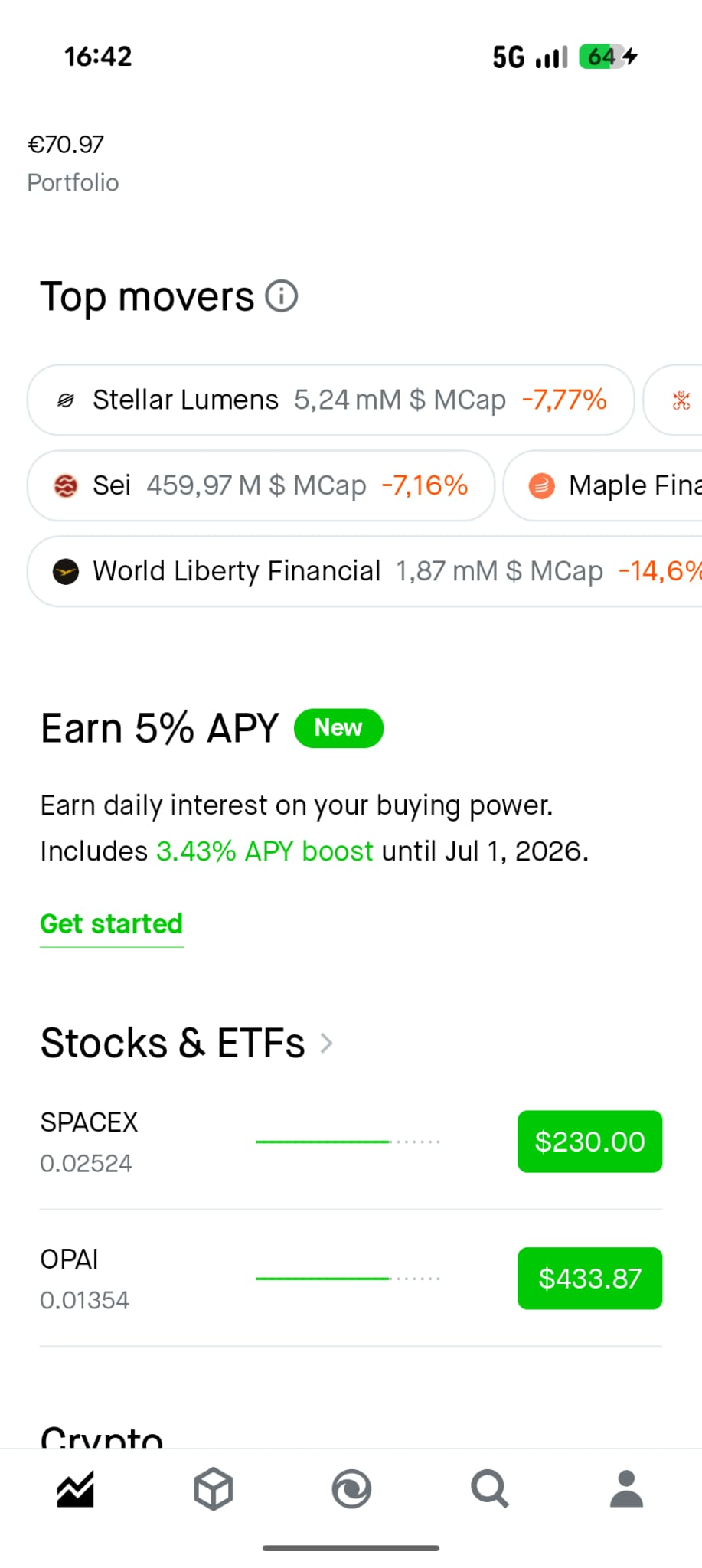
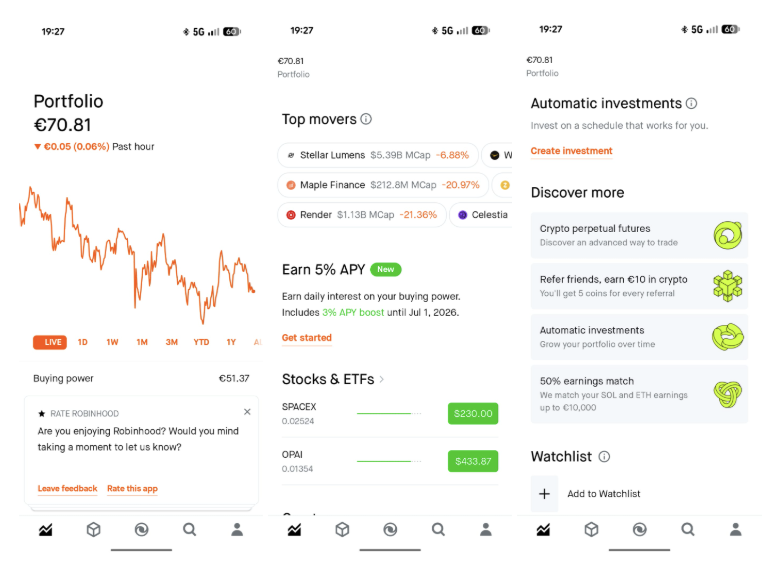
Stocks include the obvious US large-caps (Apple, Microsoft, NVIDIA, Tesla, etc.) plus, more unusually, private company tokens like the SPACEX and OPAI tokens visible in our portfolio screenshot below. These reference internal Robinhood valuations of private companies and are an even more experimental product than the listed-equity tokens. Treat them with extra caution: there is no transparent public price, the spread can be wide, and liquidity is entirely at Robinhood's discretion.
Crypto
Robinhood EU offers 65+ cryptocurrencies including BTC, ETH, SOL, USDC, DOGE, SHIB, PEPE, BONK, and WIF. Trading runs 24/7 and supports fractional buys from €1. Crypto buy and sell orders pay 0.50% of the euro value, with a €0.01 minimum. EURC (Circle's euro stablecoin) is fee-free, a useful detail if you want to park cash on-chain without incurring conversion costs.
Crypto services are provided by Robinhood Europe UAB itself, authorised by the Bank of Lithuania as a crypto-asset service provider under MiCA. Crypto is not covered by any investor compensation or deposit guarantee scheme.

For a broader comparison of EU-regulated alternatives, see our list of the best crypto exchanges in Europe.
Perpetual futures
This is the most advanced product in the Robinhood EU lineup. Perpetual futures are derivative contracts that track the price of an underlying asset, with no expiry date, and allow leveraged long or short positions. Robinhood EU launched with crypto perpetuals (BTC, ETH and other majors) at up to 10x leverage.
On 1 July 2026 Robinhood extended the range beyond crypto. Eligible European clients can now also trade commodity, ETF and FX perpetual futures, including GOLD, SILVER, QQQ, EUR/USD, WTI, Brent crude and EWY, at up to 10x leverage, 24 hours a day, seven days a week. Robinhood says the expanded contracts are rolling out in waves, so availability may lag on your account.
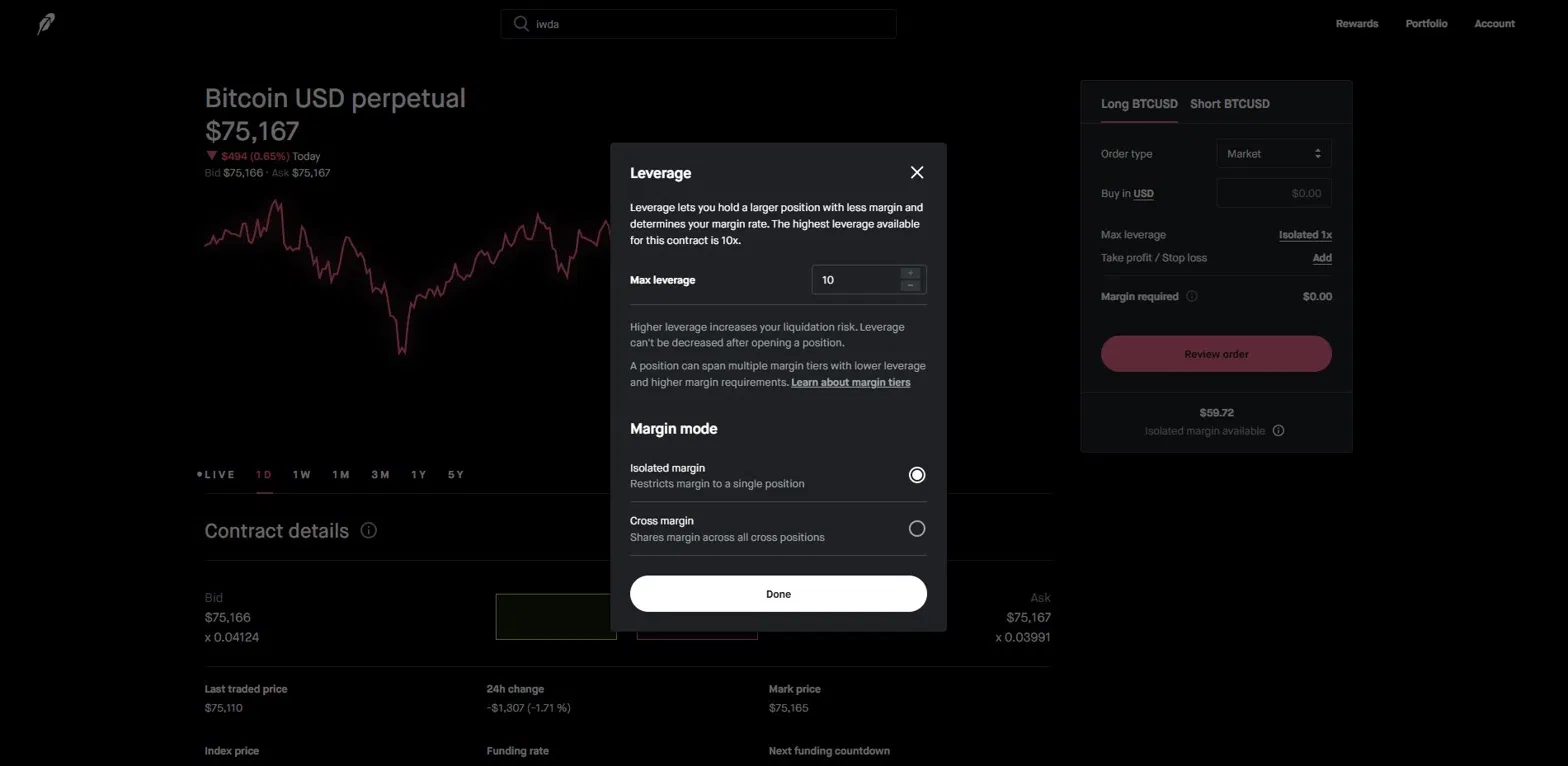
Mechanically: perpetuals are custodied at Bitstamp (a Slovenian MiFID II firm regulated by the ATVP, and since June 2025 a wholly owned Robinhood subsidiary trading as "Bitstamp by Robinhood") under an omnibus account in Robinhood's name. You face Robinhood Europe UAB directly, and Robinhood faces Bitstamp, so there are two legal entities between you and the position, even though both now sit inside the same group. Funding rates are paid periodically to keep the perpetual price aligned with the index. Liquidation fees are 0.05% of USD notional.
Perpetual futures are a high-risk product. Most retail investors will lose money trading them. Robinhood's own risk disclosure flags trading with leverage, liquidation risk, socialization of losses, and index risks as material concerns. We would only recommend this product to investors who already trade perpetuals elsewhere and fully understand margin mechanics.
Staking
Robinhood EU offers staking on ETH and SOL only, from €1. The commission is 15% of rewards, which is in the middle of the range for European retail crypto platforms (some are lower, some are much higher). Rewards are paid in the staked asset on a schedule set by Robinhood. There is no minimum lockup imposed by Robinhood beyond the validator-level mechanics of each chain.
Money market fund (cash interest)
Uninvested EUR cash can be opted into the J.P. Morgan EUR Liquidity LVNAV money market fund (ISIN LU2599140782), an AAA-rated fund with a stable NAV of €1 per share. The headline rate advertised on Robinhood's EU site is 5% APY, made up of the fund's own variable yield plus a promotional boost from Robinhood. When we first tested the product in May 2026, that split was roughly 1.57% fund yield plus a 3.43% boost.
Two things have changed since our original review, both in the investor's favour. First, the promotional boost has no announced end date: Robinhood's own FAQ states that the boost is open-ended, though the rate is variable and the promotion can be withdrawn with notice. Second, the 0.50% service fee that Robinhood had signalled for after 1 July 2026 is not being charged: the current help centre page states plainly that "Robinhood does not charge a fee on the annual yield". The in-app figure is shown net of fees and inclusive of any promotion.
Yield accrues daily on your balance at the fund's 14:00 Luxembourg cutoff and is paid monthly, within the first three business days. Your MMF balance and buying power are treated as a single balance, so you can trade or withdraw at any time, although withdrawals can settle T+1 if fund liquidity is tight.


The two screenshots above date from our May 2026 testing and reflect the fee and promotion terms as they were disclosed at the time. Robinhood has since dropped the planned 0.50% yield fee and removed the end date on the boost, as described above.
A few details worth knowing: the MMF is not a deposit. The fund itself is covered by the investor liabilities scheme up to €22,000, but it is a separate investment product with its own risks (interest rate risk, NAV volatility, issuer default risk on the underlying short-term debt).
For context, a 5% headline rate is well above what the euro money market itself pays: the ECB deposit facility rate has been 2.50% since 16 September 2026, and the best EUR uninvested-cash rates at mainstream European brokers sit between roughly 1% and 3.5%. The gap is Robinhood's promotional subsidy, not a market yield, and it can be reduced at any time.
This is more attractive than 0% on cash, but it is not the same risk profile as an EU bank deposit covered by a €100,000 deposit guarantee scheme. For investors who want bank-grade protection on cash, our best high-yield euro savings accounts guide is a better starting point.
Wallet
Robinhood Wallet is a self-custody crypto wallet (a separate app), supporting multiple chains. Since July 2026 it is also the home of Robinhood's second-generation Stock Tokens, the tokenised debt securities issued by Robinhood Assets (Jersey) Limited, which trade 24/7 on the Robinhood Chain via decentralised exchanges. Those are a different product from the Classic Stock Tokens in the Robinhood Europe app, with a different issuer and a different risk profile, and they are subject to their own jurisdictional restrictions. If you keep your assets inside Robinhood Europe UAB, you do not need the Wallet.
Fees and commissions
The Robinhood EU fee schedule is one of the simplest in the European market. The trade-off is that the simplicity comes from the fact that this is not a multi-product broker - there is no custody, no exchange fees, no inactivity fees, no FX margins on currency holdings (because you do not hold currencies in the traditional sense - everything settles in EUR via the platform).

Classic Stock Tokens
- Trading commission: 0%
- FX conversion fee: 0.10% per transaction, applied to both buy and sell
- Round-trip cost: ~0.20% in FX, plus the bid-ask spread on the token itself
On a 1,000 EUR buy of an Apple Classic Stock Token, the FX fee is 1 EUR on the way in and 1 EUR on the way out, for a total of 2 EUR in explicit fees. The implicit cost (the spread) varies by token and time of day.
In our screenshot above, taken during our May 2026 testing, Apple was quoted at $311.29 bid / $311.31 ask, a 0.0064% spread - very tight. During extended hours and on less liquid tokens, expect this to widen.
Crypto
- Trading fee: 0.50% on the euro value (€0.01 minimum)
- EURC: fee-free buys and sells
- Network/gas fees: passed through on transfers
The 0.50% rate is competitive but not market-leading. Bitstamp, Kraken Pro, and Binance can be cheaper for active traders. For occasional buys, the simplicity of the Robinhood interface may be worth the modest premium.
Perpetual futures
- Maker fee: 0.02% (Robinhood) + 0.00% (venue) = 0.02% total
- Taker fee: 0.02% (Robinhood) + 0.02% (venue) = 0.04% total
- Liquidation fee: 0.05% of USD notional
- Funding rate: variable, periodic
These rates are competitive against major crypto perpetuals venues.
Staking
- Commission: 15% on rewards (ETH and SOL only)
Money market fund (cash interest)
- Robinhood service fee on the yield: 0%
- Fund-level fees: deducted before the yield is calculated (J.P. Morgan)
- No trading or withdrawal fees for moving money in or out of the MMF
Other
- Inactivity fee: €0
- SEPA deposit / withdrawal: €0
- Account opening / closing: €0
Trading platforms
Robinhood EU has two platforms: a mobile app (iOS and Android) and a web platform. There is no desktop application and no third-party platform support (no TradingView integration, no MetaTrader, no API for retail).

The mobile app is the primary experience and is one of the cleanest financial apps available in Europe. Onboarding is fast, the order ticket is simple, charts are readable, and the navigation is intuitive. This is the area where Robinhood's US heritage shows most clearly - the company has spent more than a decade optimising consumer mobile UX for retail traders, and it shows.
The web platform mirrors the mobile experience and is functional but less polished than the desktop platforms offered by professional brokers (no multi-monitor layouts, no advanced order types beyond market and limit, no Level 2 data on Classic Stock Tokens). For active traders, this is a limitation. For long-term buy-and-hold investors, it is a non-issue.
There is no demo account. The product is simple enough that you can fund €1 and learn live, but if you want to test before committing, this is a gap.
Regulation and safety
Legal entity and regulator
Robinhood Europe UAB is incorporated in Lithuania (company code 306377915, registered address Vilniaus g. 33-201, LT-01402 Vilnius) and authorised by the Bank of Lithuania under three licences:
- Financial brokerage firm (MiFID II investment firm)
- Crypto-asset service provider (under MiCA)
- Payment institution

This is a robust regulatory footprint for the EU/EEA passport, but two points are worth emphasising.
First, Robinhood Europe UAB is not a credit institution. It is an investment firm. This matters for the protection regime: there is no deposit guarantee scheme covering your cash at Robinhood Europe UAB. Cash is held in client money accounts at an EU-licensed credit institution (in practice, Banking Circle in Luxembourg, judging by the IBAN visible on the deposit screen), and is segregated from Robinhood's own funds. If Banking Circle were to fail, your cash would be exposed to credit institution insolvency risk, mitigated only by the Luxembourg deposit guarantee scheme covering Banking Circle's deposits.
Second, the European entity is much smaller and younger than the US parent. The Bank of Lithuania has done a good job at growing into a leading EU regulator for fintech, but a Lithuanian investment firm licence does not carry the same weight as, say, a banking licence from BaFin or the AFM, and there is no SIFI designation. For an overview of how European regulators compare, see our guide to financial regulators in Europe.
How Robinhood Europe makes money (and why it is not PFOF)
In the United States, Robinhood's commission-free equities and options business is funded largely by payment for order flow: market makers pay Robinhood to route retail orders to them. That model does not apply in Europe. Payment for order flow has been prohibited across the EU since 30 June 2026 under MiFIR, and Robinhood Europe UAB does not operate an equities order-routing business in any case.
Robinhood Europe's revenue instead comes from the 0.10% FX conversion fee on Classic Stock Tokens, the 0.50% crypto spread and fee, perpetual futures maker/taker fees and funding, the 15% staking commission, and whatever margin it earns on hedging its own Classic Stock Token book. That is a cleaner incentive structure than PFOF, but it also means the derivative product itself, rather than order routing, is where the economics sit.
Investor protection
Robinhood Europe UAB is covered by the Lithuanian Liabilities to Investors Insurance Fund, managed by Deposit and Investment Insurance, a Lithuanian state company. The protection limit is €22,000 per investor.

This is notably lower than the protection most European investors are used to. The typical European broker structure (whether under MiFID II investor compensation schemes or banking deposit guarantee schemes) provides €20,000 in securities protection + €100,000 in cash protection = up to €120,000 per investor. Robinhood EU's €22,000 cap covers everything, securities and cash combined.
Two important carve-outs. Crypto-assets are not covered by any investor compensation or deposit guarantee scheme, in Lithuania or anywhere else in the EU. And the scheme protects against a failure by Robinhood to return client assets or money it holds for you: it is not a guarantee against investment losses on a Classic Stock Token, which can go to zero on market moves alone. Robinhood's own money market fund page confirms the €22,000 cover applies to the MMF balance.
For an account size of €5,000-€10,000, this is not a material concern. For an account holding €50,000+, the gap matters: roughly €100,000 of expected protection that you do not get.
Asset segregation
According to Robinhood Europe's Description of Services:
- Classic Stock Tokens are held in individual customer accounts on Robinhood's books, segregated from Robinhood's proprietary holdings. Robinhood hedges its obligations by buying the underlying US stocks/ETFs 1:1 on its own account, held with a US-licensed institution.
- Perpetual futures are held in an omnibus account at Bitstamp (Slovenia, a Robinhood group company since June 2025), in Robinhood's name. Robinhood maintains book-and-record segregation.
- Crypto spot assets are custodied directly by Robinhood Europe.
- Client money is in segregated client money accounts at an EU-licensed credit institution.
This is broadly the standard MiFID II segregation model. The practical risk is the same as at any other European investment firm: in an insolvency scenario, segregation should mean your assets are not part of the bankruptcy estate, but recovery can be slow and operational risk can never be fully eliminated.
Note also what Robinhood Europe does not do with your assets: there is no securities lending programme and no margin lending on Classic Stock Tokens. Leverage is available only through the perpetual futures product.
Parent company strength
Robinhood Markets, Inc. (NASDAQ: HOOD) is a publicly listed US company serving nearly 28 million customers across 38 countries. The most recent quarterly disclosures are available at investors.robinhood.com. As of the most recent reporting, the group has been consistently profitable and well-capitalised, with strong revenue growth in 2025-2026.
Parent company strength is not a guarantee that the European subsidiary would be supported in distress, but it is a reasonable positive signal.
.png)
Tax treatment for European investors
We are not tax advisors, and this section is general guidance only. Speak to your tax advisor before investing meaningful amounts via Robinhood EU.
The key issue is that Classic Stock Tokens are derivatives, not shares. In most European tax systems, derivative income is taxed differently from equity income, often less favourably:
- Capital gains: in many countries (Germany, Portugal, the Netherlands), capital gains on derivatives are taxed at the standard income tax rate or a specific derivative rate, not at the typically lower equity rate. Holding-period reductions (such as Portugal's 50% exclusion after 12 months for non-tax-haven residents on certain securities) generally do not apply to derivatives.
- Dividend equivalents: payments from Robinhood corresponding to dividends are usually treated as derivative income, not as dividends, which means you may lose access to the dividend withholding tax credits and the 50%/100% participation exemptions in some regimes. Robinhood itself warns that these amounts "may be treated differently for tax purposes compared to direct dividend income".
- Loss offsetting: in some countries, derivative losses can only be offset against derivative gains, not against other types of investment income.
- Reporting: Classic Stock Tokens are unlikely to appear on the same tax declarations or reporting line as regular equity holdings.
Account opening
Opening a Robinhood EU account is one of the fastest onboarding experiences in European retail finance. The full process takes roughly 5-10 minutes for the application plus typically same-day verification.
Step by step:
- Download the Robinhood app (iOS or Android) or go to robinhood.com
- Provide email, password, and basic personal data
- Complete identity verification (passport or ID + selfie)
- Complete the MiFID II appropriateness questionnaire (this is mandatory because Classic Stock Tokens and perpetuals are complex products - if you fail the assessment, you cannot trade them)
- Add tax residency information
- Fund the account via SEPA transfer or crypto deposit
No minimum deposit applies. Funding via SEPA usually takes 1-2 business days. Crypto deposits clear within the relevant network confirmation time.
If you sign up using our Robinhood Europe referral link, you and your referrer each receive €10 in crypto (split across BTC, EIGEN, AVNT, PAXG, and HYPE) after you deposit at least €10 and start trading. The reward must be held for 180 days, and the offer is capped at the first 30 successful referrals per referrer. See our Robinhood Europe referral guide for the latest terms.

Customer support
Customer support is exclusively digital - in-app chat and help centre articles. There is no phone line. Response times for in-app support tend to be reasonable for routine queries but can lag for complex issues, particularly anything involving Classic Stock Tokens mechanics, dividends, or tax documentation.
The help centre articles are well-written and cover most operational topics. For more technical questions about how Classic Stock Tokens or perpetuals work, the official Description of Services document is more authoritative than the help centre.
Language support is currently English-only for written support, though the app interface is available in several European languages.
Who is Robinhood Europe for?
Robinhood Europe makes the most sense for three profiles.
Profile 1: the European investor who wants exposure to US ETF prices
If you want price exposure to US-listed ETFs (VOO, VTI, QQQ, SPY) and you have been blocked by PRIIPs at every traditional EU broker, Classic Stock Tokens are the simplest mass-market way to get that exposure today. The alternatives - qualifying as an elective professional client at IBKR/Saxo, using US-listed ETF equivalents available in some CEE markets, or buying CFDs - are either more complex, more restrictive, or more expensive.
Classic Stock Tokens will not give you the actual ETF: you are holding a derivative referencing the ETF, with Robinhood Europe UAB as counterparty. As long as you understand that distinction, this is a real value proposition. For investors who want the real thing in UCITS format, CSPX, VUAA, or SXR8 at a traditional EU broker remain the cleaner option.
Profile 2: the crypto-and-equities multi-asset trader
If you trade crypto spot, perpetual futures, and a bit of US equity exposure, having all three in one polished mobile app is genuinely convenient. The crypto fees are competitive, the perpetuals fees are competitive, and the Classic Stock Tokens cost almost nothing in explicit fees. The July 2026 addition of commodity, ETF and FX perpetuals widens that appeal further.
For European investors looking at Bitcoin exposure specifically, we also cover the regulated UCITS-style alternative in our best Bitcoin ETFs (ETNs) in Europe guide.
Profile 3: the small-account experimenter
For accounts of €100-€5,000, the €22,000 protection cap is not a concern, the simplicity is a positive, and the fractional sizing from €1 is genuinely useful for learning. We would not recommend running a serious long-term portfolio through Robinhood EU, but as a sandbox for understanding markets, it is well-suited.
Who Robinhood Europe is not for
- Long-term passive investors with €20,000+ portfolios. The combination of derivative risk on Classic Stock Tokens, the €22,000 protection cap, and the absence of UCITS ETFs means a traditional broker is structurally better. Use a real broker for the core portfolio and, if you want, Robinhood EU as a small satellite.
- Investors who care about tax efficiency. Derivative tax treatment will generally cost you more than equivalent equity holdings.
- Investors who value voting rights or dividend certainty. Classic Stock Tokens do not give you either.
- Active equity traders. No real options, no advanced order types, no Level 2 data, no desktop trading platform. Active equity traders need IBKR, Saxo, or similar.
- Investors looking for bonds, mutual funds, or local tax wrappers. None of these are offered.
- UK residents. Robinhood Europe UAB does not serve the UK. Robinhood U.K. Ltd is a different entity with a different product set.
Alternatives to Robinhood Europe
If Robinhood EU does not fit, three other European brokers are worth comparing. See also our overview of the best trading platforms in Europe.
| Broker | Best for | Key strengths | Key weaknesses |
|---|---|---|---|
| Interactive Brokers | Cost-conscious investors who want real assets | Real shares and UCITS ETFs, ultra-low FX (~0.002%), interest on EUR cash above €10,000 (1.944% IBKR Pro, 0.944% IBKR Lite, October 2026; the full rate requires a NAV of USD 100,000+), widest market access, €20k+€100k investor protection | Steeper learning curve, no Stock Tokens, no PRIIPs workaround for retail US ETFs |
| Trade Republic | Long-term ETF investors in the eurozone | Real UCITS ETFs, full banking licence (BaFin), €100k deposit guarantee, ETF savings plans from €1, 2.50% (2.53% AER) on uninvested EUR since 16 September 2026 (3.00% for new clients on up to €50,000) | No US ETFs (PRIIPs), no perpetuals, no Stock Tokens |
| Trading 212 | Beginners wanting real shares and ETFs with no commissions | Real shares and UCITS ETFs, no commissions (other fees may apply), fractional from €1, 2.50% on uninvested EUR at Trading 212 Markets Ltd (new Trading 212 GmbH clients opening an account between 16 September and 2 November 2026 get 4.20% for 4 months, then 2.80%; rates shown may no longer be current, see Trading 212's Terms and Fees page), ISA available for UK residents | No US ETFs (PRIIPs) for retail, no perpetuals, less mature in some EU markets |
Source: each provider's published pricing and rate pages, verified 7 August 2026 (cash interest rates updated 8 October 2026). Interest rates on uninvested cash are variable and can change at short notice.
The pattern is clear: for European investors who want real assets with standard EU protection, IBKR, Trade Republic, and Trading 212 are the right starting points. Robinhood EU is a complement, not a replacement.
Final verdict: is Robinhood Europe worth it in 2026?
Robinhood Europe is a well-engineered platform that does something genuinely new for European retail investors. The crypto offering is competitive, the perpetual futures product is competitive and now spans commodities, ETFs and FX as well as crypto, the staking is reasonable, and the cash yield via the J.P. Morgan MMF is a useful add-on that has quietly got better since our first review.
But the framing matters more than the features. This is not a traditional broker. You do not own the stocks. You own a derivative claim on Robinhood Europe UAB, an EU investment firm with €22,000 of investor protection per client. That is fine for a satellite position, fine for crypto exposure, fine for sandbox experimentation. It is not appropriate as the sole home for a serious long-term portfolio.
From our experience:
- For token-based exposure to US ETFs blocked by PRIIPs: Robinhood EU is currently the cleanest mass-market solution, provided you understand you are holding a derivative referencing the ETF (not the ETF itself) and you size the position to fit within the €22,000 protection envelope.
- For crypto and perpetual futures: Robinhood EU is a competitive option, particularly for users who want a unified mobile experience.
- For a core long-term European portfolio: use a real broker that gives you real UCITS ETFs and real shares (IBKR, Trade Republic, or Trading 212).
- For a multi-broker setup: Robinhood EU complements rather than replaces a traditional broker. Use it for the specific niches it does well (US ETF tokens, perpetuals, cash yield) and keep your main holdings somewhere else.
The product is good. The marketing makes it sound like a broker. It is not, in the European sense of that word. Once you internalise that, the value proposition is clear and the risks are manageable.
Disclaimer: This article is for informational purposes only and does not constitute financial advice. Investing involves risk, including the potential loss of your invested capital. Classic Stock Tokens, crypto, and perpetual futures are complex and high-risk financial instruments and are not suitable for all investors. Do your own research and consider seeking advice from a qualified financial professional before making investment decisions.