Trade Republic vs Scalable Capital: which broker is best in 2026?





Trade Republic and Scalable Capital are the two biggest neobrokers in Germany, and both are now banks. They look very similar: free savings plans from €1, low fees per trade, interest on cash and a simple app. The differences are in the details, and those details decide which one costs you less.
We compared both on fees, where your orders are executed, interest on cash, safety, products, taxes and extra features. Every figure was checked on the brokers' own websites and price lists in October 2026.
Summary
- Trade Republic: best if you want one app for investing, cash and daily spending. It pays 2.50% on all uninvested cash (3% for new clients on up to €50,000), offers a debit card with 1% Saveback, real crypto and is available in 18 countries. Every trade costs €1.
- Scalable Capital: best if you mainly buy ETFs and want the lowest cost per order. ETF purchases from €250 are free even on the free plan, and the PRIME+ flat rate (€4.99/month) makes all trades from €250 free. Orders run on a regulated exchange and the Overnight account pays 2.60%. It is only available in six countries.
For a monthly ETF savings plan, both cost €0, so the choice comes down to the extras. For larger one off ETF purchases and frequent trading, Scalable is cheaper. For cash, card and crypto, Trade Republic offers more.
Comparison table
Sources: Trade Republic (pricing scheme and interest page), Scalable Broker, Scalable List of Prices and Services (from 1 September 2026) and Scalable factsheet (September 2026). Checked in October 2026.
Trade Republic overview
Trade Republic was founded in Berlin in 2015 and has grown into the largest neobroker in Europe, with more than 10 million clients and over €150 billion in client assets across 18 countries. Trade Republic Bank GmbH holds a full German banking licence and is supervised by BaFin and the Bundesbank.
It works more and more like a bank account with investing built in. Your whole cash balance earns interest, you get a debit card that invests 1% of your card spending, and you can buy stocks, ETFs, bonds, real crypto, derivatives and private market funds (Apollo and EQT) from €1. For a full breakdown, read our Trade Republic review.

Trade Republic pros and cons
Pros
- Interest on all uninvested cash, with no need to move it
- Debit card with 1% Saveback and free ATM withdrawals from €100
- Real crypto (50 coins) that you can send to external wallets
- Available in 18 European countries
- Direct access to around 30 exchanges, including NYSE and Nasdaq, with Direct Price
Cons
- Every single trade costs €1, even large ETF purchases
- Default Best Price orders are filled against Trade Republic, not on an exchange
- EUR is the only base currency
Scalable Capital overview
Scalable Capital was founded in Munich in 2014 by former Goldman Sachs bankers. It has over 1 million clients and more than €60 billion in client assets, and its investors include BlackRock and Tencent. Scalable Capital Bank GmbH is also a German bank under BaFin and Bundesbank supervision.
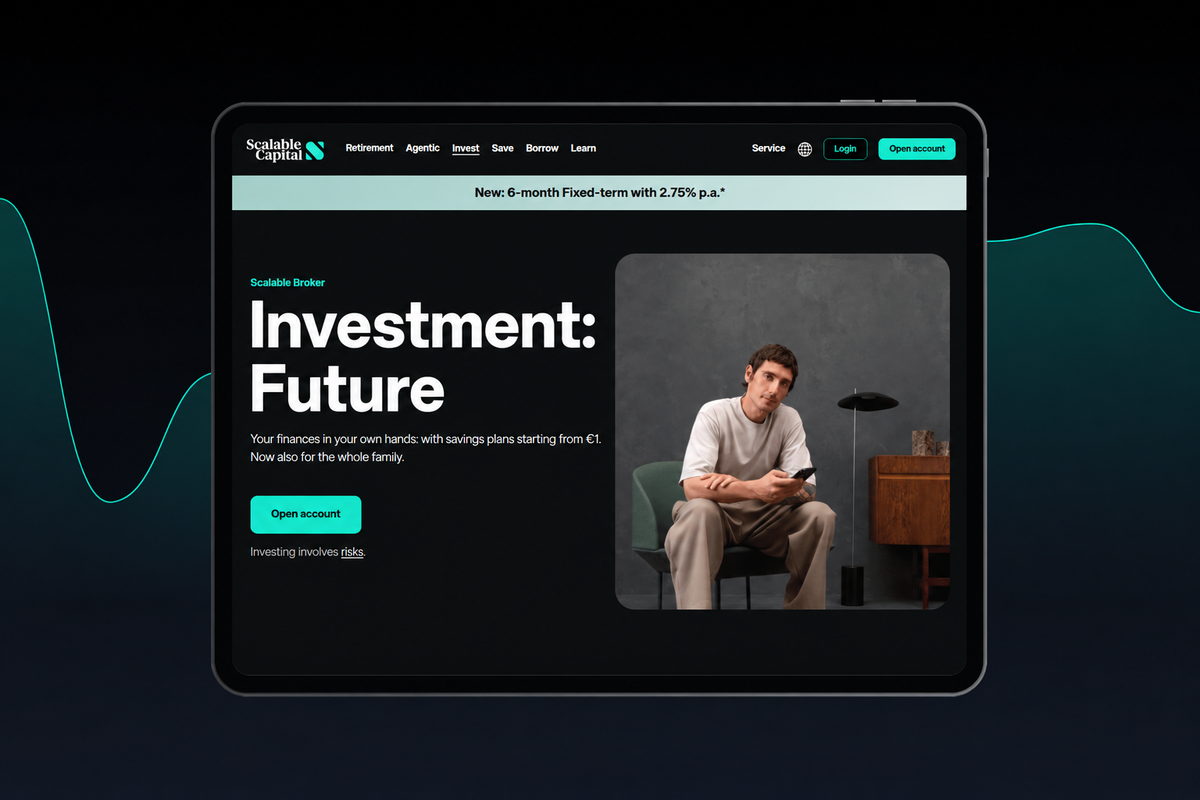
Scalable is more focused on investing. It offers two plans (FREE and PRIME+), the EIX trading venue it set up with the Hanover Stock Exchange, a 2.60% Overnight account, fixed-term deposits and a Kid's account. It also lets you connect an AI agent such as ChatGPT or Claude to your account. For a full breakdown, read our Scalable Capital review.
Scalable Capital pros and cons
Pros
- ETF purchases from Amundi, iShares, Vanguard and Xtrackers free from €250 on the free plan
- PRIME+ flat rate: €0 on every trade from €250
- Orders executed on a regulated exchange (EIX)
- Fixed-term accounts with 2.75% (6 months) or 3% (12 months)
- Up to 5 x €100,000 deposit guarantee with PRIME+
Cons
- Only available in six countries
- Cash in the broker account earns 0% until you move it to the Overnight account
- No debit card, no real crypto and no direct US market access
Fees
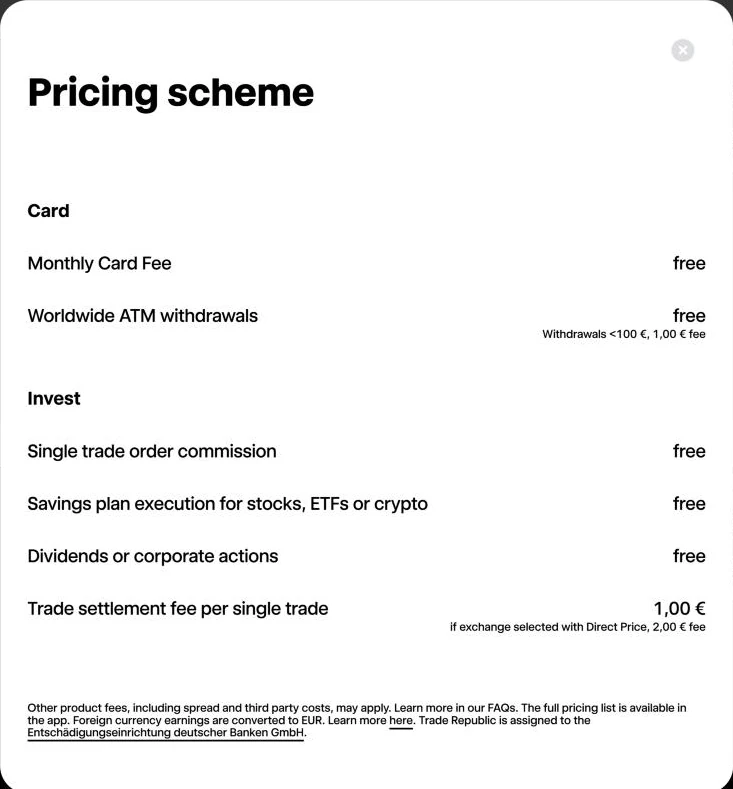
Both brokers charge no custody, account or inactivity fees, and both make savings plans free. The difference is in single orders.
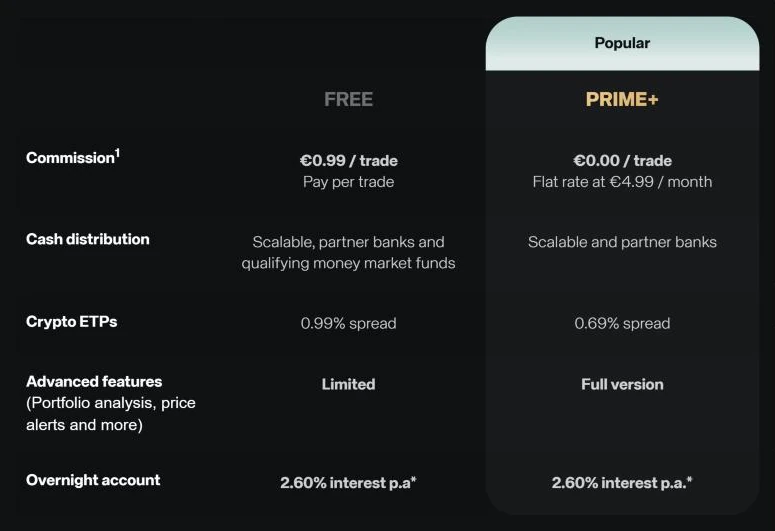
Sources: Trade Republic pricing scheme and Scalable List of Prices and Services, Netherlands, October 2026. PRIME ETFs are all ETFs from Amundi, iShares, Vanguard and Xtrackers. Spreads and product costs may apply at both brokers.
What does this mean in euros? Here is the monthly cost for four common investors:
Order fees only, based on the price lists above (October 2026). Excludes spreads and product costs.
The two are almost level for small or occasional trades: €1 against €0.99. Scalable pulls ahead in two cases. If you buy ETFs from the big four providers in one go, it costs nothing on the free plan. And if you trade six or more times a month, PRIME+ is cheaper than paying per order at either broker.
One cost both brokers keep quiet about is currency conversion. Both accounts are in euros, and dividends paid in dollars are converted at a reference rate plus a markup that neither broker publishes as a fixed number.
Where your orders are executed
Since July 2026 the EU no longer allows brokers to be paid for sending orders to a market maker (payment for order flow). Both brokers changed how they execute orders, in different ways.
- Trade Republic Best Price: an algorithm compares quotes on Xetra, Euronext, Nasdaq and other reference exchanges and fills your order at the best price, with Trade Republic as the counterparty. If you want to choose the exchange yourself (around 30 venues, including NYSE and Nasdaq in USD), you use Direct Price for €2.
- Scalable EIX: your order goes by default to the European Investor Exchange, a segment of the Hanover Stock Exchange, where Scalable Capital Bank and mwb fairtrade act as market makers. You can also pick gettex or Xetra for up to €1.99.
On weekdays, Trade Republic trades from 7:30 to 23:00 and EIX from 6:00 to 23:00. For a long-term ETF investor, the price you get is close to the main market in both cases. The practical difference is that Trade Republic gives you access to US exchanges in dollars, while Scalable only trades in euros on German venues.
Interest on cash
Both brokers pay interest above most banks, but in different ways.
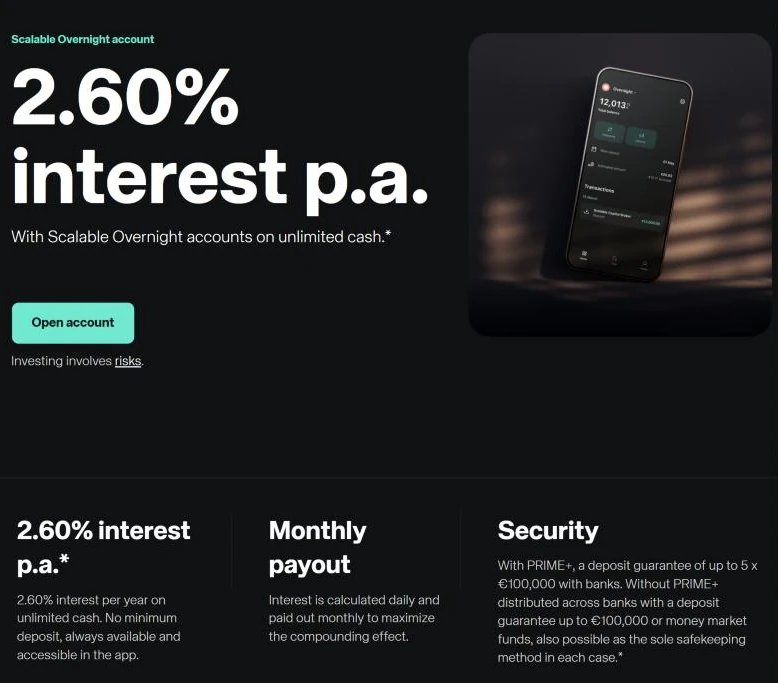
Sources: Trade Republic interest (standard rate since 16 September 2026), Scalable Overnight account and Scalable Fixed-term account. Variable rates, October 2026.
Example: you keep €10,000 in cash for a year at current rates.
- Trade Republic, existing client: about €253.
- Trade Republic, new client at 3%: about €304, as long as the new client offer applies.
- Scalable Overnight account: about €263.
- Scalable 12-month fixed-term account: €300, locked for the full year.
The rates are close. The bigger difference is convenience. At Trade Republic, every euro in your account earns interest automatically and you can spend it with the card. At Scalable, cash in the broker account earns nothing until you move it to the Overnight account, although that takes a few seconds in the app.
If you hold more than €100,000 in cash, look at how it is protected. Trade Republic spreads cash across several partner banks (each covered up to €100,000) and may place higher balances in money market funds. With PRIME+, Scalable spreads your cash across up to five banks, for up to 5 x €100,000 under statutory deposit guarantees. For more options, see our savings accounts comparator.
Regulation and safety
Sources: Trade Republic fund protection, Scalable security and Entschädigungseinrichtung deutscher Banken. October 2026.
On safety, the two are on the same level. Both are German banks with the same supervisors (BaFin and the Bundesbank), the same deposit guarantee rules and the same investor compensation scheme. In both cases your securities are kept separate from the bank's own assets, so they remain yours if the broker fails. Neither lends out client securities.
The most common complaint about both is slow customer support at busy times. Scalable also reported a data breach in October 2020. You can read more in our article on whether Trade Republic is safe.
Products
Trade Republic product counts from our Trade Republic review (October 2026). Sources: Trade Republic and Scalable Broker, October 2026.
For an ETF portfolio, both have everything you need. If you want to buy a world ETF, an S&P 500 ETF or a bond ETF, you will find it at both. Our guide to the best European brokers for ETFs explains how to choose one.
The main product difference is crypto. Trade Republic sells real crypto that you own and can send to an external wallet, and you can trade it 24/7. Scalable only offers crypto through ETPs, which trade like ETFs during exchange hours and carry a spread surcharge plus the ETP's own annual cost.
Savings plans
This is where the two brokers are most alike. Both let you invest automatically from €1, with no order fee, in ETFs, stocks and crypto.
Example: you invest €200 a month in an MSCI World ETF for 20 years. That is 240 executions, which cost €0 at both brokers. At a broker charging €1 per order, you would pay €240 in total.
Trade Republic adds two ways to feed your plan: Round up (spare change from card payments) and Saveback (1% of card spending, up to €15 a month, if you invest at least €50 a month). Scalable has no card, so its plans are funded from your account or by direct debit.
Taxes
Both brokers withhold German tax automatically for German residents. In other countries the picture is different:
- Trade Republic has local branches in several countries and offers pre-filled tax reports. In the Netherlands, for example, it advertises automatically pre-filled tax declarations, and in France it offers a PEA.
- Scalable handles tax in Germany, in Italy since September 2026 (regime amministrato) and in Austria since October 2026 (KESt for new clients). In France, Spain and the Netherlands it provides an annual tax report but does not withhold local tax.
Tax rules depend on your country and situation. Check what each broker offers where you live before you choose.
App and extra features
Sources: Trade Republic, Scalable Kid's account and Scalable Agentic Investing, October 2026.
Both apps are clean and easy to use. Trade Republic feels more like a bank: one balance, a card, interest and investments in the same view. Scalable feels more like an investing tool, with portfolio analysis, price alerts and the option to let an AI assistant analyse your holdings or prepare orders, which you then approve.
Which one should you choose?
The answer depends on what you do with your money.
Choose Trade Republic if:
- you want interest on all your cash without moving it around
- you want a debit card that invests part of your spending
- you want real crypto or access to US exchanges
- you live outside Germany, Austria, France, Italy, Spain and the Netherlands
Choose Scalable Capital if:
- you buy ETFs from Amundi, iShares, Vanguard or Xtrackers in amounts of €250 or more
- you trade six or more times a month and want a flat rate
- you prefer orders executed on a regulated exchange
- you hold a large cash balance and want up to 5 x €100,000 deposit protection
If you only run a monthly ETF savings plan, both are free and both are safe. In that case, pick the one whose extras you will actually use. Many investors keep both: one for cash and card, the other for investing. Want to see other options? Read our comparison of Trading 212 vs Trade Republic or our list of the best trading platforms in Europe.
Frequently asked questions
Is Trade Republic or Scalable Capital cheaper?
For savings plans, both are free. For single trades, Trade Republic charges €1 and Scalable €0.99 on the free plan. Scalable is cheaper for ETF purchases of €250 or more from Amundi, iShares, Vanguard and Xtrackers (€0), and for anyone placing six or more trades a month with PRIME+ (€4.99 flat).
Which pays more interest, Trade Republic or Scalable Capital?
Scalable pays 2.60% in its Overnight account and Trade Republic 2.50% on your balance. New Trade Republic clients get 3% on up to €50,000. Scalable also offers fixed-term accounts at 2.75% for 6 months and 3% for 12 months.
Is Scalable Capital as safe as Trade Republic?
Yes. Both are German banks supervised by BaFin and the Bundesbank, with the same €100,000 deposit guarantee per bank and €20,000 investor compensation. Your securities are held separately from the bank's assets at both.
Can I use both brokers at the same time?
Yes. Both accounts are free to open and have no minimum deposit, so many investors use Trade Republic for cash and card spending and Scalable for ETF investing, or the other way round.
Is Trade Republic risky?
As a company, Trade Republic is a regulated German bank, and client securities are segregated. The main risks come from the investments themselves: stocks, ETFs and especially crypto and derivatives can lose value.
Can I transfer my portfolio from Trade Republic to Scalable Capital?
Yes. Scalable charges €0 for securities transfers, plus any third-party costs, and Trade Republic shows its own conditions in the app. You request the transfer at the broker that will receive the securities. Check with both brokers how your purchase prices are carried over, since this matters for tax.
Disclaimer: this article is for information purposes only and does not constitute financial advice. Fees, interest rates and features were checked on the Trade Republic and Scalable Capital websites in October 2026 and can change. Conditions can differ by country. Investing involves risk, and you may get back less than you invest. Crypto and derivatives carry high risks.