Vanguard FTSE Global All-Cap ETF (VGLA/VALL): full review in 2026




On 20 August 2026, Vanguard launched what many European investors consider the ETF that was missing in Europe: the Vanguard FTSE Global All-Cap UCITS ETF (ticker VGLA on Xetra and VALL on most other exchanges). With a single product, you get exposure to an index of more than 10,000 companies worldwide, from large caps down to small caps, across developed and emerging markets, for an annual cost of just 0.07%.
For reference, the popular VWCE (Vanguard FTSE All-World), for years the "default" ETF for many European investors, charges 0.14% per year and does not include small caps. The new ETF is, in practice, the European (UCITS) version of the famous US-listed VT, the go-to ETF of the Bogleheads community.
In this review, we explain what VGLA is, how it compares with VWCE and WEBN, where you can buy it in Europe and what to keep in mind before investing.
Update, September 2026: Vanguard has now published the fund's first holdings and the ETF reached around €1.9 billion in assets in just over a month. We have updated the figures throughout the article.
What is the Vanguard FTSE Global All-Cap UCITS ETF?
It is a passively managed ETF (Exchange-Traded Fund) that tracks the FTSE Global All Cap Index, a market-capitalisation weighted index composed of large, mid and small cap stocks of companies globally, covering approximately 98% of the world's investable equity market.
| Characteristic | Detail |
|---|---|
| Name | Vanguard FTSE Global All-Cap UCITS ETF (USD) Accumulating |
| ISIN | IE000VAHT5T0 |
| Tickers | VGLA (Xetra, EUR); VALL (Euronext Amsterdam and Borsa Italiana in EUR, LSE in GBP, SIX in USD); VALU (LSE, USD) |
| TER | 0.07% per year |
| Index | FTSE Global All Cap Index (~10,000 stocks) |
| Distribution policy | Accumulating |
| Replication | Physical (representative sampling) |
| Domicile | Ireland (Vanguard Funds plc, UCITS structure) |
| Inception date | 18 August 2026 (trading on exchanges since 20 August) |
| Base currency | USD |
| Stocks held by the fund | 6,429 (as of 31 August 2026) |
| Assets under management | ~€1.9 billion (as of 24 September 2026) |
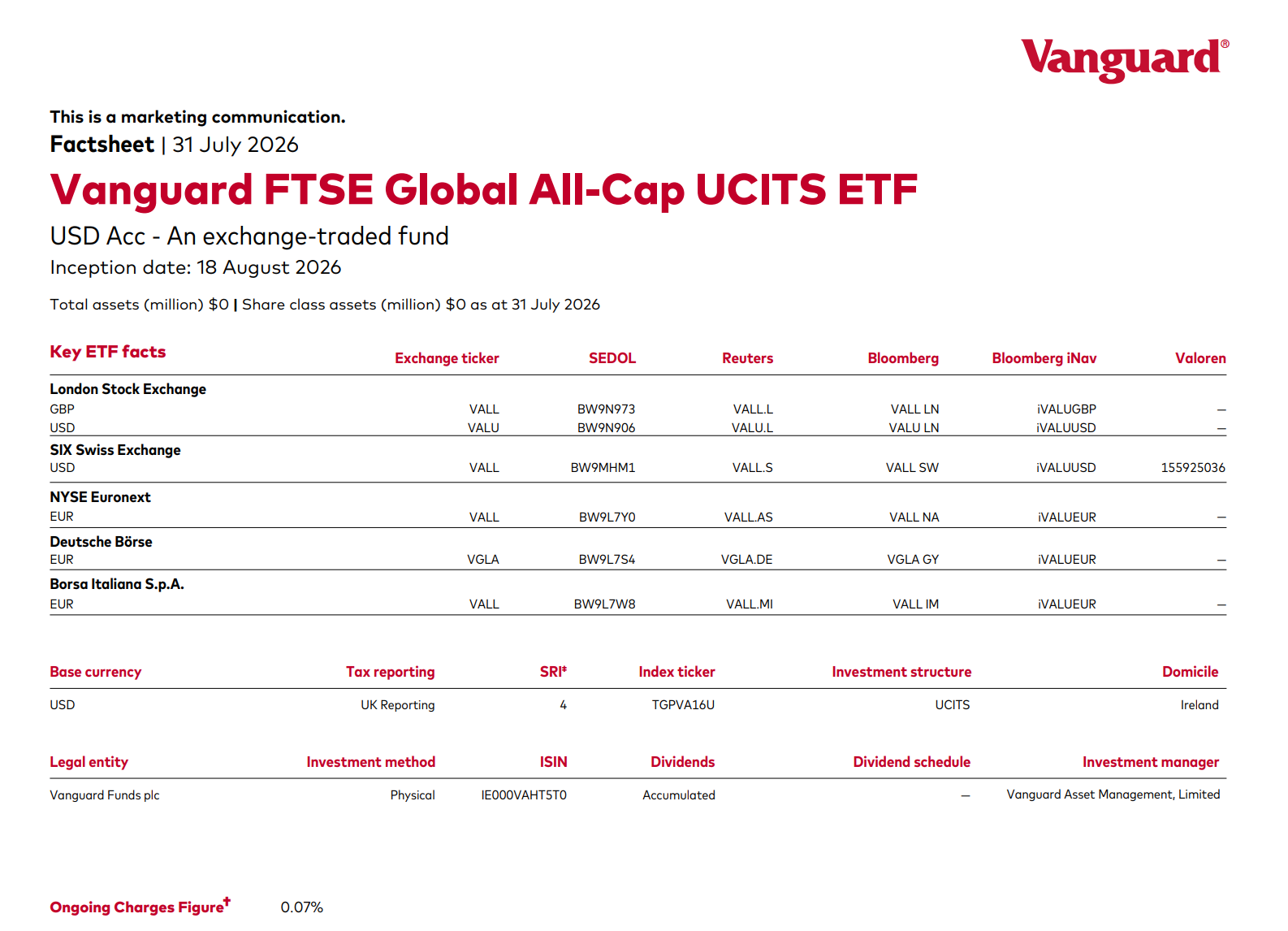
TER stands for Total Expense Ratio, the fund's total annual cost, which is already reflected in the daily price. You never pay it separately. You can confirm all of this on the official ETF page and in the ETF factsheet.
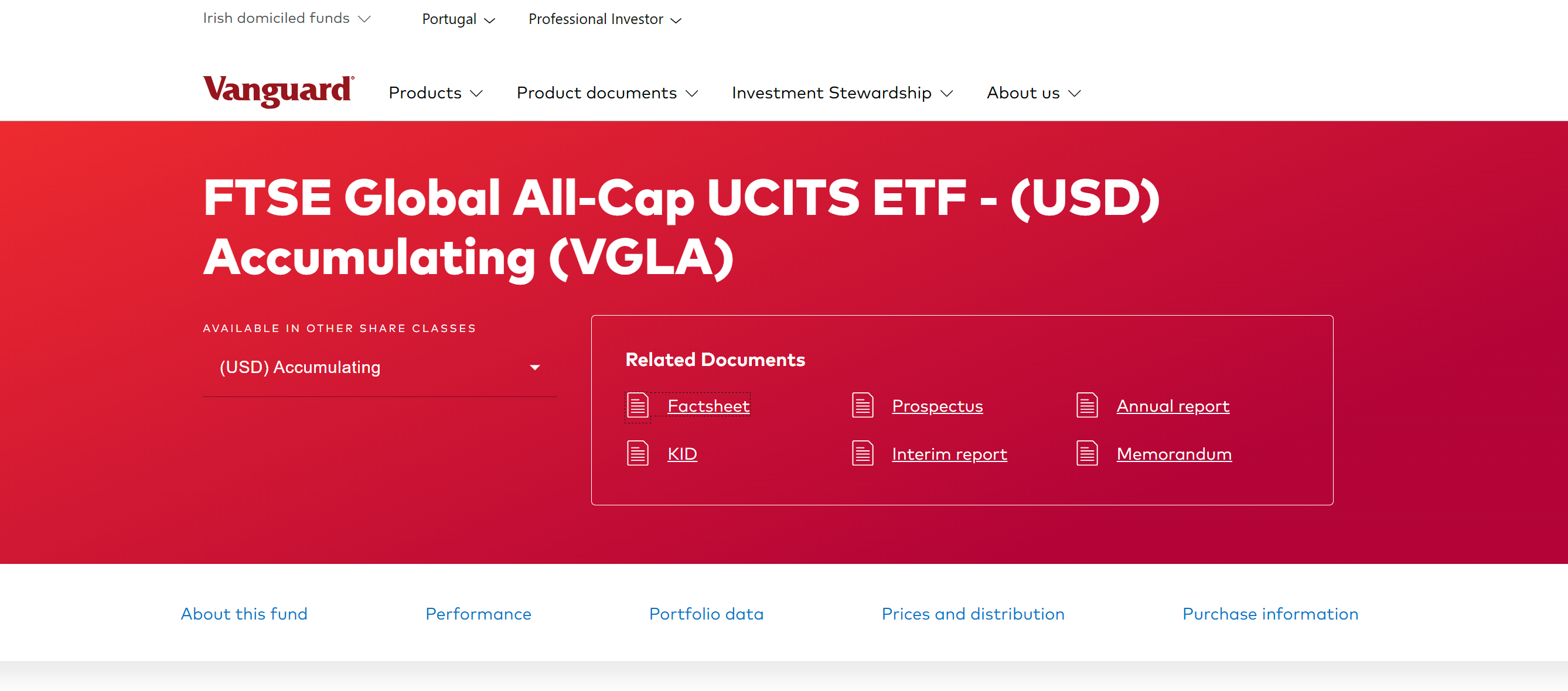
One important note about the base currency: the "USD" in the ETF's name refers only to the currency in which the fund is accounted internally, not the currency you buy it in. The ETF is listed in euros on Xetra, Euronext Amsterdam and Borsa Italiana, in pounds on the London Stock Exchange and in dollars on SIX, so you can simply buy the line quoted in your own currency. Your currency exposure comes from the stocks inside the fund and would be exactly the same if the base currency were the euro.
There is also a distributing share class (ISIN IE000CVUM3N6), with dividends paid quarterly, and the prospectus provides for a currency-hedged class (0.10%) that has not been listed yet. For most long-term investors in Europe, the accumulating class tends to be the most efficient option, because dividends are automatically reinvested inside the fund without passing through your hands (and, in most countries, without triggering yearly dividend taxes).
The index: FTSE Global All Cap
The big difference between this ETF and the vast majority of global ETFs available in Europe lies in the index it tracks.
The FTSE All-World (used by VWCE) includes "only" large and mid cap companies: around 3,800 stocks representing roughly 90% of the investable market.
The FTSE Global All Cap goes further and adds small caps. According to the FTSE Russell index factsheet, with data as of 31 July 2026, the index had 10,127 stocks, of which 5,862 were small caps, weighing around 9% of the total.
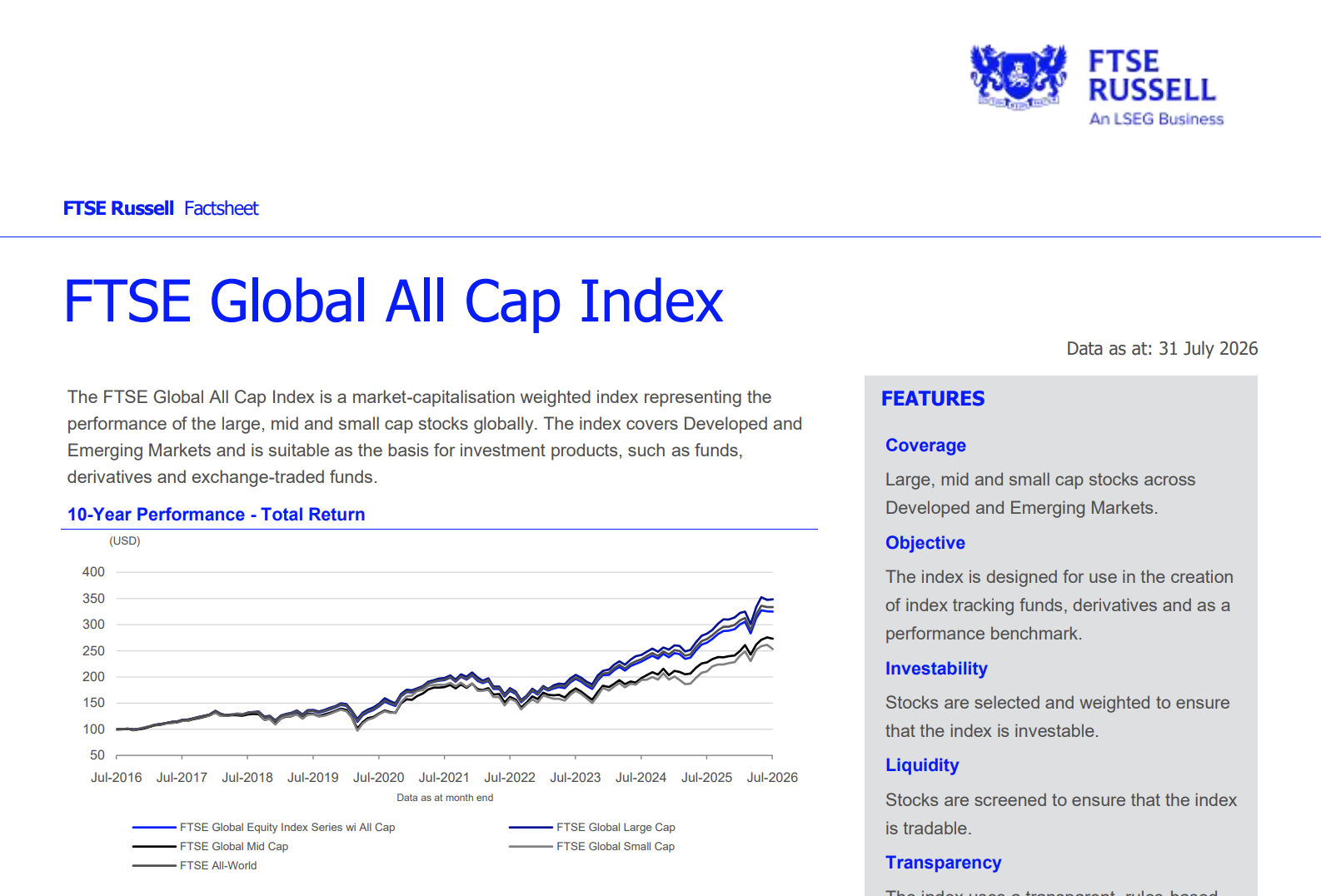
A few numbers that help you understand what you are actually buying (index data as of 31 July 2026):
- The US represents around 62% of the index and Japan is the second largest country, at around 6%;
- The top 10 holdings weigh around 21.6% of the total, with Nvidia as the largest position (around 4.1%);
- Technology is the largest sector, at around 31.6% of the index;
- Thousands of smaller companies that never make it into the traditional flagship indices are included.
In practice, with a single ETF you are exposed to virtually the entire global stock market: the US, Europe, Japan, emerging markets and the small cap segment on top.
It is worth keeping expectations realistic: because the index is weighted by market capitalisation, small caps are a small slice of the total (around 9%). The impact on performance will be marginal in most periods. The case for the fund is mainly one of diversification and simplicity: you no longer need to bolt a separate small cap ETF onto your portfolio to get near-total market coverage.
What is inside the ETF
Vanguard has now published the fund's first holdings on the official ETF page. As of 31 August 2026, VGLA held 6,429 stocks, well below the roughly 10,000 in the index. This is because the ETF uses sampling: it buys a representative selection of the index and leaves out many of the smallest and least liquid companies, whose individual weight is minimal. The aim is to track the index's performance with lower transaction costs. VWCE follows the same approach.
As of 31 August 2026, the fund's composition closely matches the index:
- The US weighs 61.93%, followed by Japan (5.94%), Taiwan (3.27%), the UK (3.24%) and Canada (3.08%)
- Nvidia is the largest holding (4.37%), followed by Apple (3.89%), Microsoft (3.20%) and Amazon (2.14%)
VGLA vs VWCE vs WEBN: which one to choose?
This is the comparison everyone wants to see. These three ETFs are the most talked-about options for buying "the whole world" in a single product:
| Criteria | VGLA/VALL | VWCE | WEBN |
|---|---|---|---|
| Provider | Vanguard | Vanguard | Amundi |
| Index | FTSE Global All Cap | FTSE All-World | Solactive GBS Global Markets |
| Number of stocks (index) | ~10,000 | ~3,800 | ~3,500 |
| Small caps | Yes | No | No |
| Market coverage | ~98% | ~90% | ~85-90% |
| TER | 0.07% | 0.14% | 0.07% |
| Track record | Since August 2026 | Since 2019 | Since 2024 |
| Fund size (AUM) | ~€1.9 billion | ~€53 billion | ~€3.1 billion |
AUM (Assets Under Management, the total assets held) figures refer to each ETF's accumulating share class, using Trackinsight data from 23 and 24 September 2026.
VGLA got off to a very strong start: according to Banker on Wheels, the ETF passed $1 billion in two weeks and $2 billion in its first month, Vanguard's best launch ever worldwide. Outside Vanguard, the main all-cap alternative in Europe is the SPDR MSCI ACWI IMI (SPYI), which charges 0.17% per year.
In theory, VGLA is the most complete product: more diversification at a lower cost, from the most reputable index fund manager in the world. In practice, two points justify some caution in the first months:
- Liquidity and spreads. A newly launched ETF has lower trading volumes, which can translate into slightly wider spreads (the difference between the buy and sell price). These tend to normalise quickly as AUM grows and interest has been enormous, with around €1.9 billion gathered in the first month.
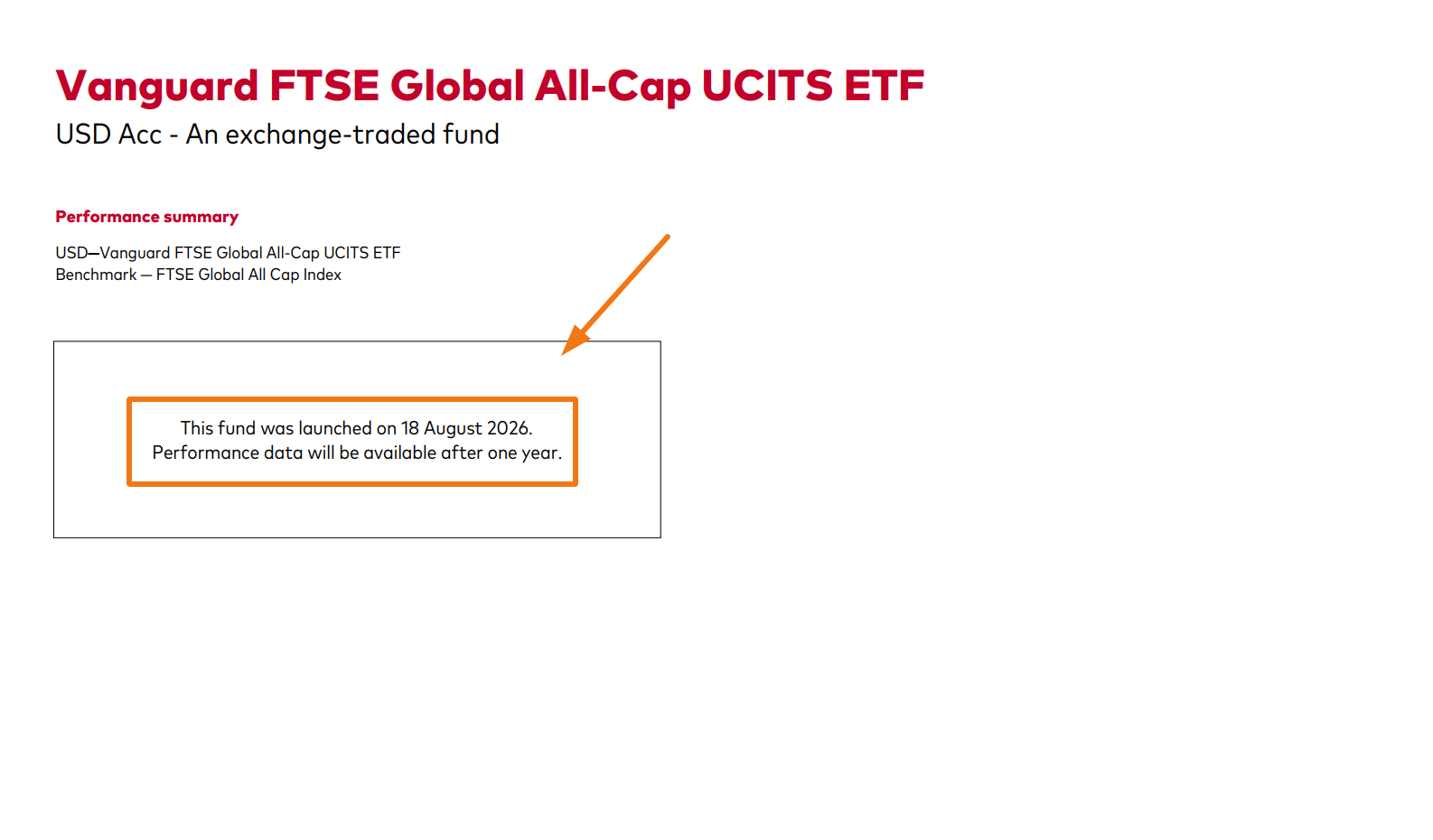
- Tracking record. There is no tracking difference history yet (the real gap between the ETF's performance and the index). The TER is not the only cost that matters: replication quality, securities lending and the fund's internal tax management also count. That said, Vanguard's track record with VWCE and with the equivalent UK index fund is reassuring.
What if you already own VWCE?
If you already invest in VWCE, selling to switch ETFs means realising capital gains and, in most European countries, paying tax on them, which would likely wipe out the 0.07% annual saving for many years. For most investors, the more rational decision is to keep the accumulated VWCE position and simply direct new money to VGLA, if they prefer the new product. There is nothing wrong with VWCE: it remains an excellent ETF and, after the TER cut to 0.14% in July 2026, the cost gap has narrowed considerably. If you are still weighing up the classic global indices, see our VWCE vs IWDA comparison.
The two other ETFs launched the same day
VGLA did not arrive alone. On the same day, Vanguard launched two more global ETFs: the FTSE Global Small-Cap UCITS ETF, holding only small caps from around the world with a 0.22% TER, and the FTSE All-World ex-US UCITS ETF, which tracks the FTSE All-World without US companies, with a 0.12% TER. They suit investors who prefer to build their portfolio in modules, for example to control their US weight. For anyone looking for a single ETF, VGLA remains the simplest option.
Where to buy VGLA in Europe?
The ETF is listed on five exchanges: Xetra (VGLA, in euros), Euronext Amsterdam and Borsa Italiana (VALL, in euros), the London Stock Exchange (VALL in GBP and VALU in USD) and the SIX Swiss Exchange (VALL, in USD). To avoid currency conversion costs, buy the line quoted in your own currency, which for most eurozone investors means the Xetra, Amsterdam or Milan listings.
The ETF is already available at the main brokers used by European investors:
- Interactive Brokers: already available. It offers the widest exchange coverage and is usually among the cheapest brokers for ETFs. Read our full Interactive Brokers review;
- Trading 212: already available, with 0% commissions. See our Trading 212 review;
- Lightyear: already available, with no ETF execution fees. See our Lightyear review;
- Trade Republic: already available, including for savings plans. See our Trade Republic review;
- DEGIRO and XTB: already available at both. If you cannot find the ETF by its ticker, search by the ISIN IE000VAHT5T0. See our reviews of DEGIRO and XTB.
If you do not have a broker yet, compare the most popular options in our guide to the best European brokers for ETFs.
Tax efficiency for European investors
As an accumulating, Irish-domiciled ETF, VGLA is a tax-efficient vehicle for most European investors:
- While you hold it, you receive no dividends, so in most countries there is no yearly dividend tax to pay or declare. Dividends from the underlying stocks are reinvested inside the fund;
- The Irish domicile means the fund benefits from the US-Ireland tax treaty, paying a reduced 15% withholding tax on dividends from US stocks (instead of 30% for many other domiciles), which improves long-term returns;
- When you sell, capital gains are taxed under your country's rules. These vary widely across Europe (and a few countries, such as Germany with its Vorabpauschale, do tax accumulating funds annually), so check how your local regime treats accumulating UCITS ETFs.
Pros and cons
Pros
- 0.07% TER, the lowest ever for a global ETF with small caps in Europe
- Maximum diversification: around 98% of the world market in a single product, with more than 6,400 stocks in the portfolio
- Accumulating: tax-efficient for most long-term European investors
- Vanguard: decades of reputation in low-cost indexing and a history of successive fee cuts
- Irish-domiciled UCITS structure, efficient on US dividend withholding tax
- Removes the need to combine two ETFs to get small cap exposure
Cons
- Very young fund: no tracking difference history yet
- Liquidity still building, with spreads that may be wider than on older global ETFs
- The small cap weight is modest, so the practical benefit over VWCE will be limited
- Unhedged currency exposure to the dollar and other currencies (common to virtually all global ETFs, but worth knowing)
Who is it for?
- Investors starting out now who want a single, diversified, low-cost global ETF: VGLA becomes a natural candidate, although it may make sense to wait a few weeks or months for liquidity and tracking to settle;
- Investors already holding VWCE or another global ETF: keep what you have and consider directing new contributions to VGLA;
- Investors combining a global ETF with a small cap ETF to replicate the total market: VGLA simplifies the portfolio into a single product.
If you are still getting familiar with how these funds work, start with our guide on what a UCITS ETF is.
Frequently asked questions
What is the difference between VGLA and VALL?
None: it is the same ETF (same ISIN, IE000VAHT5T0) with different tickers depending on the exchange. VGLA is the Xetra ticker and VALL is used on the other European exchanges (plus VALU for the USD line in London).
Is VGLA the same as the US-listed VT?
It is the European equivalent. Both track the same FTSE Global All Cap Index, but VT (0.06% TER) is US-domiciled and is not accessible to most European retail investors because it does not meet the PRIIPs documentation requirements. VGLA is the UCITS version, created precisely for the European investor.
Does VGLA pay dividends?
The VGLA/VALL class (IE000VAHT5T0) is accumulating: dividends are automatically reinvested. There is a separate distributing class (IE000CVUM3N6) with quarterly payouts.
Can I buy VGLA in euros?
Yes. Despite the "USD" in the name (the fund's base currency), the ETF is listed in euros on Xetra (VGLA), Euronext Amsterdam and Borsa Italiana (VALL). London offers GBP and USD lines and SIX offers a USD line.
Will VGLA replace VWCE?
Vanguard is keeping both products. Much of the new money is likely to flow into VGLA, but VWCE remains one of the largest ETFs in Europe, with around €53 billion under management in its accumulating class alone (Trackinsight data as of 24 September 2026).
How many stocks does VGLA hold?
As of 31 August 2026, the fund held 6,429 stocks, according to Vanguard. The index it tracks had 10,127 constituents as of 31 July 2026. The gap comes from physical replication with sampling: the fund buys a representative selection of the index and leaves out many of the smallest companies, whose individual weight is minimal.
Bottom line
The Vanguard FTSE Global All-Cap UCITS ETF is, on paper, the most complete global ETF ever launched in Europe: near-total coverage of the world's stock market, small caps included, at the lowest cost in its category, from the manager that practically invented low-cost index investing. For anyone following a passive, long-term strategy, it is a very strong candidate for a one-ETF portfolio. The only reason for a little patience is the fund's youth: over the first months it is worth watching liquidity and replication quality and, for anyone with an existing portfolio, selling to switch rarely pays off.
This article is for informational purposes only and does not constitute financial advice.