Maclear review: an independent analysis of the Swiss crowdlending platform




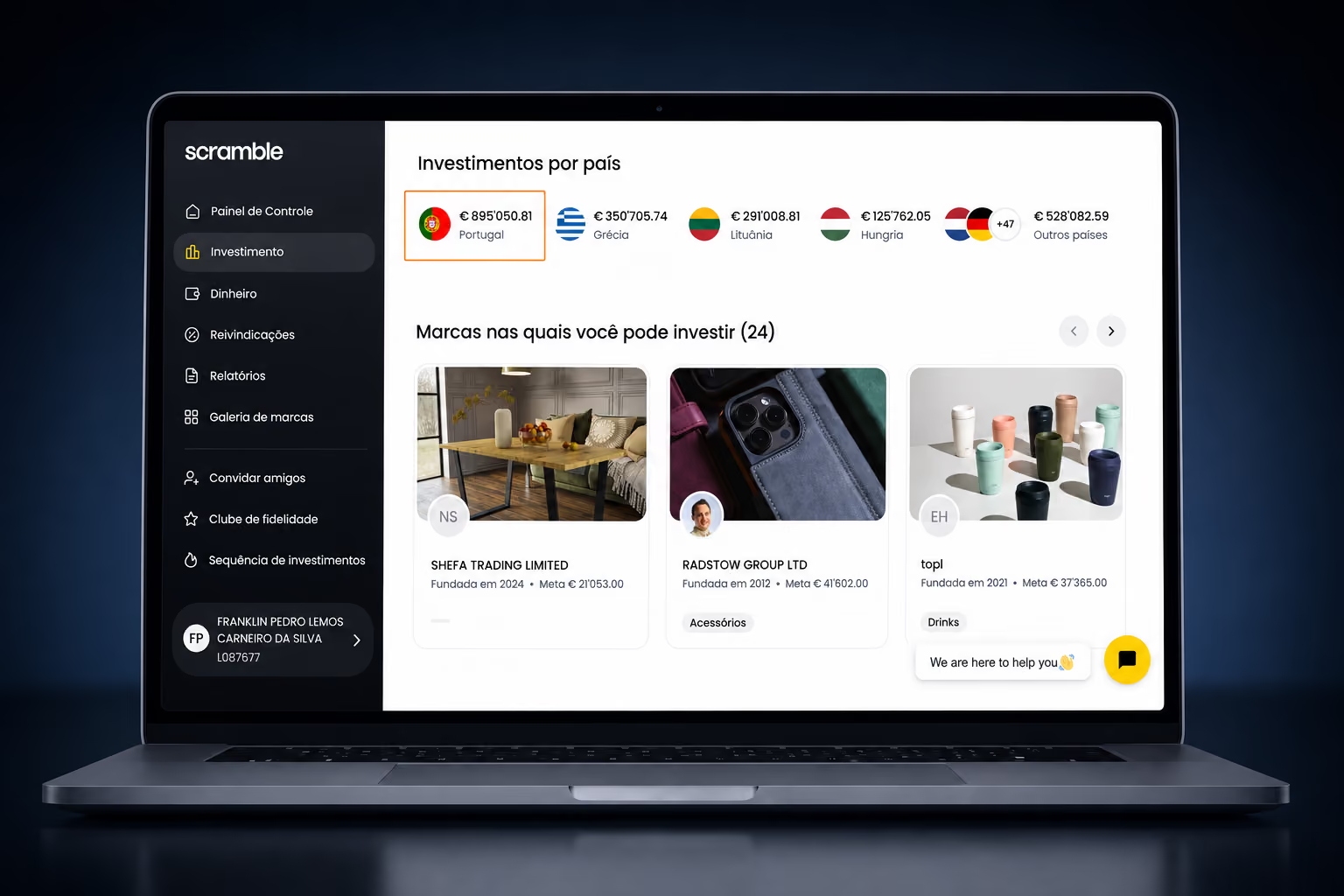
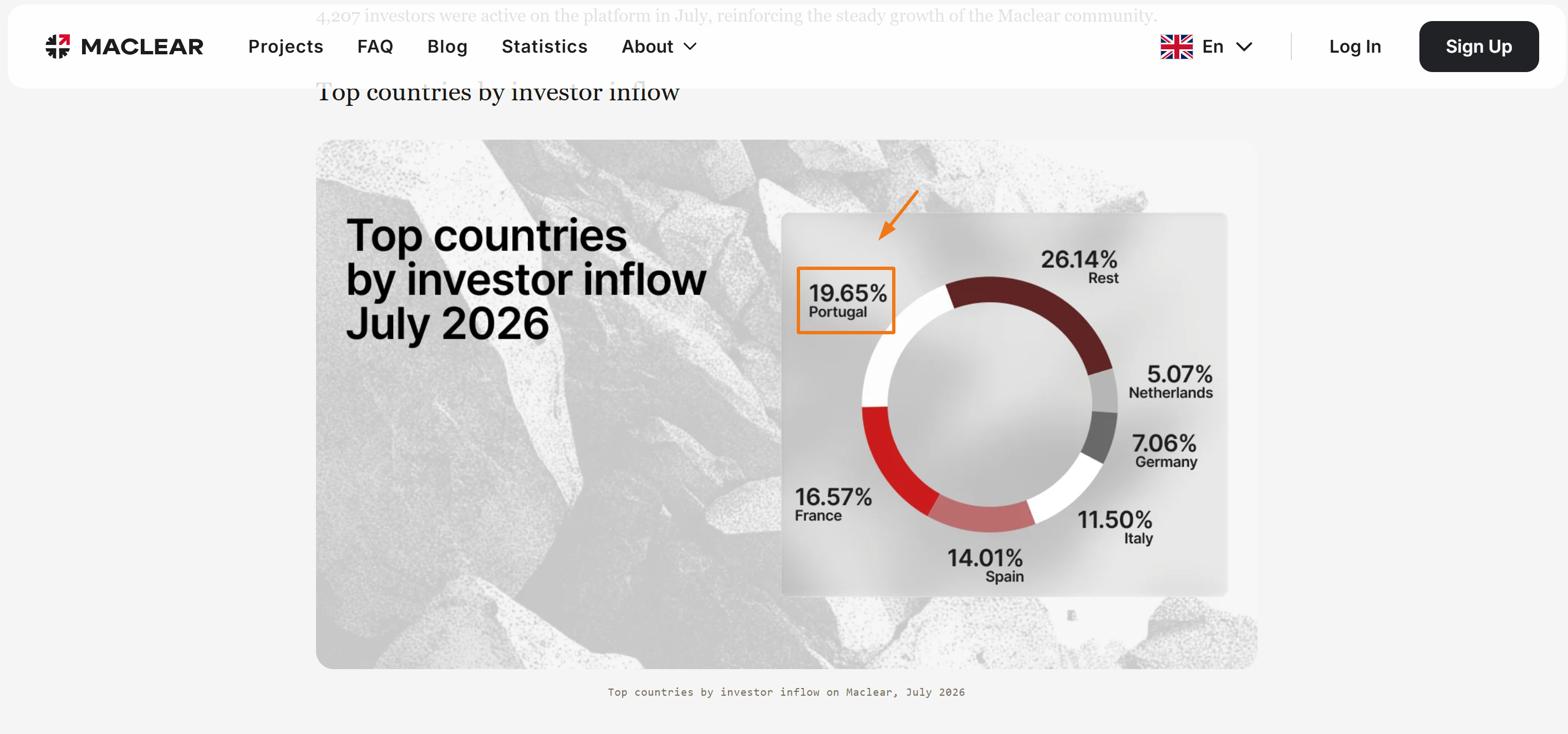
After our Scramble review, it is Maclear's turn - another business lending (crowdlending) platform that has been heavily promoted by finfluencers across Europe. And the numbers show the message is landing: according to the platform itself, Portugal was the third country by number of investors in 2025 (21% of the total) and, in July 2026, became the first country in new investors, with almost a fifth of all new accounts:
The central argument in all the videos is always the same: "it is a Swiss platform, regulated, audited and with guarantees".
To understand what this means in practice, we went and read the terms, the internal policies, the PolyReg registration, the 2024 annual accounts and the independent reviews already published in other countries.
In this article we explain what Maclear is, how it works, what the "Swiss regulation" really means (spoiler: much less than it seems), what the costs are, what the company's accounts say, what the real risks are, and we fact-check the main claims made in the videos.
Warning: we looked into some of the companies with open projects on Maclear. We found signs that call for caution: their websites were created in 2026, weeks before the fundraising campaigns, all with the same hosting provider. We were unable to independently confirm the activity described for any of them. Before investing, check the company yourself in the commercial registry. If you have relevant information, contact us with more details. We will keep updating this article.
What is Maclear?
Maclear is a crowdlending platform operated by Maclear AG, a public limited company registered in Switzerland (UID CHE-115.674.165, headquartered in Wallisellen, in the canton of Zurich). The company has existed since 2010, but it was acquired in 2020 by the current shareholders and the lending platform only began operating in 2023. According to independent reviews, the two shareholders (50% each) have no connection to Switzerland and the operation is managed from the Baltic countries.
The concept: retail investors finance loans to small and medium-sized companies, mostly from Eastern Europe, at advertised rates of roughly 13% to 16.5% per year, with monthly interest and repayment of the capital at the end of the term (typically between 6 and 18 months).
According to the figures published by Maclear itself (not audited by third parties), the platform has already intermediated more than €133 million, has more than 47,000 registered investors and has financed almost 2,000 projects. The growth is recent and very fast: 93 projects were financed in 2024, 886 in 2025.
How it works in practice
- You register, complete identity verification (KYC through Sumsub) and deposit by bank transfer.
- You pick individual projects on the primary market (€50 minimum per project). Each project has a rate, a term, an internal rating (from AAA to D), financial ratios and a description of the collateral.
- You receive monthly interest and the capital at the end of the term. There is a secondary market where you can try to sell your position to another investor.
- If the borrower is late, a "provision fund" covers the interest from the 3rd day. At 30 days an amicable collection process begins, and at 60 days Maclear moves to enforce the collateral.
.png)
Just like at Scramble, you have no direct contract with the financed company. Maclear signs the loan agreement with the borrower and then assigns part of the credit to you through a Claims Purchase and Assignment Agreement. Users are anonymous to each other, and Maclear acts as collection agent and security agent on behalf of all investors.
In the Terms and Conditions, Maclear expressly states that it does not grant loans and is not a bank. Curiously, as we will see in the accounts section, the balance sheet says otherwise.
.png)
Regulation and safety: what does "Swiss-regulated" mean?
This is the most important section of the article, because it is here that the communication around Maclear is most ambiguous.
Maclear AG is a member of PolyReg Services GmbH, a self-regulatory organisation (SRO) recognised by FINMA (the Swiss financial supervisor) under article 24 of the Swiss anti-money laundering law. The membership dates from May 2022 and can be confirmed in the public PolyReg register. This is true and verifiable.
The problem is what gets concluded from there. An SRO like PolyReg supervises only compliance with anti-money laundering rules: client identification (KYC), origin of funds, suspicious transaction reports, documentation. It does not supervise the platform's financial soundness, the quality of the credits, the accuracy of the project information or investor protection. It is neither prudential supervision nor conduct supervision. In practice, it is the same kind of framework that applies to currency exchange offices, fiduciaries and payment service providers in Switzerland. If you want to see what each type of authority actually supervises, we mapped them in our guide to financial regulators in Europe.
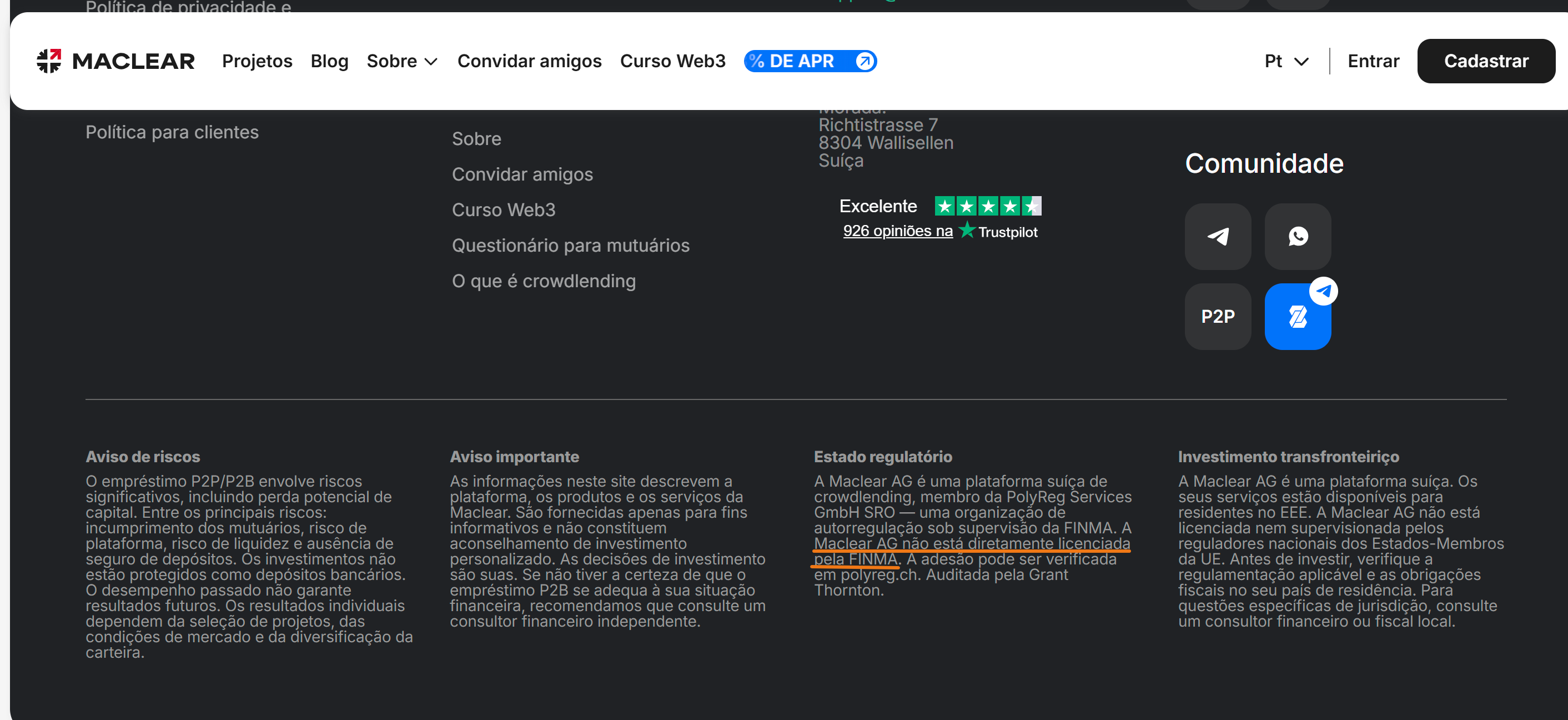
Maclear itself acknowledges this in the website footer and on its FAQ page about regulation: Maclear AG is not directly licensed or supervised by FINMA, it is not a bank, funds are not covered by the Swiss deposit guarantee (esisuisse) and the company is not licensed or supervised by any national regulator in the European Union either. In other words, no European authority supervises it.
The contradiction between the homepage and the footer
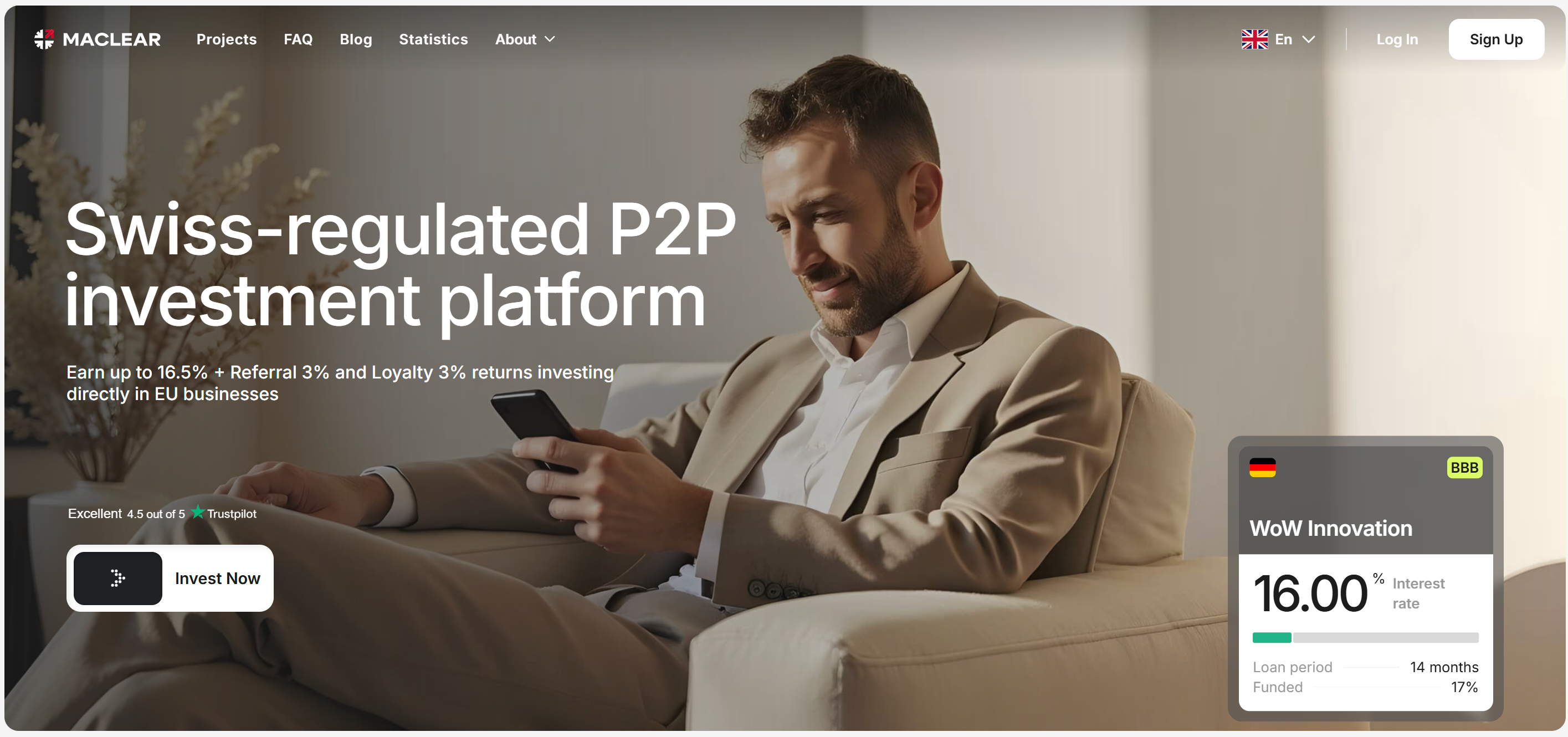
This is, for us, the most problematic point in Maclear's communication. The homepage headline says "Swiss-regulated P2P investment platform":
.png)
The footer of the same page says that "Maclear AG is not directly licensed by FINMA". In a strictly literal sense, the first sentence is defensible: the company is subject to Swiss anti-money laundering law through PolyReg. But anyone reading "Swiss-regulated investment platform" understands that there is a Swiss financial regulator supervising the platform and its investments - and that is exactly what does not exist. The correct information is there, but in the footer, in small print.
FINMA itself has publicly warned about this type of practice: membership of a self-regulatory organisation is not a licence or FINMA supervision, and it should not be used as a marketing argument suggesting otherwise.
What this means for you:
- There is no deposit guarantee scheme.
- There is no investor compensation scheme, like the one that protects clients of regulated EU brokers up to €20,000.
- There is no prudential regulator checking capital, liquidity or the quality of the loan book.
- In case of dispute, Swiss law applies and the forum is the courts of Wallisellen.
Since 2023, any platform intermediating business loans for retail investors in the European Union needs a European Crowdfunding Service Provider (ECSP) licence, under Regulation (EU) 2020/1503, with capital requirements, investor information requirements and appropriateness tests. A platform based in Switzerland sits outside this regime.
On 11 May 2026, the Spanish regulator (CNMV) included Maclear AG and the maclear.ch website in its public warning list, for carrying on activities reserved for crowdfunding platforms without authorisation under Spanish Law 5/2015 and Regulation (EU) 2020/1503. The warning has since been entered in IOSCO's global investor alerts database, which means other regulators can pick it up. At the time of this review, no other European regulator had issued its own warning about the platform.
The platform is "exclusively" for Swiss residents
Reading the Terms and Conditions and the Internal Client Policy, we found something that deserves attention. Maclear writes that the platform "is intended exclusively for users with residence or registered office in Switzerland" and that users outside Switzerland are only accepted under "reverse solicitation" - that is, they have to declare that they discovered the platform on their own and were not targeted by Maclear's marketing. The same policy says the referral programme "works only within Swiss borders" and that no user outside Switzerland can register with a referral code.
.png)
At the same time, the website is available in Portuguese and other European languages, the platform actively communicates to EU markets, and there are welcome bonuses and referral programmes widely promoted in content aimed at those audiences.
The most benevolent reading is that these clauses are a formal mechanism for Maclear to stay within the Swiss framework. The less benevolent reading is that there is a relevant difference between what the legal documents say and what the platform does in practice. Either way, by accepting the terms you are declaring that you were not targeted by marketing - which is worth knowing.
Pros and cons
Pros
- Low minimum investment (€50 per project) and no direct fees for the investor
- Project-by-project selection, with detailed financial information, a rating and a description of the collateral
- Monthly interest and a secondary market (with limitations)
- Provision fund for late interest and Maclear as collective collection agent
- Publicly verifiable membership of a Swiss SRO and an AML compliance audit
- Monthly volume statistics published and downloadable tax reports
- Website and support in several European languages
Cons
- Supervision limited to anti-money laundering: no prudential regulator, no compensation fund, outside the European ECSP regime
- Operating company with negative equity and unaudited accounts, published with long delays
- Loans recorded on Maclear's own balance sheet, meaning it takes credit risk on its own account
- Discrepancies reported by third parties between project information and companies' official records
- Ratings assigned internally, with no external validation
- Growing concentration in loan originators from Bulgaria
- Contradiction between the terms (platform "exclusively" for Swiss residents) and the active marketing to EU countries
- Cross-promotion of a crypto platform (8lends) with 25% returns and an entity in the Caribbean
- Swiss courts as the legal forum and manual tax obligations
The "guarantees": collateral, provision fund and collection agent
Maclear presents a multi-layered protection system. It is worth separating what each layer is and is not:
| Mechanism | What Maclear says | What it is in practice |
|---|---|---|
| Collateral | Each loan is secured by company assets (equipment, real estate, inventory) | The collateral valuation is done only by Maclear. Independent reviews found, in several projects, discrepancies between the announced collateral and the assets in the companies' public accounts (see next section) |
| Provision fund | Reserve fed with 2% of each financed project, covers late interest from the 3rd day | Covers only interest, not capital. Maclear itself writes that it "is not an insurance scheme and does not guarantee full payment". At the end of 2024, the loss provision on the balance sheet was around CHF 195,000, about 2% of a CHF 9.3 million loan book |
| Security agent | Maclear enforces the collateral on behalf of all investors | Positive - it avoids each investor having to litigate alone. But it depends on the financial and operational capacity of Maclear itself, which has negative equity |
| Maclear's liability | The Collection Agreement says that "Maclear itself is liable with its corporate assets for defaults" | A promise worth as much as the company's net assets. At the end of 2024, those net assets were negative (-CHF 87,000) |
| Segregated account | Uninvested funds are held in a separate client account | Declared by the company. There is no prudential supervisor verifying it |
The Debt Collection Procedure Agreement states that "Maclear will guarantee to the investor strict compliance with all interest payment schedules", and two paragraphs later says the reserve fund "cannot guarantee full payment of interest". Contracts that guarantee and un-guarantee the same thing on consecutive pages are not a good sign of legal rigour.
How are the projects selected?
Selection and rating assignment are done exclusively by Maclear's internal models. The borrower scoring system uses a scale from AAA to D "consistent with S&P, Moody's and Fitch", combining financial ratios (debt/equity, interest coverage), qualitative factors and liquidity. It sounds sophisticated, but there is no independent entity (auditor, rating agency, trustee) validating the quality of the credits or the information published about each project. An "A" rating assigned by the very platform that profits from selling the credit is not comparable to an "A" rating from an external agency.
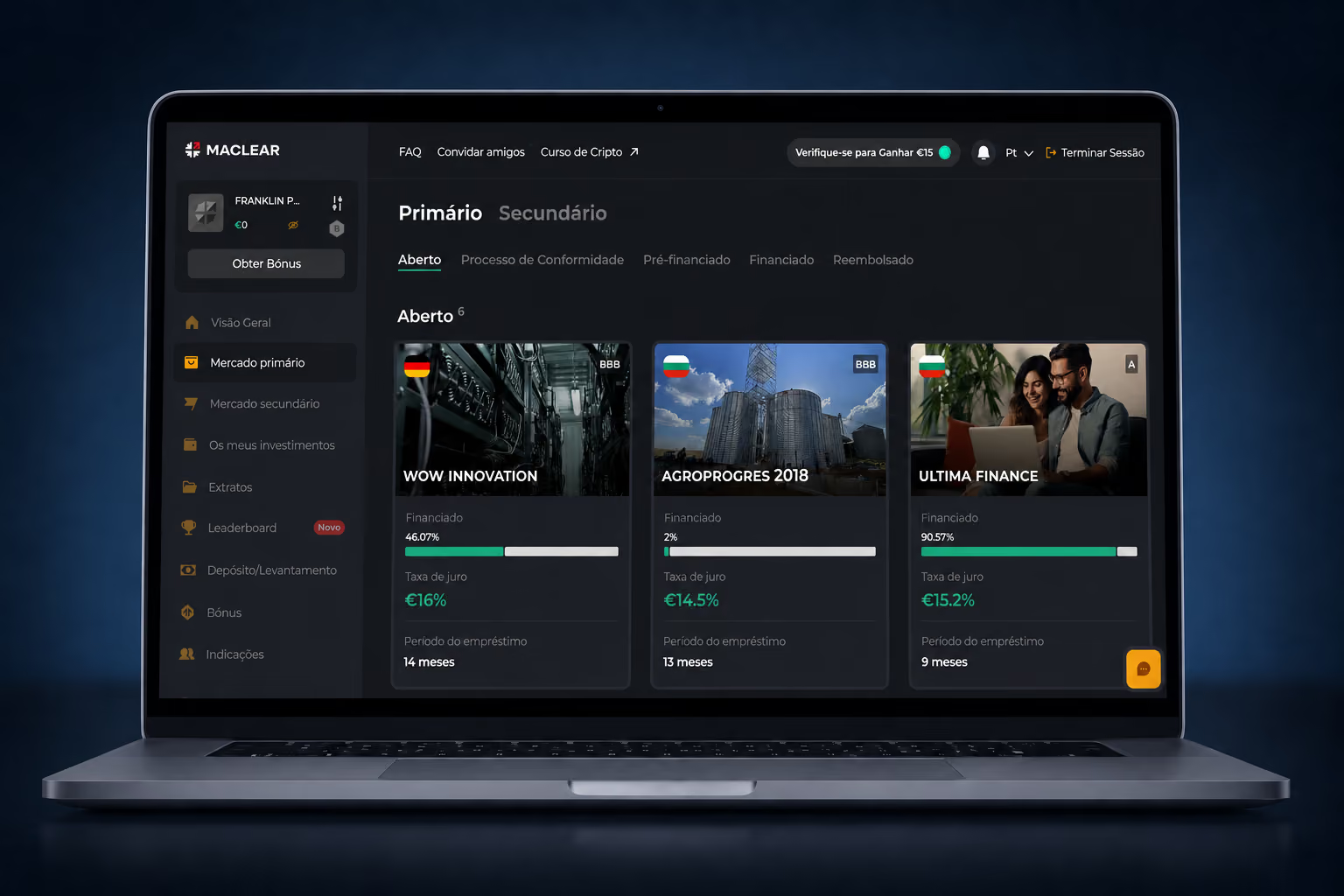
To be fair, the per-project information is extensive. We took as an example a project open in August 2026, WOW Innovation, a German Bitcoin mining company asking for €3.2 million at 16% over 14 months, in tranches. The page has dozens of pages of description, historical accounts, projections to 2028, market analysis and a detailed explanation of the collateral, including the ratios used in the risk classification. It is more than most platforms offer.
But it is also a good example of how a rating can mislead anyone who does not read the whole document: the project has a "BBB" rating (which Maclear's scale describes as "investment grade"), with debt-to-equity of 5.5, an LTV of 126% and a team of three people. The text itself admits that "once the haircuts are applied, the collateral does not fully cover the loan", that the collateral consists of fast-depreciating mining machines installed in emerging regions, and that the projection assumes the price of Bitcoin doubles by 2028. No rating agency would classify this as investment grade.
And this is where the most relevant facts we found come in. Independent P2P lending analysts, namely Germany's re:think P2P and P2P Empire, cross-checked the information of several Maclear projects against official commercial registries (Estonian and Italian) and report a pattern of discrepancies:
- An Estonian company presented with 12 employees and forecast revenues of €1.65 million would have, according to its public accounts, 1 employee and revenues of €33,000, with no fixed assets on the balance sheet despite the loan being "secured by machinery".
- A logistics company that raised almost €300,000 to buy a truck and a trailer would have, the following year, fixed assets of just €72,000, suggesting the equipment was not bought.
- In the only default acknowledged by Maclear (Italy's Vibroedil, which entered insolvency in July 2025), the financial figures published on the sister platform 8lends (revenues of €15.9 million and a profit) diverged from the official Italian records (€6.4 million in revenues and a €1.9 million loss). Maclear says investors received 100% of their capital through a private agreement.
We did not replicate all these checks company by company, but the cited registries are public and Maclear has not, to date, contested them in a documented way. If these data are correct, the conclusion is serious: the collateral and projections underpinning the internal ratings may not correspond to reality. We strongly recommend that, before investing in a project, you look up the company's accounts yourself in the commercial registry of the country in question.
Concentration in loan originators
In its first years, Maclear mostly financed small industrial and services companies. In 2025, the "Loan Originator" category (finance companies that in turn lend to third parties) already represented 22% of volume. In July 2026 it represented 42%, with a single project (a Bulgarian finance company) absorbing 36% of everything invested that month, and Bulgaria concentrating almost half of the financed volume.
In other words, you are increasingly lending money to companies whose business is lending money to others, in a model similar to the Baltic loan originator platforms, with the cascading risk that implies.
Costs and fees
For the investor, Maclear advertises zero direct costs:
| Item | Cost |
|---|---|
| Account opening | €0 |
| Deposits and withdrawals | €0 (transfer costs may be charged by your bank) |
| Investment fee | €0 |
| Minimum investment | €50 per project |
| Secondary market | Fees may apply (Maclear says it will allocate them to the reserve fund) |
The revenue model is based on a success fee charged to the borrower when the project is financed, plus the 2% retained for the provision fund. In other words, the companies pay, with the cost embedded in the rates they bear.
The platform is very generous with bonuses (welcome offers, 3% cashback in the first 90 days, €30 for every €500 invested, a loyalty programme with up to 3% extra, prize draws). In the 2024 accounts, investor bonuses and referrals cost CHF 298,000, plus CHF 235,000 in advertising, in a year when total revenue was CHF 758,000. That is a very high customer acquisition cost for a loss-making company, and it partly explains the intensity of the promotion seen in markets like Portugal.
What the accounts of Maclear AG reveal
We analysed the 2024 annual report, published on Maclear's website only in June 2026 - that is, about a year and a half after the end of the financial year. At the time of this review there are no 2025 accounts: the "2025 annual report" the platform promotes is a summary of commercial metrics (volumes, number of investors, countries), not a financial report. For a retail investor, these are the points that deserve attention:
- Unaudited accounts: the document is a version prepared by the company itself. According to re:think P2P, the CFO letter accompanying it says it is "in the final phase of audit", just as an audit of the 2023 accounts had been announced and was never published. The only Grant Thornton audit confirmed by Maclear is an AML/KYC compliance audit (November 2024), required by PolyReg. It is not an audit of the financial statements.
- Negative equity: a loss of CHF 123,000 in 2024 (CHF 118,000 in 2023) and equity of -CHF 87,000 at year-end, despite a capital increase of CHF 55,000. It is a technically over-indebted company under Swiss corporate law criteria.
- The loans are on Maclear's balance sheet: at the end of 2024, the company had CHF 9.3 million of "loans and interest" in assets and CHF 9.2 million of "interest-bearing liabilities" towards investors. The notes themselves say the company "operates a credit intermediation business on its own account, bearing the risk of potential losses from bad loans", and add that "the default risk of individual debtors is not sufficiently provided for" and that there is "a considerable risk that part of the company's assets cannot be repaid". This contradicts the marketing message that Maclear is a mere intermediary and suggests that, in the event of the platform's insolvency, the separation between investors' credits and the insolvency estate may not be as clean as presented.
- It pays more interest than it receives: in 2024 Maclear received CHF 464,000 in interest from borrowers and paid CHF 530,000 in interest to investors, plus CHF 298,000 in bonuses. In a healthy credit platform, interest received exceeds interest paid. Here the difference was covered with fees charged on the origination of new loans. There may be timing effects (interest paid monthly, capital at the end), but it is a profile that depends on continuous growth, and therefore deserves vigilance.
- A loss provision of just 2% of the portfolio, in a loan book of Eastern European SME credit at rates of 13% to 16.5%.
- A very small company: fewer than 10 employees, staff costs of CHF 29,000 for the whole year (which indicates the operational team sits outside the Swiss entity), managing a portfolio that today far exceeds €100 million intermediated.
None of this proves misconduct. But the picture is that of a loss-making micro-company, with negative equity, unaudited accounts published with long delays, growing at 400% to 800% per year and intermediating tens of millions of euros of retail savings without prudential supervision. Platform risk is real and should weigh as much as the credit risk of the financed companies.
And what about 8lends?
Anyone visiting Maclear's website immediately notices a button in the header: "Earn 25%". It leads to 8lends, a cryptocurrency crowdlending platform (USDC, on the Base blockchain) launched in March 2025 by the same founders as Maclear, with advertised returns of 19% to 25% per year and its own token (8LNDS) offered as a bonus.
According to Maclear's own FAQ, the entity operating 8lends is Alpha Systems LLC, registered in Saint Vincent and the Grenadines as a virtual asset service provider. Maclear AG acts only as "security agent". Maclear is transparent in writing that this registration is "a lighter framework" and that it does not confer protections equivalent to those of the EU. For comparison, crypto platforms that do operate under the European regime appear in our list of MiCA-licensed crypto exchanges.
Two notes:
- Returns of 25% on SME credit are a clear sign of very high risk, and the same team that does the due diligence at Maclear does the due diligence at 8lends: the discrepancies reported in the projects apply to both.
- An investigation published by P2P Empire and replicated by re:think P2P in July 2026 concluded that a "reviews" site called CrowdIndex, which ranks Maclear as the best P2P platform in Europe, shares the same Google Analytics ownership as maclear.ch and uses internal campaign parameters from Maclear and 8lends, pointing to an own-marketing operation disguised as independent analysis.
If you are researching Maclear, it is worth knowing that not all the "reviews" you will find are independent. We covered how to tell the difference in our piece on broker comparison websites.
The main risks
- Credit risk: you are lending to Eastern European SMEs, and increasingly to finance companies that in turn lend to third parties. Rates of 13% to 16.5% are, by definition, a high risk premium.
- Information risk: project data is provided and validated only by Maclear, and third parties report discrepancies against official records in several cases.
- Platform risk: a company with negative equity, unaudited accounts and loans on its own balance sheet. If Maclear shuts down, enforcing collateral and collecting Bulgarian, Estonian or Czech credits as an individual investor from another country would be difficult and expensive.
- Regulatory risk: supervision limited to anti-money laundering, no prudential regulator, no compensation fund, outside the European crowdfunding regime.
- Liquidity risk: the capital only comes back at the end of the term. The secondary market depends on finding a buyer and is not available for projects in arrears.
- Limited provision fund: 2% of projects, covers only interest, is not a contractual guarantee.
- Concentration: in July 2026, a single borrower absorbed 36% of the monthly volume and Bulgaria almost 50%.
- Short track record: the platform has operated since 2023 and has never been through a recession. Growth of 800% in a year has not yet been tested by a default cycle.
- Limited transparency: arrears rates, loss rates per batch or per year and portfolio performance are not published. The monthly metrics disclosed are about volume, not quality.
Fact-checking the finfluencer videos
We analysed four videos by finfluencers promoting Maclear (from Portugal, one of the platform's main markets). Here are the main claims and what we found:
| Claim in the videos | What we found |
|---|---|
| "Regulated in Switzerland, under FINMA, the equivalent of our securities regulator" | Misleading. Maclear is a member of a self-regulatory organisation (PolyReg) that supervises only compliance with anti-money laundering rules. It is not licensed or supervised by FINMA, as Maclear itself admits in the website footer. It is not comparable to a national regulator's supervision of a broker. |
| "This supervision ensures the company is regularly audited and that funds are managed ethically, transparently and under supervision" | Unfounded. PolyReg does not supervise the management of investors' funds, financial soundness or credit quality. The 2024 accounts are not audited. |
| "The accounts are audited by Grant Thornton" | Inaccurate. Grant Thornton performed, in November 2024, an AML/KYC compliance audit required by PolyReg. According to the available information, the 2023 and 2024 financial statements were published without an audit report. |
| "So far it has had no delays or payment failures" | Outdated. Maclear itself acknowledges one default (Vibroedil, insolvency in July 2025) and the 2024 accounts state that borrowers' payment discipline "does not always correspond exactly" to the schedule. |
| "The provision fund covers delays and defaults" | Partially correct. It covers only interest from the 3rd day of delay, corresponds to 2% of financed projects and is not a contractual guarantee. It does not cover capital. |
| "Loans secured by real assets" | Declared by Maclear, not verified by third parties. Independent reviews report cases where the assets given as collateral do not appear in the companies' public accounts. |
| "Portugal is the third country with the most investors" | Correct. In 2025, Portugal was the 3rd country by number of investors (21%) and by deposits (12%). In July 2026 it was 1st in new investors. |
| "Payments are processed by a Finnish partner bank regulated in the EU" | Irrelevant for protection. A regulated payment provider processes transfers - it does not guarantee your investments or supervise Maclear. |
| Quoting Larry Fink on "20% in private assets" | Out of context. The "private assets" BlackRock refers to are institutional private equity and private credit funds with professional management, diversification and supervision. They are not individual €50 loans to Bulgarian SMEs through an unsupervised platform. |
In summary: the videos describe the platform's mechanics well and most include risk warnings, but they repeat the "Swiss regulation" narrative without explaining that it is only anti-money laundering supervision, and none mentions the company's accounts or the independent reviews already published.
Taxes
Maclear does not withhold tax anywhere. The interest you receive is foreign-sourced investment income and it is up to you to declare it in your country of residence:
- In most European countries, it is taxed as investment income, at your local rates and rules
- The source country is Switzerland, which may be relevant for the foreign-income section of your return
- There is no local paying agent, so nothing is withheld or reported automatically on your behalf
- If in doubt, check with a local tax adviser - the rules vary widely from country to country
The platform provides downloadable tax reports, which helps, but the responsibility to declare is yours.
Maclear vs a regulated broker: the structural difference
| Item | Regulated EU broker | Maclear |
|---|---|---|
| Supervision | National EU regulators, prudential and conduct | Self-regulation (PolyReg), anti-money laundering only |
| Investor compensation scheme | Yes, up to €20,000 | Does not exist |
| Audited accounts | Mandatory | Not published |
| Asset segregation | Mandatory and audited | Declared by the company |
| Products | Stocks, ETFs, bonds | Assigned credits on SMEs, with internal ratings |
| Liquidity | Daily, on-exchange | Capital only at maturity, limited secondary market |
| Target return | Depends on the market | 13% to 16.5% (not guaranteed) |
See our list of the best trading platforms in Europe to understand what an effectively supervised platform looks like.
Who it is for (and who it is not for)
Maclear may make sense only for experienced investors who already have a consolidated, diversified portfolio, who understand high-risk private credit, who are willing to check the financed companies' accounts themselves and who allocate to this type of platform only a small slice of their wealth - money whose total loss would not affect their goals.
It is not suitable for anyone starting to invest, for short-term goals, for the emergency fund, or for anyone looking for "safe passive income" - an expression that does not apply to this product.
Verdict
Maclear does not appear to be a fraud: it is a real company, with a public registration, verifiable membership of a Swiss SRO, tens of millions of euros intermediated and repayments made. But the "Swiss-regulated and audited platform" narrative with which it is promoted across Europe is much stronger than the reality the documents reveal.
The facts that sum up this review: first, the "regulation" is anti-money laundering supervision by a self-regulatory organisation, not financial supervision, and no compensation mechanism exists. Second, the company has negative equity, unaudited accounts and takes credit risk on its own balance sheet. Third, independent reviews report serious discrepancies between the information of several projects and the companies' official records. Fourth, the 13% to 16.5% returns are the price of the risk of lending to Eastern European SMEs, and increasingly to finance companies, that banks will not lend to on these terms.
The two main international independent reviews reach harsher conclusions than ours: P2P Empire withdrew the platform's rating, assigns it a platform risk score of 0.0 out of 10 with four substantial red flags, and states it does not consider Maclear investable for risk-conscious retail investors, and re:think P2P gives it 1.8 out of 10, placing it 25th of 29 platforms analysed, with 21 penalty points from documented red flags.
If you decide to test it, do so with amounts you can afford to lose entirely, check the companies' accounts yourself in the commercial registries before investing, and do not assume that the word "Switzerland" replaces the supervision that does not exist.
This article is for information purposes only and does not constitute financial advice. Invest responsibly.