Trading 212 vs Trade Republic: Which is best for European investors?




Both Trading 212 and Trade Republic have invested heavily in the European market and have become two of the most popular brokers among beginner (and not so beginner) investors across Europe.
So which one is better? We are users of both, and what we've noticed is that each has its own unique features, advantages and disadvantages. In this article, we'll share our experience with both.
The goal is to help you understand which of these two platforms might be more suitable for your needs. We'll explore in detail everything Trading 212 and Trade Republic have to offer.
Summary:
- Trading 212*: Best for investing in stocks and ETFs without commissions (Other fees may apply. See the terms and fees) and for earning interest on uninvested cash and on lent shares. It is offering a free fractional share (worth up to €100) to new users.
- Trade Republic: Best for those who value an account with a full banking licence (with deposit protection up to €100,000), local IBANs in a growing number of European countries, interest on your balance (withheld at source in branch countries), automatic savings plans from €1 and access to bonds and private markets (ELTIFs).
We feel comfortable investing with either broker.
Trading 212 stands out for letting you invest in stocks and ETFs with no commissions and no volume limits (other fees may apply), with a modern app, fractional shares and the Pies & AutoInvest feature. It also pays interest on uninvested cash and lets you earn extra interest by lending out your shares.
Trade Republic, on the other hand, is a German fintech with a full banking licence that stands out for its extremely simple app, 3% interest on the account balance up to €50,000 (an offer for new clients, with interest accrued daily), automatic savings plans from €1 and, increasingly, for operating through local branches across Europe, with local IBANs and, in some countries, tax on interest withheld at source. It is also the only one of the two with access to bonds and private markets (Apollo and EQT ELTIFs).
If you are looking for the lowest possible cost on one-off purchases of stocks and ETFs, Trading 212 has the edge.
If you prefer an "all-in-one" account with a bank, automated savings and simpler tax handling, Trade Republic may be better for you.
*Sponsored content. In the EU, Trading 212's services are provided by Trading 212 Markets Ltd, regulated by CySEC, operating across the EU under the freedom to provide cross-border services, or by Trading 212 EU GmbH, regulated by BaFin, depending on your country. When investing, your capital is at risk and you may get back less than the amount invested. Crypto assets are high-risk, highly volatile investments. You can lose all the capital you invest, and these assets are not covered by any protection mechanisms. Make sure you understand the risks before investing and consider whether you can afford to lose your money. Past performance does not guarantee future results.
General comparison table
Interest rates as of 16 September 2026. Rates are variable and may no longer be current.
Trading 212 - overview
Founded in 2003, Trading 212 was one of the pioneers in offering low commissions and simplified access to financial markets for investors in Europe. It is headquartered in the United Kingdom and regulated by several financial authorities, such as the Financial Conduct Authority (FCA).
In the EU, clients are served by "Trading 212 Markets Ltd", regulated by CySEC, which passports its services across the Union.
Trading 212 gained popularity thanks to the simplicity of its investment platform and the possibility of investing with just €1, with access to more than 13,000 stocks and ETFs, fractional shares and the Pies & AutoInvest feature, which lets you automate recurring deposits and investments.
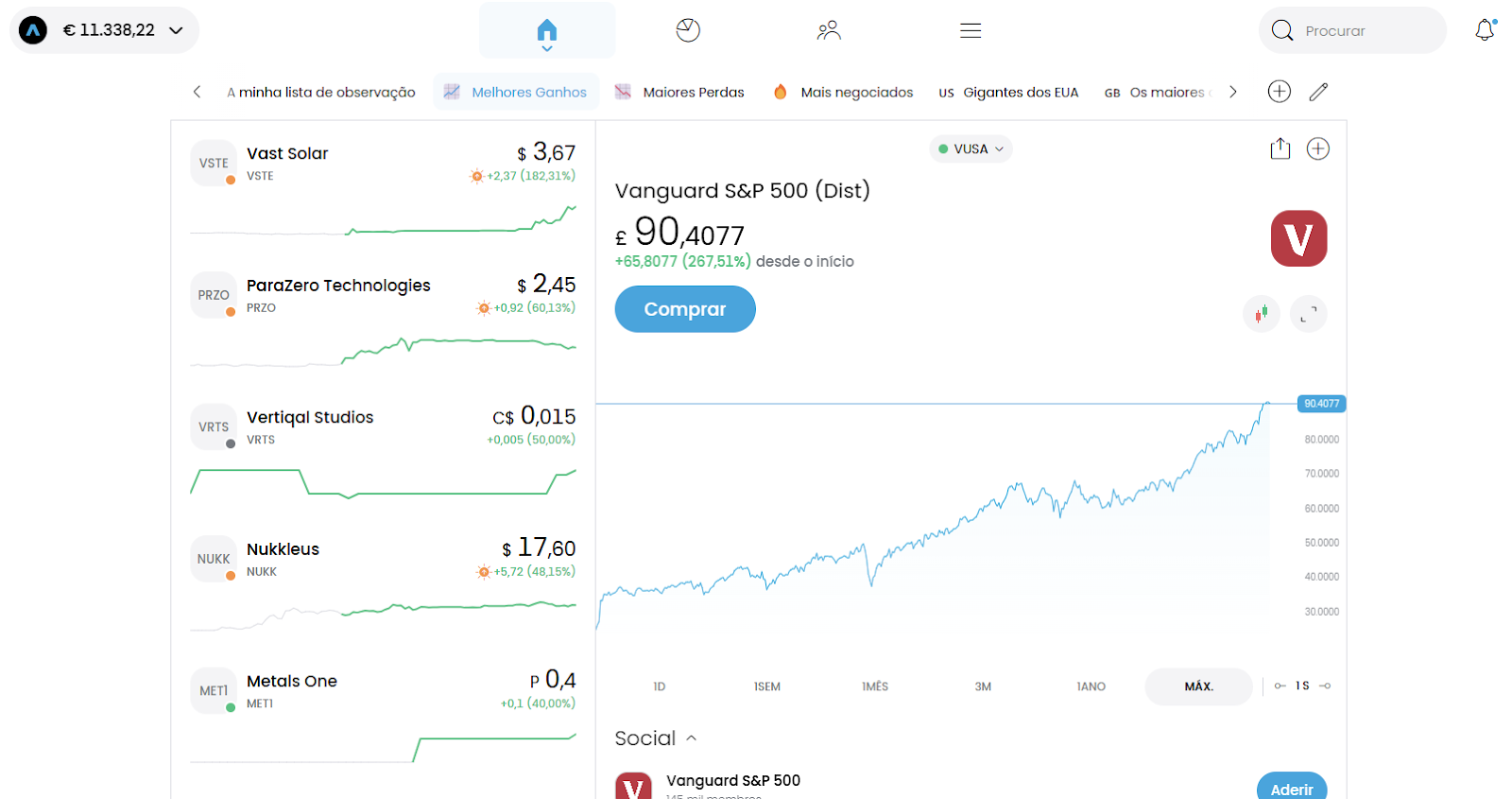
Pies & AutoInvest is an execution-only service. It does not constitute investment advice or portfolio management. Automatic investing refers to the execution of scheduled deposits. You are responsible for all investment and rebalancing decisions.
Want to know more about Trading 212's safety? Read our article "Is Trading 212 safe?".
Trading 212 pros and cons
Pros
- Commission-free trading of stocks and ETFs with no volume limits (other fees may apply. See the terms and fees)
- It is offering a free fractional share (worth up to €100) to new users
- Pies & AutoInvest feature, enabling automated investing
- Fast and easy account opening, from €1
- Demo account
- Interest on uninvested cash, paid daily
- Interest on lent shares
- Modern, easy-to-use app with TradingView charts
- Virtual and physical debit card
Cons
- Limited product range (no bonds, mutual funds, options or private markets)
- No banking licence or local IBANs, unlike Trade Republic
- 0.15% currency conversion fee
- No tax withholding at source: you have to declare investment income yourself in your annual tax return
- No phone support
- Investor compensation fund limited to €20,000 (no bank deposit guarantee)
Trade Republic - overview
Founded in 2015 in Berlin, Trade Republic is one of the fastest-growing investment fintechs in Europe. It holds a German banking licence, supervised by BaFin and the Bundesbank, and has been steadily opening local branches across Europe - in Portugal, for example, it has operated through its own branch (Trade Republic Bank GmbH) since July 2026.
This local presence, something most international brokers do not have, is a significant advantage: it means the cash balance benefits from the German deposit guarantee of up to €100,000, while investment assets are protected by the investor compensation fund - and in branch countries clients get local IBANs and locally withheld taxes.
Trade Republic also stands out for three main operational features: an extremely simple mobile app, interest of 3% per year (3.04% AER) on the account balance up to €50,000 (an exclusive offer for new clients, with interest accrued daily; above that amount, and for existing clients, 2.50% (2.53% AER) applies with no limit), and the ability to create automatic savings plans in stocks and ETFs from just €1 per month, with no additional fees on savings plans. The standard rate rose from 2.25% to 2.50% on 16 September 2026, after the ECB raised its deposit facility rate to 2.50%.
.png)
Want to know more about Trade Republic? Read our full Trade Republic review. If you want more details on the broker's safety, read our article "Is Trade Republic safe?".
Trade Republic pros and cons
Pros
- Simple, intuitive app, ideal for beginners
- 3% interest on the account balance up to €50,000 (offer for new clients - interest accrued daily)
- Automatic savings plans in stocks and ETFs from €1
- German banking licence (deposit protection up to €100,000)
- Local branches in a growing number of European countries
- In branch countries, tax on interest withheld at source, which simplifies your tax return
- Access to stocks, ETFs, bonds, cryptocurrencies and private markets (ELTIFs)
- Integrated bank account with a local IBAN in branch markets
Cons
- €1 fee per trade (outside savings plans)
- Historically more focused on the mobile app, although it has launched the Web Terminal, a web platform for more active investors
- Historically limited customer support - although since April 2026 it has been rolling out 24/7 phone and live chat with human agents, including in local languages
- No demo account
- Smaller selection of stocks and ETFs than Trading 212
Regulation and safety
Both are private companies regulated in Europe, but the protection structures are different.
At Trading 212, EU clients are served by Trading 212 Markets Ltd (Cyprus) and assets are protected by the investor compensation fund (ICF) up to €20,000. Uninvested cash is held at banks and, if you enable interest, also in qualifying money market funds (QMMFs).
Trade Republic, in turn, benefits from a German banking licence and a growing local presence across Europe, offering deposit protection of up to €100,000 on the account balance - a significant advantage for anyone holding larger cash balances.
Financial instruments
Trading 212 offers a wider variety of stocks and ETFs (more than 13,000 in total), which makes it especially interesting for anyone wanting to build a diversified portfolio of individual stocks.
Trade Republic, for its part, has a broader range of asset classes: beyond stocks and ETFs, it gives access to bonds, derivatives, spot cryptocurrencies and private markets. For long-term investors who want everything in a single account, it is a more complete offer. Explore other brokers in our guide to the best trading platforms in Europe.
Since July 2026, with the end of Payment for Order Flow in the EU, Trade Republic executes at Best Price (aggregation of reference exchanges, with itself as counterparty) or via Direct Price on an exchange of your choice (€2 per order). For most long-term investors, the impact on price tends to be small.
Private markets at Trade Republic
One of the big differences between the two brokers is access to private markets. Since September 2025, Trade Republic lets you invest in ELTIFs (European long-term investment funds) managed by Apollo and EQT, two of the biggest global names in private equity and private credit.
The main points of this offer:
- Investing from €1, with fractional units and the option to include them in savings plans;
- Returns are updated monthly;
- There is an option to sell monthly on Trade Republic's internal market, but these sales are not guaranteed: they depend on there being buyers.
It is important to understand that private markets are long-term investments with limited tradability: your money can be locked up for longer periods than in a traditional ETF. Trading 212 does not offer this asset class.
If this topic interests you, also read our article "Private markets on Revolut: are they worth it?", where we explain in detail how ELTIFs work.
Investment platforms
Both apps are known for their simplicity, but with slightly different philosophies: Trading 212 offers more analysis tools (TradingView charts, an investor community, basic fundamental data), while Trade Republic goes for absolute minimalism, ideal for anyone who wants to invest on a recurring basis without distractions.
Fees
*Other fees may apply. See Trading 212's terms and fees. A 0.15% currency conversion fee applies.
For one-off purchases of stocks and ETFs, Trading 212 has a clear advantage with its zero-commission, no-volume-limit policy. At Trade Republic, each one-off trade costs €1, which weighs most on small orders.
However, for anyone investing exclusively through recurring savings plans, the two are practically tied: €0 commission on both. Trading 212 charges 0.15% on currency conversion (relevant if you buy US stocks in USD), while at Trade Republic conversion is included in the spread.
Interest on uninvested cash
This is one of the areas where the two brokers compete most directly, but with different approaches:
Trade Republic currently offers a higher rate for new clients (3% up to €50,000) and more robust protection, since the balance is a genuine bank deposit covered by the deposit guarantee up to €100,000. Since 16 September 2026, its standard rate for existing clients (2.50%) is the same as Trading 212's.
At Trading 212, the 2.50% interest in EUR is paid daily with no balance limit, but part of the money is held in money market funds, which are not covered by a deposit guarantee. New clients in some countries get a promotional rate: in Portugal, for example, accounts opened between 16 September and 2 November 2026 earn 4.20% for four months.
Trading 212 also has an additional source of income that Trade Republic does not offer: interest on lent shares. If you enable this (optional) service, your shares can be lent to third parties and the income generated is split 50:50 with you. The loans are backed by collateral of at least 102% of the shares' value, but they involve a small counterparty risk and mean losing voting rights while the shares are on loan.
Interest rates as of 16 September 2026. When investing, your capital is at risk. If you enable interest, Trading 212 will hold your money in qualifying money market funds and banks. Otherwise, your money will be held only at banks. Interest applies to the balance in an investment account. Terms apply. The rates shown may no longer be up to date; check Trading 212's terms and fees page for the current rates.
Taxes
Trade Republic has an advantage here in the countries where it operates local branches: interest is paid with local tax already withheld at source, and clients get a local IBAN. This reduces the work at tax time and the risk of errors or omissions.
At Trading 212, interest paid on uninvested cash (and other income, such as capital gains and dividends) is not withheld at source and needs to be declared manually in your annual tax return, as foreign-sourced income.
If you use Trading 212 and do not declare this income, the risk of a tax discrepancy increases, since tax authorities across Europe receive information through the Common Reporting Standard (CRS). So it is important to keep an annual record of the interest received, which you can check directly in the app or in the tax statement provided by the broker.
Tax rules vary from country to country, so if you are unsure about your situation, check with a local tax adviser.
Customer support
Trading 212
Trading 212's customer support is provided mainly through:
- In-app chat: Available 24/7, with generally fast response times.
- Email: Response times can vary depending on the volume of requests.
The weak point is the absence of phone support, which can be a drawback for users who prefer more direct interaction on complex issues.
Trade Republic
Historically, Trade Republic's customer support was one of its main limitations - no phone, no dedicated account managers and recurring complaints about response times. In April 2026, the company announced a complete overhaul of this service:
- 24/7 phone and live chat inside the app, with more than 1,000 human agents (no chatbots), including support in several European languages.
- Real-time request tracking in the app, for cases not resolved on first contact.
The service is being rolled out gradually, so the real quality of the new support can be better judged in the coming months. Right now, neither of the two clearly stands out on this criterion: Trading 212 has a proven, fast chat, and Trade Republic is betting big on phone support in local languages.
So, which one should you choose?
The choice between Trading 212 and Trade Republic depends, above all, on your investor profile and your specific needs.
Trading 212 stands out for offering stocks and ETFs with no commissions and no limits (other fees may apply), for the wider variety of stocks and ETFs, for the demo account and for the ability to earn daily interest on uninvested cash and on lent shares. It is the natural choice for anyone wanting to minimise costs on one-off purchases and who values an app with more tools.
On the other hand, Trade Republic is the ideal option for anyone who prefers an "all-in-one" account: a banking licence with deposit protection up to €100,000, local branches with local IBANs and tax withheld at source in several countries, commission-free savings plans from €1 and access to asset classes that Trading 212 does not have, such as bonds and private markets (ELTIFs).
If you are looking for the lowest cost on one-off trades and the widest selection of stocks and ETFs, Trading 212 may be the better choice. If you prefer tax simplicity, banking protection and automating your monthly investing, Trade Republic will be an excellent option.
Whichever you choose, both brokers are regulated and offer a good level of safety. The most important thing is to analyse your financial goals and your investing style, and to explore the features of both before making a decision.
If you have the chance, trying both platforms can be a useful strategy to figure out which one fits your needs best!