Private markets on Revolut: are they worth it?





Since the end of July 2026, Revolut customers across Europe can invest in private markets funds starting from just €1. Until very recently, these funds required minimum tickets of €100,000 or more and were practically reserved for pension funds, insurers and large fortunes.
It is a genuine novelty and deserves to be taken seriously. It is also a complex, illiquid and expensive product, launched precisely at the moment when this asset class is going through its toughest test in many years.
This article tries to explain, in plain language, what you are buying, what it really costs and what questions you should ask yourself before tapping "Start investing". It is not a recommendation to buy or to sell.
Quick summary
- What it is: three funds (ELTIFs) managed by Hamilton Lane, Partners Group and Apollo, investing in companies, debt and infrastructure that are not listed on any stock exchange.
- The good part: real access to top institutional managers from €1, with no subscription fee charged by Revolut and a mandatory appropriateness assessment before you invest.
- The part to weigh up: total annual costs range from 3.7% to 5.8% per year, against roughly 0.20% for a global ETF.
- Liquidity: redemptions only quarterly, with lock-up periods, exit gates and, in one of the funds, a redemption fee of up to 5%.
- Who it is for: at most, a small slice of an already-built portfolio, with money you can afford to leave untouched for years.
What are "private markets"?
When you buy a listed stock or an ETF, you are in the public market: the assets are listed on an exchange and have a price that changes by the second. You can sell today, right now, at whatever price the market offers.
In private markets none of that happens. You buy a stake in assets that are not listed anywhere. There are three main families:
- Private equity: funds that buy unlisted companies, usually using a lot of debt, try to improve them and sell them at a profit after 3 to 7 years.
- Private credit: instead of the company borrowing from a bank or issuing bonds on an exchange, it borrows directly from a fund. It earns interest, but the loan itself is not traded.
- Infrastructure and real estate: airports, motorways, power plants, office or logistics buildings held directly by the fund. It is the illiquid cousin of REITs, which do the same thing but on the stock exchange.
The best analogy is your house. Your house has a value every single day, but you only see a number when someone appraises it or when you sell it. Between valuations, the chart looks like a calm straight line. That does not mean the value is not moving.
Hold on to this idea. It is the most important point in the article and we will come back to it later.
Why is this happening now?
Two things changed at the same time.
The first is regulatory. Regulation (EU) 2023/606, known as ELTIF 2.0 and applicable since 10 January 2024, removed the €10,000 minimum per retail investor and the concentration limit that existed in the previous version of the regime. It became legally possible to sell these funds to ordinary investors, as long as the distributor performs an appropriateness assessment. This is what opened the door, and it explains why so many asset managers launched products of this type at the same time. The CSSF, the Luxembourg regulator, keeps the register of funds authorised under this regime.
The second is commercial, and it is useful to understand the incentive on the other side of the table. Private markets managers are struggling to sell the companies they bought and to return capital to the institutional investors who financed them. At the same time, index fund fees have fallen so much that retail is no longer a very profitable business for the financial industry. Private markets solve both problems at once: they bring in fresh capital and substantially higher fees.
This does not make the offer a trap. It makes it a product that is being pushed hard, and products that are pushed hard always deserve a second look.
What exactly is Revolut offering?
In the app, the funds appear in the investments section, under the Private markets tab. The offer is the result of distribution agreements with four large alternative asset managers. At the time of writing, three funds were available, all domiciled in Luxembourg and supervised by the CSSF:
.png)
Source: Key Information Documents (KIDs) of each fund, June 2026. The share class available in the app may differ from the one analysed, so always confirm the KID inside the app itself.
A few practical points on how it works:
- €1 minimum. The KIDs of these funds indicate minimums of €5,000 to €10,000, but those figures apply to direct subscriptions with the asset manager. Revolut aggregates client orders, which allows it to offer fractions. It is, honestly, the most impressive part of the offer.
- Revolut charges you nothing, but earns 45% of the management fee. There is no subscription fee, no redemption fee and none of the per-order cost you pay on stocks and ETFs. In return, Revolut states in its ex-ante costs and charges document that the asset managers pay it a distribution fee, and that the simulator assumes 45% of the fund's management fee for illustrative purposes, with the exact percentage varying from fund to fund. That fee is included in the management fee, meaning you do not pay more because of it, but a relevant slice of what you pay the fund ends up with Revolut. The actual amount is only disclosed afterwards, in the annual costs report.
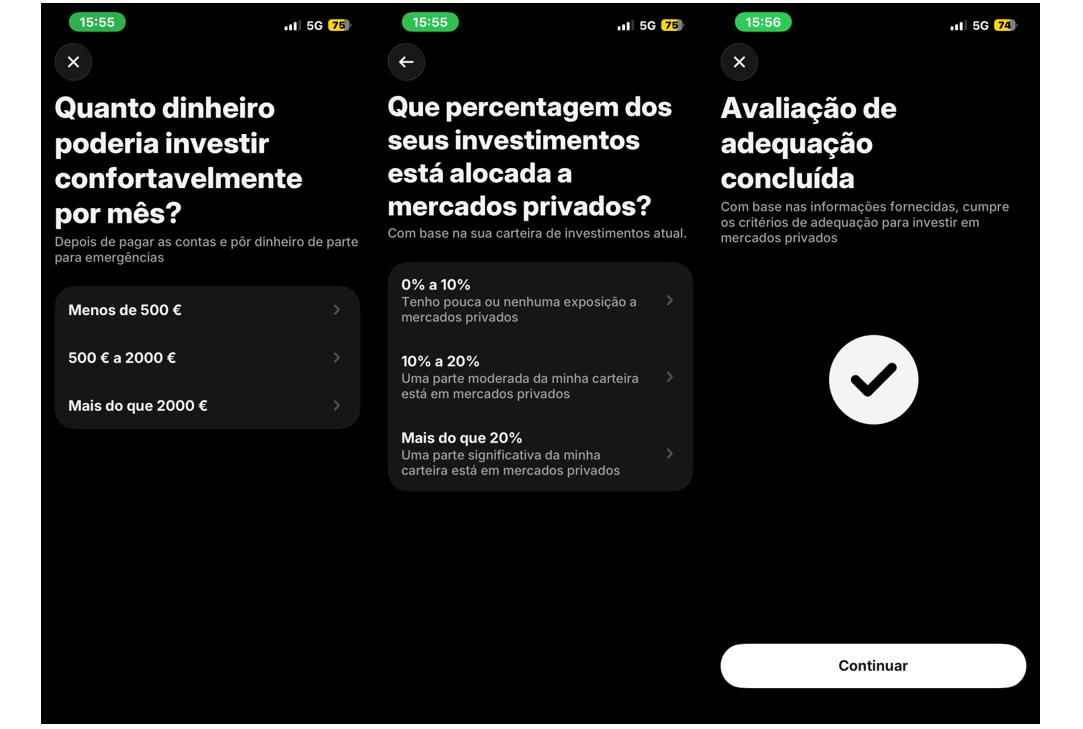
- Mandatory appropriateness assessment. Before you invest, you answer questions about your experience, what percentage of your portfolio is already in illiquid assets and how much you can comfortably invest. It is considerably more demanding than for stocks or ETFs.
- Leverage of up to 50%. The managers can take on debt to increase exposure to the assets. In the ELTIFs available on Revolut, that borrowing cannot exceed 50% of the fund's net asset value. It amplifies gains, but it amplifies losses in exactly the same way.
- Monthly subscriptions, quarterly redemptions. Settlement of an order typically takes one to three weeks after submission.
- Who executes: the services are provided by Revolut Securities Europe UAB, regulated by the Bank of Lithuania, which acts as sub-distributor of the funds made available through Allfunds Bank. Orders do not go through an exchange: they are executed off-market, directly with the fund manager.
Pros and cons
Pros
- Real access to reference institutional managers, which together manage more than $2.8 trillion
- Entry barrier practically eliminated (from €1)
- No Revolut subscription fee and no entry fee on the funds
- Mandatory appropriateness assessment that can actually block access to the product, and clear risk disclosure inside the app
- Evergreen structure: your money is invested from day one, with no unpredictable capital calls
- You have 14 days to cancel a purchase order
- Exposure to an asset class that was genuinely out of reach for ordinary investors
Cons
- Annual costs between 3.7% and 5.8%, an order of magnitude above an ETF
- Limited liquidity: quarterly redemptions, lock-ups and exit gates
- One of the funds applies a 3% redemption fee, which can go up to 5%
- You cannot transfer the positions to another broker or sell them on a secondary market
- The funds can use leverage of up to 50% of net asset value
- Infrequent valuations, which give a false sense of stability
- No track record of their own: these are recent funds, with no past performance series to show
Three factors to keep in mind
1. Liquidity is not what it seems
"Quarterly redemptions" sounds like "I can get out every three months". It is not quite like that.
These funds have three layers of brakes:
- Lock-up period: in the Hamilton Lane fund, 12 months during which you simply cannot exit.
- Quarterly gate: the fund is only obliged to redeem a percentage of its assets each quarter. Hamilton Lane's KID sets that limit at 5% per quarter. The Partners Group and Apollo KIDs do not state the percentage, referring instead to the prospectus and the fund supplement, and in the Partners Group case the board of directors can raise or remove the gate. If exit requests exceed the limit, redemptions are scaled back proportionally and the excess rolls over to the next redemption date.
- Exit fee: in the Partners Group fund, 3% of the redeemed amount, and the fund may apply up to 5%.
The counterintuitive part is when the brakes kick in. People want their money back all at the same time, and that is usually when the market is bad and the underlying assets are hard to sell. In other words, the mechanism that stops you from exiting activates exactly at the moment you most want to exit.
There are also two details that tend to catch people by surprise:
- You do not know the price when you place the order. The value you see in the app is the latest available valuation. The order is only executed at the next valuation point, so the final price may differ from the one you saw. It is called forward pricing and it is the norm for this type of fund.
- You cannot transfer these positions. Unlike stocks and ETFs, ELTIF units held on Revolut cannot be transferred to another broker or sold on a secondary market. Some ELTIFs have a service that matches buyers and sellers, but Revolut itself states that this service is not available for positions held on its platform. The only way out is redemption with the asset manager.
On the positive side, you have 14 days to cancel a purchase order and 1 day to cancel a sell order, as long as you do so before the deadline shown in the app.
None of this is a hidden defect or bad faith from the manager. It is written in the contract and it is the only way a fund holding illiquid assets can avoid being forced to sell them at fire-sale prices. But it is a feature you have to accept consciously, not discover later.
2. The "low volatility" is, in part, an accounting illusion
Remember the house analogy? Here is the practical effect.
An equity ETF shows you a 20% drop on the day it happens. A private markets fund values its assets quarterly, based on models and comparable transactions. The result is a much smoother chart. Many investors read that smooth chart as "less risk".
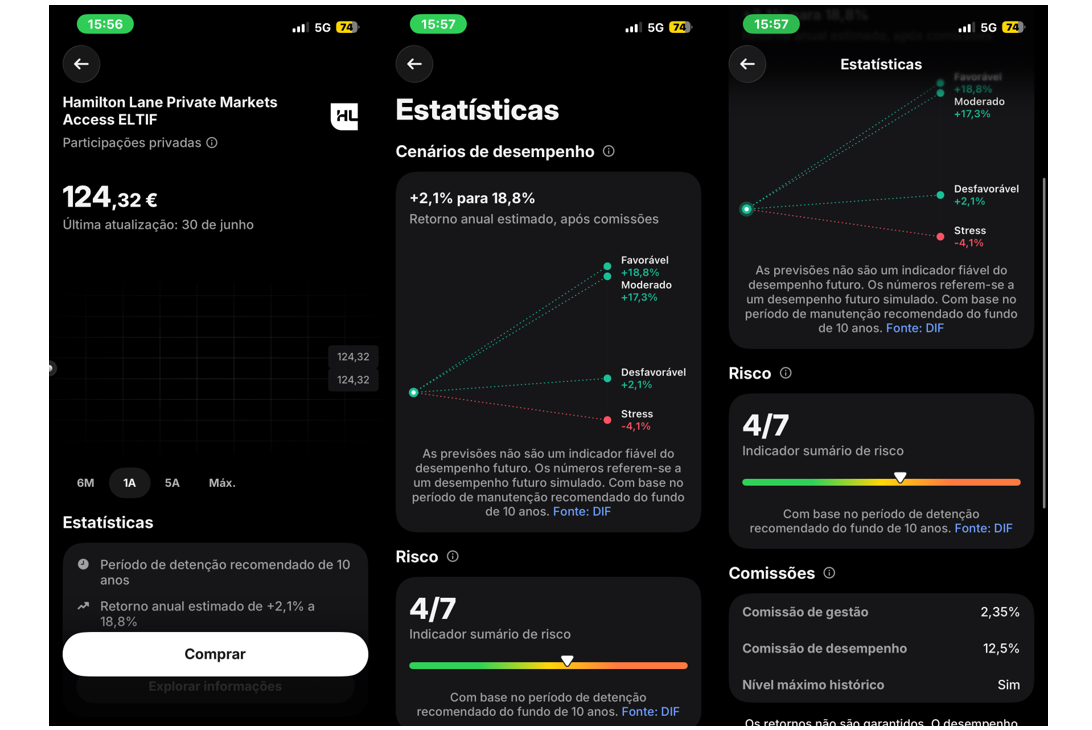
You do not have to take my word for it. It is written, in black and white, in the Key Information Document of the Partners Group fund itself, regarding the summary risk indicator (that number from 1 to 7):
"The SRI is based on recent NAV movements and may misrepresent the risk/return profile of private markets products. The risk to the investor may be higher than that suggested by the SRI."
Key Information Document, Partners Group
In other words, the fund's own legal document warns that the risk indicator you are shown understates the real risk. Revolut, to be fair, also includes in its communication a note that private markets valuations are updated less frequently than those of listed markets, which can affect reported volatility.
When one of these funds is forced to confront a real market price, the difference shows up all at once. There are two recent examples in the United States that show exactly this. In both cases we are talking about funds sold to retail investors, valued internally by the manager, which decided to list on an exchange to give participants liquidity:
Sources: InvestmentNews and AltsWire
In the case of Bluerock's real estate fund, the market decided, in the space of one day, that the properties were worth about a third less than the manager had been reporting. Nothing changed in the portfolio that day. What changed was who was setting the price.
It is fair to say that part of the discount is explained by many participants wanting to exit at the same time as soon as liquidity appeared, and not just by the valuations being wrong. But that is precisely the point: in a real sale, what you receive is what the market pays at that moment, not the number on your statement.
3. Costs are the only guaranteed part
Future returns are uncertain, costs are not. These are the figures from the KIDs themselves, compared with a common alternative:
These figures are not just the management fee. They also include the costs of the underlying funds, transaction costs and performance fees, which in Hamilton Lane's case are 12.5% of profits above a certain threshold.
To see the effect, imagine you invest €10,000 for 10 years and that every product generates exactly the same gross return of 8% per year. The only difference is the cost:
Illustrative simulation, with an identical gross return of 8% per year in all cases. You can run your own numbers on our compound interest calculator.
The conclusion is simple: to be worth it, a private markets fund does not just need to beat the market. It needs to beat it by more than 3 to 5 percentage points per year, every year, net of everything.
What about the promise of "superior returns"?
Revolut's marketing states that, historically, private markets have delivered higher long-term returns than public markets. The footnote identifies the source: the MSCI Global Buyout Closed-End Fund Index, net of fees, against the S&P 500 Total Return, between December 2000 and December 2025.
The claim is true for that index and that period. It is worth understanding three nuances before taking it at face value:
- The start date matters a lot. December 2000 is practically the top of the dot-com bubble, one of the worst entry points in history for the S&P 500. Long-term comparisons are very sensitive to the chosen starting point.
- They are not comparable things. Buyout funds buy smaller companies and use plenty of debt. The S&P 500 is made up of the largest listed companies in the world, with far less leverage. A relevant part of the return difference is simply more risk taken, not more talent.
- The return maths is different. Private funds frequently report internal rates of return (IRRs), which depend on when the manager decides to call and return capital. That is not directly comparable to an index return.
Academic research comparing private equity with public portfolios adjusted for the same type of risk and leverage tends to conclude that, net of fees, the asset class's average return is in line with the stock market. The talent exists, and it is enormous. The question is who captures the value created: with management fees of 2% to 3% plus 12.5% of profits, a good slice stays along the way.
There is also a gigantic dispersion between funds. The best private markets funds comfortably beat the market. The worst destroy capital. Picking which is which in advance is the hard part, and that is why these multi-manager funds (which invest in several funds at the same time) make sense as a structure, even at the cost of another layer of fees.
If you want to dig deeper, the Canadian youtuber Ben Felix has a detailed and well-documented analysis of this topic on his channel, and it is a good introduction to the sceptical side of the debate.
Private markets in 2026
It is the elephant in the room and it would be strange not to mention it. 2026 has been a difficult year for the asset class:
- Several private credit funds in the United States received redemption requests above their contractual gates and had to ration them. The issue was even the subject of analysis by the US Congress research service, which describes the usual gate of around 5% of assets per quarter.
- Equivalent exchange-listed funds trade at material discounts to their reported values, a sign that the market doubts the declared valuations.
- Shares of the alternative asset managers themselves have fallen significantly since late 2025.
- The concentration in loans to software companies, at a time when artificial intelligence is pressuring that business model, is flagged as a relevant risk.
None of this means the funds available on Revolut are in trouble. They are European vehicles, recent, diversified and with conservative liquidity rules designed precisely for this type of scenario. But it shows that the risks described in the documents are not theoretical. They are exactly the risks materialising elsewhere in the market right now.
On the positive side, entering an asset class after a correction tends to be better than entering at the peak of enthusiasm. If there are more sellers than buyers in private markets today, whoever enters now may be buying at more reasonable prices than whoever entered in 2021.
What about taxes?
These are foreign accumulating funds, held through an entity based in Lithuania. What that means for you depends entirely on the country where you are tax resident, but there are a few general points worth knowing:
- In most European countries, capital gains are taxed when you redeem, at the rates and under the rules of your country of residence.
- There is no withholding at source. Declaring the gains in your annual tax return is up to you.
- Some countries tax accumulating funds even before you sell (Germany's Vorabpauschale or the Dutch box 3 regime are the best-known examples), so "accumulating" does not automatically mean "tax deferred" everywhere.
- Since the account is held abroad, many countries also require you to report foreign accounts in your annual tax return.
If you are in any doubt about your specific situation, it is genuinely worth confirming with a certified tax adviser in your country.
So, does it make sense for you?
I cannot tell you that, and be suspicious of anyone who tells you without knowing your situation. What I can give you are the right questions.
It probably does not make sense yet if:
- You do not have an emergency fund covering 3 to 6 months of expenses
- You do not yet have a diversified core portfolio of stocks and bonds
- You might need this money in the next 5 to 10 years
- You would not sleep well if you were told your redemption was only partially met
- You are considering it because it feels exclusive and institutional. That is an emotional reason, not a financial one
It may make sense if:
- You already have your core portfolio built and want to diversify into different sources of return
- You can lock the money away for a decade without it affecting your life
- You understand and accept the costs, the redemption gates and the way these assets are valued
- You are talking about a small slice, not the centre of your portfolio
On the size of that slice, the practical rule that applies to any illiquid and expensive asset is to start small enough that, if it goes wrong, nothing important changes in your life. And then not to increase it just because the chart looks pretty, because in private markets the chart almost always looks pretty.
Conclusion
The arrival of private markets in the Revolut app is one of those changes that will only be properly understood a few years from now. From an access point of view, it is positive, and Revolut executed it more carefully than you might expect: no subscription fee of its own, an appropriateness assessment that can actually block access, and risk disclosure visible inside the app.
From the investor's point of view, the assessment is more nuanced. You are trading liquidity and price transparency for access to top managers, and paying between 3.7% and 5.8% per year for it. That trade can pay off. It can also not pay off. What you should not do is assume it pays off just because the product is institutional, exclusive and shows a pretty chart.
If you are starting out, the order of priorities remains the same as always: emergency fund, expensive debt paid off, a cheap and diversified core portfolio. Private markets, if they make sense for you at all, are the chapter that comes long after those.
Frequently asked questions
Can I withdraw the money whenever I want?
No. Redemptions are quarterly and have to be requested in advance. There may be lock-up periods, quarterly exit gates and, in one of the funds, a redemption fee. In difficult market conditions, your redemption may only be partially met. There is no alternative route: you cannot transfer the positions to another broker or sell them on a secondary market.
What if the appropriateness assessment says I cannot invest?
In that case Revolut genuinely blocks access to the product. In the test I did, the app indicated the questionnaire could only be retaken after 48 hours. It is worth treating that outcome as useful information rather than an obstacle to get around: if your profile does not fit, the most likely answer is that these funds are not for you yet.
Are these investments protected by any guarantee scheme?
Not against market losses, and they are not deposits, so deposit guarantee schemes do not apply. As a client of Revolut Securities Europe UAB, you are covered by Lithuania's investor compensation scheme, up to €22,000, but that protection covers operational failures or fraud by the broker, not the loss of value of your investment. The KIDs themselves expressly state that the funds are not covered by any investor compensation scheme and that, in the worst case, you can lose all the capital invested.
How much does Revolut earn from this?
It charges you nothing directly, but receives a distribution fee from the asset managers. Revolut's ex-ante costs document uses 45% of the fund's management fee as an example, indicating that the exact percentage varies by fund and that the actual amount is communicated later, in the annual costs report. This fee is included in the management fee, so it does not add to what you pay, but it is good to know that a substantial part of the fund's management fee stays with whoever sold it to you.
What is the difference between this and a private equity ETF?
An ETF labelled private equity typically buys shares of the listed asset managers, such as Apollo or Blackstone. You are investing in the fee-collecting business, not in the private companies themselves. It is liquid, cheap and volatile. Here you are investing in the underlying assets, with all the consequences we have described.
Is this comparable to a normal investment fund?
No. A traditional mutual fund invests in listed assets and normally lets you redeem within a few business days, at that day's net asset value. Here, liquidity is quarterly, conditional and subject to gates.
Are the performance scenarios in the documents forecasts?
No. They are regulatory calculations based on the past behaviour of reference indices, and they cover an enormous range. In the KID of the Hamilton Lane fund, for example, the stress scenario points to -4.1% per year over 10 years and the favourable scenario to +18.8% per year. The gap between them is precisely the point: nobody knows.
You can read our comparison of Trade Republic vs Revolut to see how Revolut's core investment offer stacks up, or explore alternatives in our guide to the best trading platforms in Europe.
Disclaimer: this article is for information and educational purposes only and does not constitute investment advice, an offer or a recommendation to buy or sell any financial instrument. Private markets funds are complex, illiquid, long-term investments and are not suitable for all investors. Your capital is at risk and you may lose part or all of the amount invested. Past performance is not a reliable indicator of future results. Before investing, read the Key Information Document and the offering documentation of each fund. EUPersonalFinance.eu may receive commercial compensation from partnerships with institutions mentioned in this article, which does not influence the analysis presented.