Is USDT banned in Europe? What happened under MiCA and what to use instead

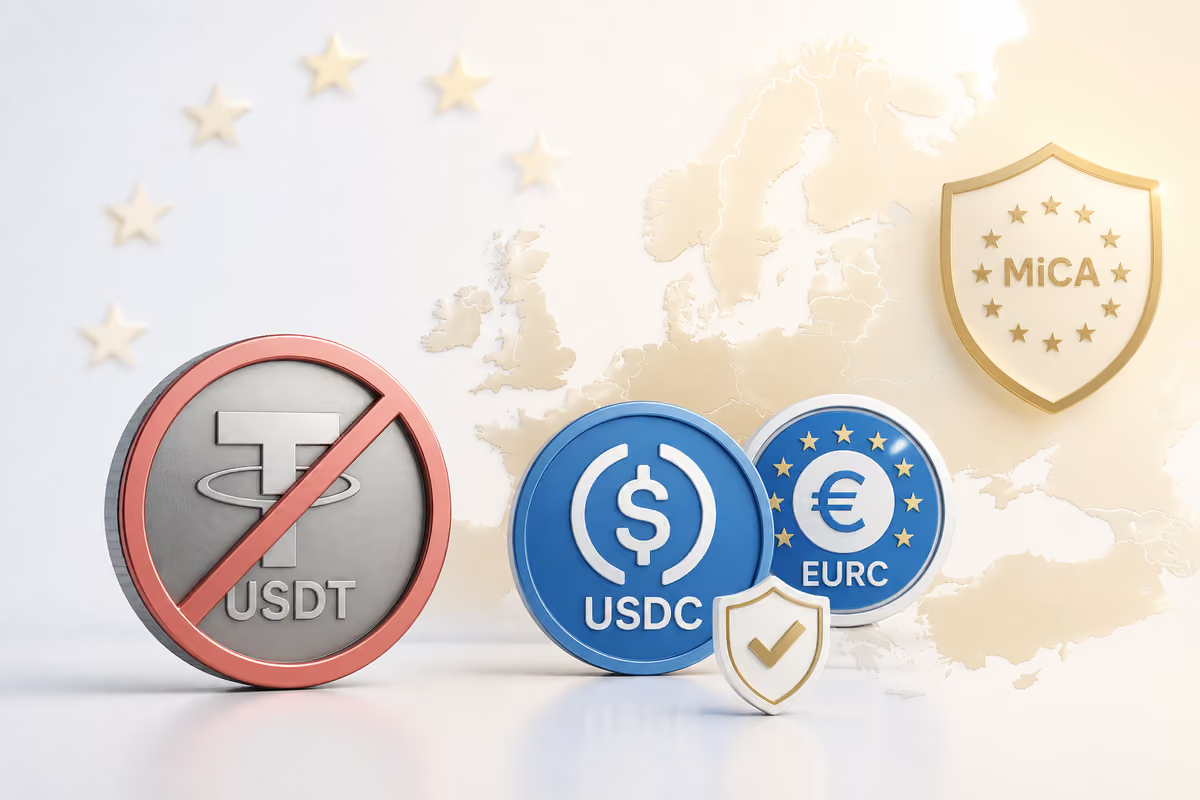



If you hold Tether (USDT), Europe's new crypto rulebook affects you directly. Since MiCA's stablecoin rules took effect, USDT has been progressively delisted from regulated European exchanges, and with MiCA's full enforcement on July 1, 2026, the world's largest stablecoin is effectively unavailable through licensed EU platforms.
Here is what "banned" actually means in practice, why it happened, and what European investors should use instead.
Is USDT technically banned?
Not in the sense of being illegal to own. Holding USDT in a self-custody wallet remains legal, and nobody is confiscating it. What MiCA does is prohibit licensed crypto-asset service providers from offering non-compliant e-money tokens to EU clients.
Since Tether never obtained MiCA authorisation as an e-money token issuer, licensed exchanges cannot list USDT for EU customers. The practical effect for most retail investors is the same as a ban: you cannot buy, sell or trade USDT on any MiCA-regulated venue.
Why Tether refused to comply
MiCA imposes strict requirements on issuers of significant stablecoins: holding a substantial portion of reserves in EU bank deposits, maintaining own capital, and submitting to EU supervision under the European Banking Authority framework.
Tether made its position clear early, in spring 2025, CEO Paolo Ardoino said the company did not plan to apply for an EU licence, later calling MiCA's requirements incompatible with Tether's business model. The concentration of reserves in bank deposits, in particular, is something Tether views as a risk rather than a safeguard.
The result: regulated European platforms began delisting USDT well before the final deadline, and by July 2026 the delisting is essentially complete across licensed venues.
Which stablecoins are MiCA-compliant?
As of August 2026, 22 issuers with 42 notified white papers appear in the ESMA e-money token (EMT) register. The best-known compliant tokens:
| Stablecoin | Issuer | Peg | MiCA status |
|---|---|---|---|
| USDC | Circle | US dollar | Authorised (licensed in France) |
| EURC | Circle | Euro | Authorised |
| EURCV | Societe Generale-Forge | Euro | Authorised |
| USDG | Paxos | US dollar | Authorised (Finland) |
| EUROe | Paxos | Euro | Authorised (Finland) |
| EURI | Banking Circle | Euro | Authorised (Luxembourg) |
| EURe | Monerium | Euro | Authorised (Iceland) |
| EURR | StablR | Euro | Authorised (Malta) |
| EURAU | AllUnity | Euro | Authorised (Germany) |
Circle was the big winner of MiCA's stablecoin regime: Circle Internet Financial Europe SAS is authorised in France as an electronic money institution, supervised by the ACPR, and can legally offer USDC and EURC across the EU. USDC is the natural USDT replacement for most users - same dollar peg, broad exchange support, deep (if smaller than USDT's) liquidity.
Notably absent from the compliant list: USDT, DAI, USDe, FDUSD, PYUSD and TUSD, none of which appear in the ESMA e-money token register as of August 2026.
What to do with your USDT
If your USDT sits on a licensed European exchange, you have likely already received notices. Your options:
- Convert to USDC or another compliant asset - the simplest route for most investors. Licensed exchanges facilitate selling or converting existing USDT balances even where new purchases are blocked
- Convert to euro or crypto - if you were using USDT as a parking asset, a euro balance on a licensed exchange achieves the same with full regulatory protection (or consider a proper high-yield euro savings account)
- Withdraw to self-custody - holding USDT in your own wallet remains legal; you can still use it on-chain or on non-EU venues, but you step outside MiCA's protections
- Do not wait - forced conversions during high-traffic periods mean worse spreads and higher network fees
Where to hold compliant stablecoins in Europe
Any MiCA-licensed exchange supports USDC - see our full list of MiCA-licensed crypto exchanges. A few options worth highlighting:
eToro - MiCA-licensed since early 2025 through CySEC, and currently the most interesting option if you are migrating assets: between July 1 and September 30, 2026, transferring supported crypto to eToro earns 5% cashback in stocks on eligible net deposits, up to $2,000 per month. If you are moving funds off an unlicensed platform anyway, the migration itself becomes a return. T&Cs apply. Read our full eToro review for fees and details.
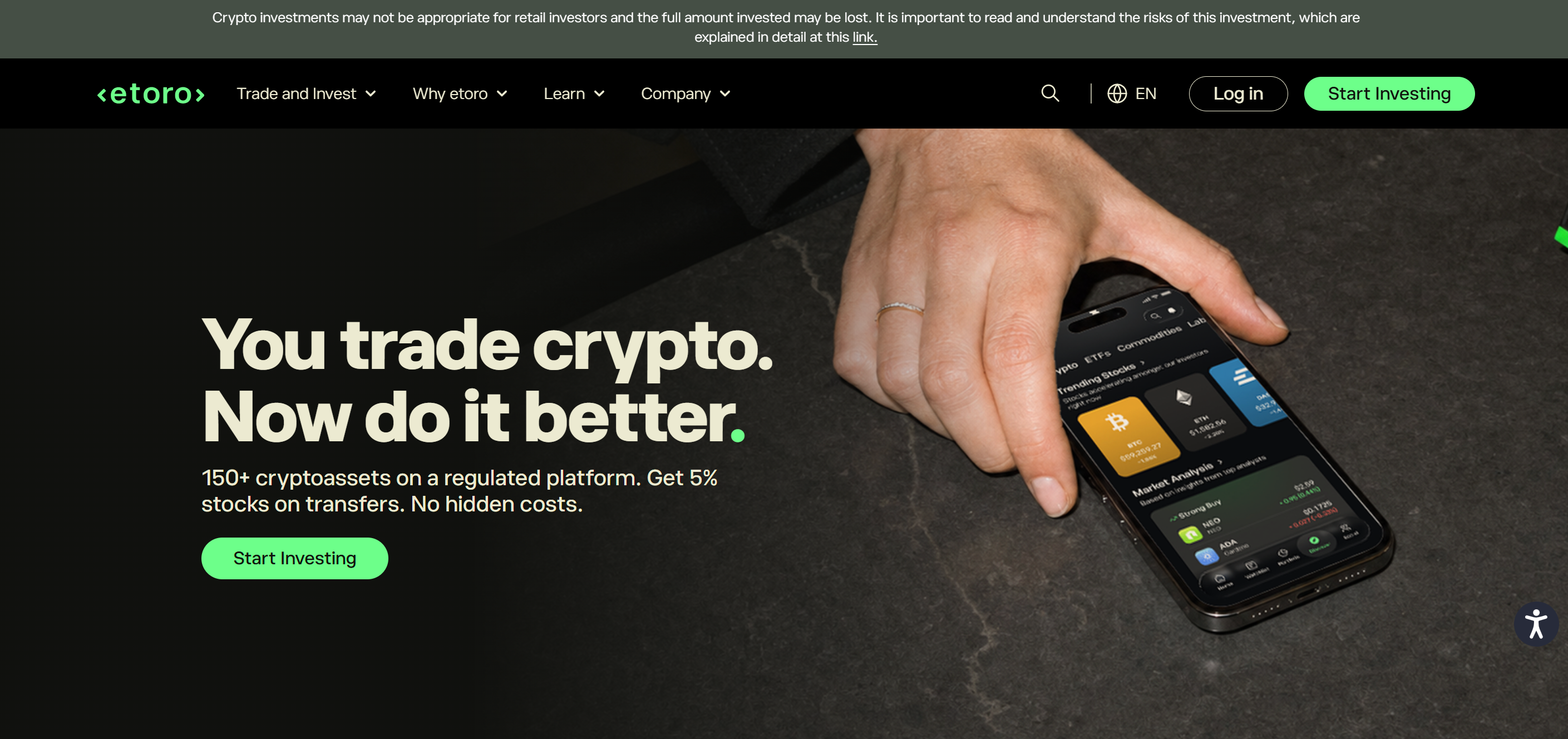
eToro is a multi-asset investment platform. The value of your investments may go up or down. Your capital is at risk.
Kraken, Coinbase, Bitvavo - all fully licensed with deep USDC liquidity.
Robinhood Europe - licensed by the Bank of Lithuania and currently offering new users up to €50 in crypto, with the cash value held for 180 days and availability limited to certain jurisdictions. Our Robinhood Europe review covers the platform in depth.

Does this affect USDT's global dominance?
Outside the EU, no. USDT remains the most traded stablecoin in the world by a wide margin. But Europe has created the first major market where USDC holds a structural regulatory advantage, and other jurisdictions are watching.
For European investors, the practical takeaway is simpler: build your workflows around USDC (or euro balances) going forward, because USDT is not coming back to licensed EU venues unless Tether reverses course on MiCA authorisation.
Bottom line
USDT is not illegal to hold in Europe, but it is no longer usable on regulated platforms and that distinction matters little in day-to-day investing. Convert existing balances to USDC, EURC or fiat on a licensed exchange, and treat any platform still offering USDT to EU retail clients as a red flag: it likely is not MiCA-licensed at all.
If your platform is affected, our guides on Binance's situation in Europe and the best crypto exchanges in Europe cover where to go next.
This article is for informational purposes only and does not constitute financial advice. Crypto assets are highly volatile; you may lose the money you invest.