GOOG vs GOOGL: What's the Difference and Which Should You Buy?

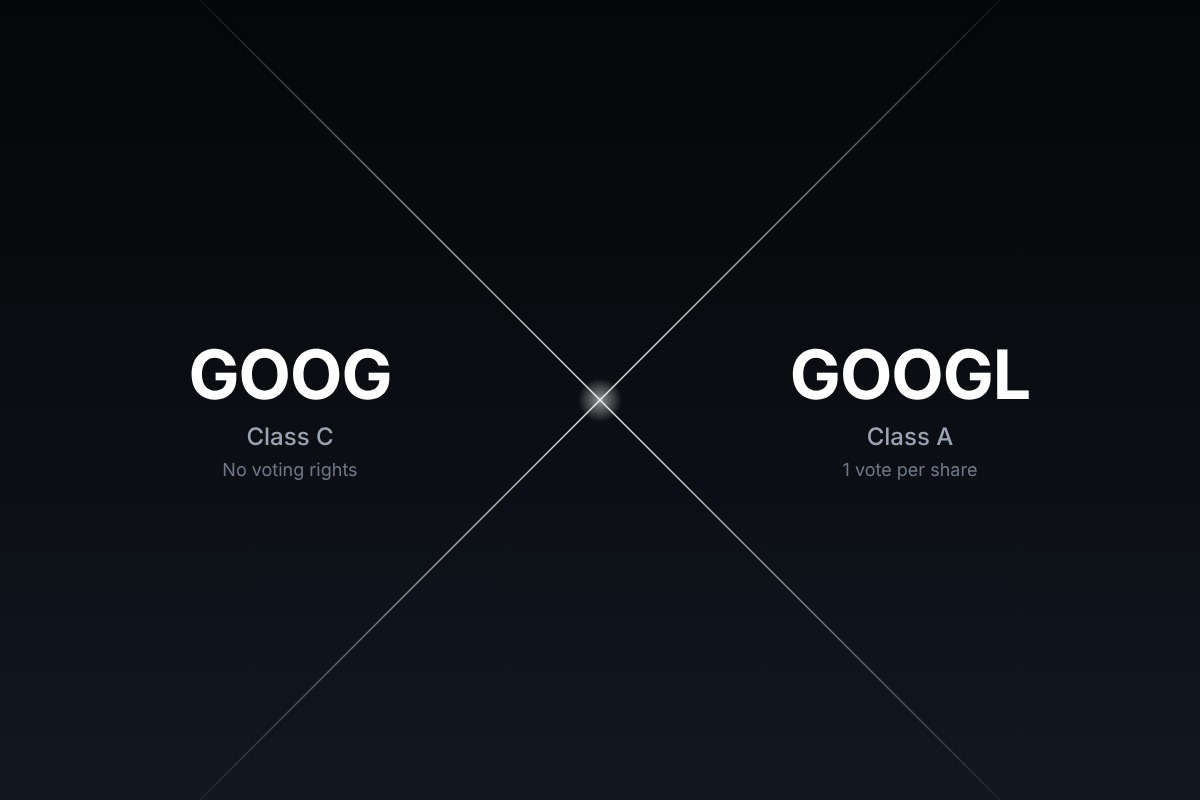


GOOGL and GOOG are two share classes of the same company, Alphabet. They give you exactly the same claim on Google's business, the same dividend and almost the same price. The only real difference is voting: GOOGL (Class A) has one vote per share, while GOOG (Class C) has none.
In this article we explain what that means for a European investor, how big the price gap is, how the two classes have performed since 2014, how they are taxed and where you can buy them in Europe. All figures were checked in November 2026.
Quick answer
- GOOG (Class C): the choice if you will never vote at Alphabet's annual meeting. Same economic exposure, usually at a slightly lower price.
- GOOGL (Class A): the choice if you want to vote, even symbolically, and your broker passes on voting rights.
In practice, the vote of a private investor carries no weight, because co-founders Larry Page and Sergey Brin control about 52.7% of all votes through a third, unlisted share class.
GOOG vs GOOGL at a glance
| GOOGL | GOOG | |
|---|---|---|
| Share class | Class A | Class C |
| Voting rights | 1 vote per share | No votes |
| Close on 6 Nov 2026 | $284.78 | $283.93 |
| Quarterly dividend | $0.22 | $0.22 |
| Shares outstanding (21 Oct 2026) | 5,888 million | 5,579 million |
| Weight in the S&P 500 (SPY, 6 Nov 2026) | 2.63% | 2.12% |
| Price return since 3 Apr 2014 | +896% | +899% |
| ISIN | US02079K3059 | US02079K1079 |
Sources: Alphabet Q3 2026 10-Q, StockAnalysis and State Street. Returns calculated by us from split-adjusted closing prices, excluding dividends.
Alphabet's three share classes
Alphabet has three classes of common stock. Class A (GOOGL) has 1 vote per share and Class C (GOOG) has none, and both are listed on Nasdaq. Class B has 10 votes per share and is not listed. According to Alphabet's annual report, the rights of the three classes, including dividends and liquidation, are identical except for voting.
The 827 million Class B shares are less than 7% of all shares, but with 10 votes each they carry about 58% of all votes. Larry Page and Sergey Brin hold most of them, which gave them about 52.7% of the voting power at the end of 2025. So whichever class you buy, the founders decide the outcome of shareholder votes.
The non-voting Class C was created in April 2014, when Google gave one Class C share for every Class A and Class B share. Since then, the old Class A trades as GOOGL and the new Class C as GOOG.
Why is GOOGL more expensive than GOOG?
The price difference comes from the vote. Some investors, mainly large funds, pay a little more for a share that can vote. The gap is small and changes over time: 0.30% at the close on 6 November 2026, about 1.15% on 21 September 2026 and 0.97% at Alphabet's share offering on 2 June 2026.
Buybacks also play a role. Alphabet has historically bought back far more Class C than Class A shares (in 2025, $38.9 billion against $6.5 billion), which supports the GOOG price. In 2026 it made no buybacks in the first nine months and started selling new shares of both classes.
For a private investor the gap rarely matters. With $10,000 you would get 35.11 GOOGL shares or 35.22 GOOG shares at the 6 November prices, a difference of about $30, less than the currency conversion cost at many brokers.
Dividends: the same for both
Alphabet paid its first dividend in June 2024 ($0.20 per share), raised it to $0.21 in April 2025 and to $0.22 in April 2026. The latest dividend of $0.22 is payable on 14 December 2026 and is exactly the same on GOOGL and GOOG. At the 6 November prices the yield is about 0.31% for both.
Have GOOG and GOOGL performed differently?
Very little. From the first day of separate trading (3 April 2014) to 6 November 2026, GOOGL returned about +896% and GOOG about +899% in price terms, both close to 20% a year. GOOG's small lead comes mostly from a one-off payment of $522 million to Class C holders in 2015, made because GOOG traded at a discount during its first year.
Do you already own Alphabet through an ETF?
Probably. The S&P 500 and the Nasdaq-100 hold both classes, so UCITS ETFs that track them do too. In the SPY ETF on 6 November 2026, Alphabet made up 4.75% of the fund (GOOGL 2.63% and GOOG 2.12%). If you already own an S&P 500, Nasdaq-100 or world ETF, buying GOOG or GOOGL on top of it increases your exposure to the same company.
How are GOOG and GOOGL taxed in Europe?
Both classes are taxed in exactly the same way. US dividends are taxed at source: with a W-8BEN form on file at your broker, most EU residents have 15% withheld under their country's tax treaty with the US. Capital gains are not taxed in the US and follow the rules of your country of residence. Switching from one class to the other means selling one and buying the other, which can trigger tax on any gain.
Where to buy GOOG and GOOGL in Europe
Unlike US-domiciled ETFs, which most European retail investors cannot buy, individual US shares such as GOOG and GOOGL are available at most European brokers. Some list the two classes under different names:
| Broker | Class A | Class C |
|---|---|---|
| Interactive Brokers | GOOGL | GOOG |
| Trading 212 | GOOGL | GOOG |
| XTB | GOOGL.US | GOOGC.US |
| Trade Republic | Alphabet (A) | Alphabet (C) |
| Lightyear | GOOGL | GOOG |
- Interactive Brokers: direct access to Nasdaq and the cheapest currency conversion. For US companies such as Alphabet, IBKR emails shareholder meeting materials with a link to vote online.
- Trading 212: both classes as Nasdaq shares in the Invest account, with fractional shares. No commission on shares (other fees may apply, see terms and fees). A 0.15% FX fee applies when converting funds.
- XTB: 0% commission on shares up to €100,000 of monthly turnover (then 0.2%) and a 0.5% currency conversion fee.
- Trade Republic: €1 per trade and free savings plans, with no separate currency conversion fee.
- Lightyear: US shares for 0.1% per order (minimum $0.10, maximum $1) and a 0.35% currency conversion fee.
When you search for Alphabet in an app, check that you are buying the share itself and not a CFD, a leveraged product or an options-income ETP with a similar name.
Sponsored link. New Trading 212 customers can get a free fractional share worth up to €100 with our Trading 212 promo code "IITW". Terms apply. New Lightyear customers can use our Lightyear promo code "INVESTINGINTHEWEB" to get a free fractional share worth up to €100 after depositing at least €100 within 15 days and keeping it for 6 months (most users get €10 to €15). T&Cs apply.
GOOG or GOOGL: which should you choose?
Choose GOOG if you only care about owning part of Google's business. You get the same profits, the same dividend and almost identical returns, usually at a slightly lower price.
Choose GOOGL if you want to vote at the annual meeting and your broker passes on voting rights. You pay a small premium, about 0.30% in November 2026, and get the more traded class.
Splitting your money between the two brings no diversification. Both are the same company.
Frequently asked questions
What is the difference between GOOG and GOOGL?
GOOGL is Alphabet's Class A share, with one vote per share. GOOG is the Class C share, with no voting rights. Both have the same claim on profits and receive the same dividend.
Can I convert GOOG into GOOGL?
No. Class C shares cannot be converted into Class A. To switch, you have to sell one and buy the other.
Is the market capitalisation of GOOG and GOOGL different?
No. Alphabet has one market capitalisation, about $3.5 trillion at the 6 November 2026 prices, covering all three share classes. Some websites show a different figure per ticker because they multiply all shares by that ticker's price.
Which class do ETFs hold?
Both. The S&P 500 and the Nasdaq-100 include GOOGL and GOOG as separate lines, so ETFs that track them hold both classes.
Disclaimer: Sponsored content. Some links in this article are affiliate links. CFDs are complex instruments and come with a high risk of losing money rapidly due to leverage. 79% of retail investor accounts lose money when trading CFDs with XTB. You should consider whether you understand how CFDs work and whether you can afford to take the high risk of losing your money. When investing, your capital is at risk and you may get back less than invested. Past performance doesn't guarantee future results. This information is not investment advice. Do your own research.