XTB vs eToro: Which is best for investing in 2026?




Both XTB and eToro are among the most popular online brokers in Europe. XTB has been betting heavily on European markets, with branches and offices in several countries. eToro became famous for social trading and massive advertising.
So which one is better? What we've noticed is that each has its own unique features, advantages and disadvantages. In this article, we'll share our experience with both.
The goal is to help you understand which of these two platforms might be more suitable for your needs. We'll explore in detail everything XTB and eToro have to offer.
Summary:
- XTB: Best for those who want to invest in euros, in stocks and ETFs with no execution fees, with automatic investment plans in ETFs and customer support in local languages (it has branches and offices in several European countries).
- eToro: Best for those who value the social component and Copy Trading, fractional shares from $10, "real" (spot) cryptocurrencies and interest on uninvested cash (in USD only).
XTB operates natively in euros and lets you invest in real stocks and ETFs with no execution fees up to €100,000 in monthly volume. It has local branches across Europe, with support in local languages by phone, chat and email. It is a company listed on the Warsaw Stock Exchange.
On the other hand, eToro stands out for its social side: you can follow and automatically copy other investors, invest in fractional shares from $10 and practise in a demo account with $100,000 in virtual funds. It also pays interest on uninvested cash, but only in USD. It is a company listed on the Nasdaq, with more than 40 million users in around 75 countries.
If you prefer to invest in euros, with no commissions and with local support, XTB has the edge. If you are looking for the social experience, Copy Trading and spot cryptocurrencies, eToro may be better for you.
General comparison table
| Feature | XTB | eToro |
|---|---|---|
| Founded | 2004 | 2007 |
| Regulators | KNF, FCA, CySEC, DFSA, FSC (local branches across the EU) | CySEC, FCA (passported across the EU) |
| Financial instruments | Stocks, ETFs, options and CFDs | Stocks, ETFs, cryptocurrencies and CFDs |
| Base currency | EUR | USD (EUR local currency account available for deposits, withdrawals and funding trades) |
| Minimum deposit | €1 | $50 |
| Interest on uninvested cash | 2.30% for the first 90 days, 0.90% after (EUR and USD, subject to change) | 2.75% to 3.55% (USD only, subject to change) |
| Fees on stocks | 0% (up to €100,000 in monthly volume) | $1 or $2 per trade |
| Fees on ETFs | 0% (up to €100,000 in monthly volume) | $0 (many ETFs are offered via CFDs) |
| Automatic investment plans | Yes (in ETFs, from €15) | Yes (Recurring Investments) |
| Demo account | Yes | Yes ($100,000 virtual) |
| Publicly listed | Yes (Warsaw Stock Exchange) | Yes (Nasdaq: ETOR) |
XTB - overview
Founded in 2004, XTB is one of the leading names in the brokerage industry, headquartered in Warsaw, Poland, and with more than 1.7 million clients worldwide. It is regulated by several reputable authorities, such as the KNF (Poland) and the FCA (United Kingdom), and is listed on the Warsaw Stock Exchange.
One thing that sets XTB apart from most international brokers is its local presence: it has had branches and offices in several European countries for years, with support teams in local languages.
You can invest through the xStation 5 and xStation Mobile platforms in real stocks and ETFs, and also in CFDs on stocks, ETFs, forex, indices, commodities and cryptocurrencies.
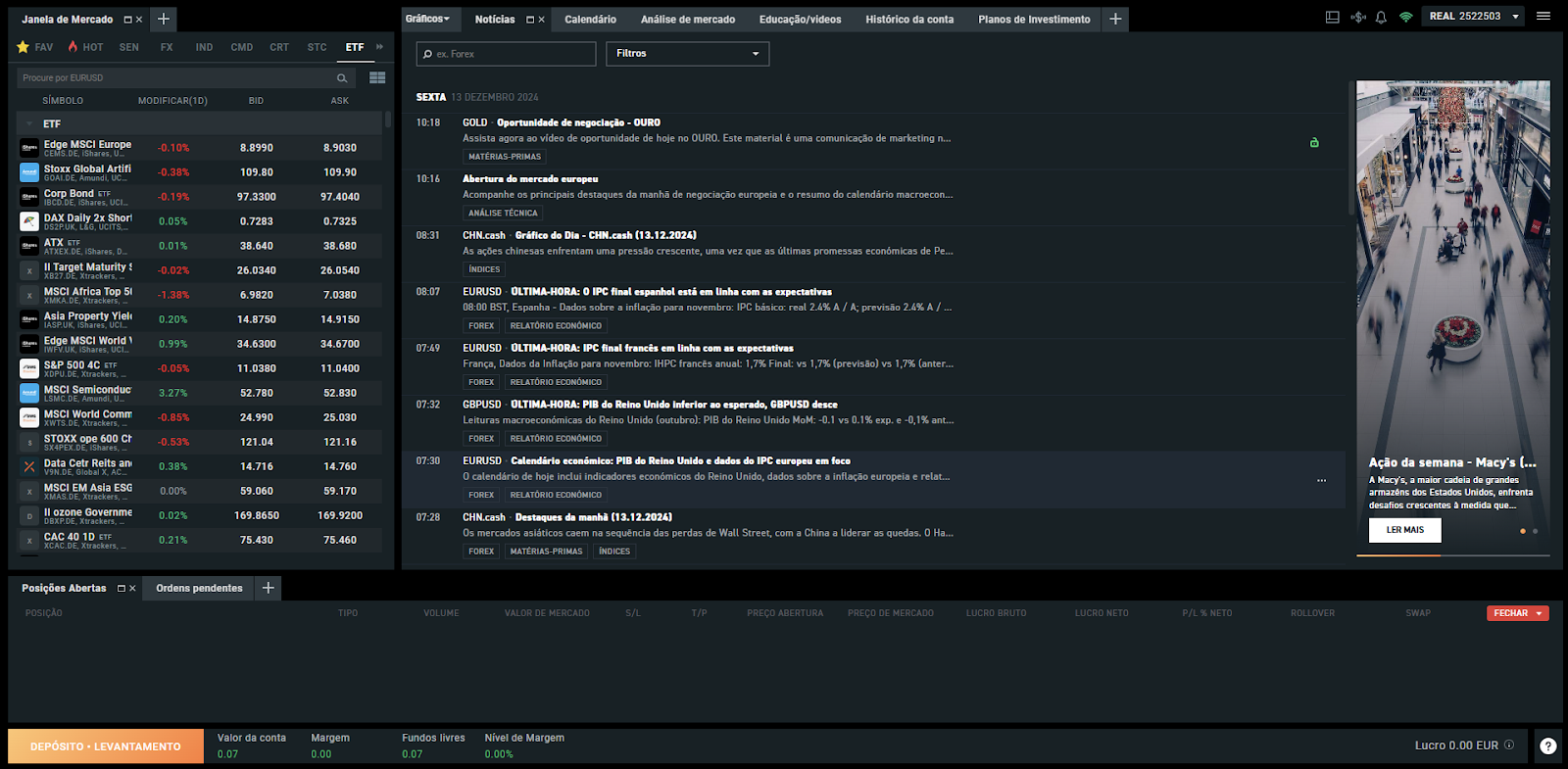
It offers 0% commission on stocks and ETFs up to a monthly volume of €100,000 (0.20% commission beyond that volume, with a €10 minimum), fractional shares and interest on uninvested cash, in euros and in dollars. The currency conversion fee is 0.50% and applies when you buy assets in currencies other than the euro.
In addition, XTB offers Investment Plans: automatic portfolios of up to 9 ETFs of your choice, with contributions from €15, useful for anyone who wants to automate their monthly investing.
Want to know more about XTB? Read our full XTB review.
XTB pros and cons
Pros
- Real stocks and ETFs with no execution fees (up to €100,000 in monthly volume)
- Operates natively in euros, with no intermediate conversions
- Automatic Investment Plans in ETFs, from €15
- Local branches and offices in several European countries
- Customer support in local languages: chat, phone and email
- In branch countries, tax on interest withheld at source (less work at tax time)
- Demo account and educational materials
- Company listed on the Warsaw Stock Exchange
Cons
- The xStation 5 platform can be complex for beginners
- Interest on cash drops to 0.90% after the first 90 days
- Cryptocurrencies only via CFDs (you do not buy the real coin)
- €10/month inactivity fee after 12 months without activity (and no deposit in the last 90 days)
- No Copy Trading or social component
- The company still relies on CFDs, riskier derivative instruments, which can be a downside for long-term "buy and hold" investors
eToro - overview
Founded in 2007, eToro revolutionised the way people invest by introducing the concept of "social investing". The platform combines social network elements with investing, allowing users to follow, communicate with and automatically copy the trades of other investors. Today it has more than 40 million users in around 75 countries and is listed on the Nasdaq (ticker ETOR).
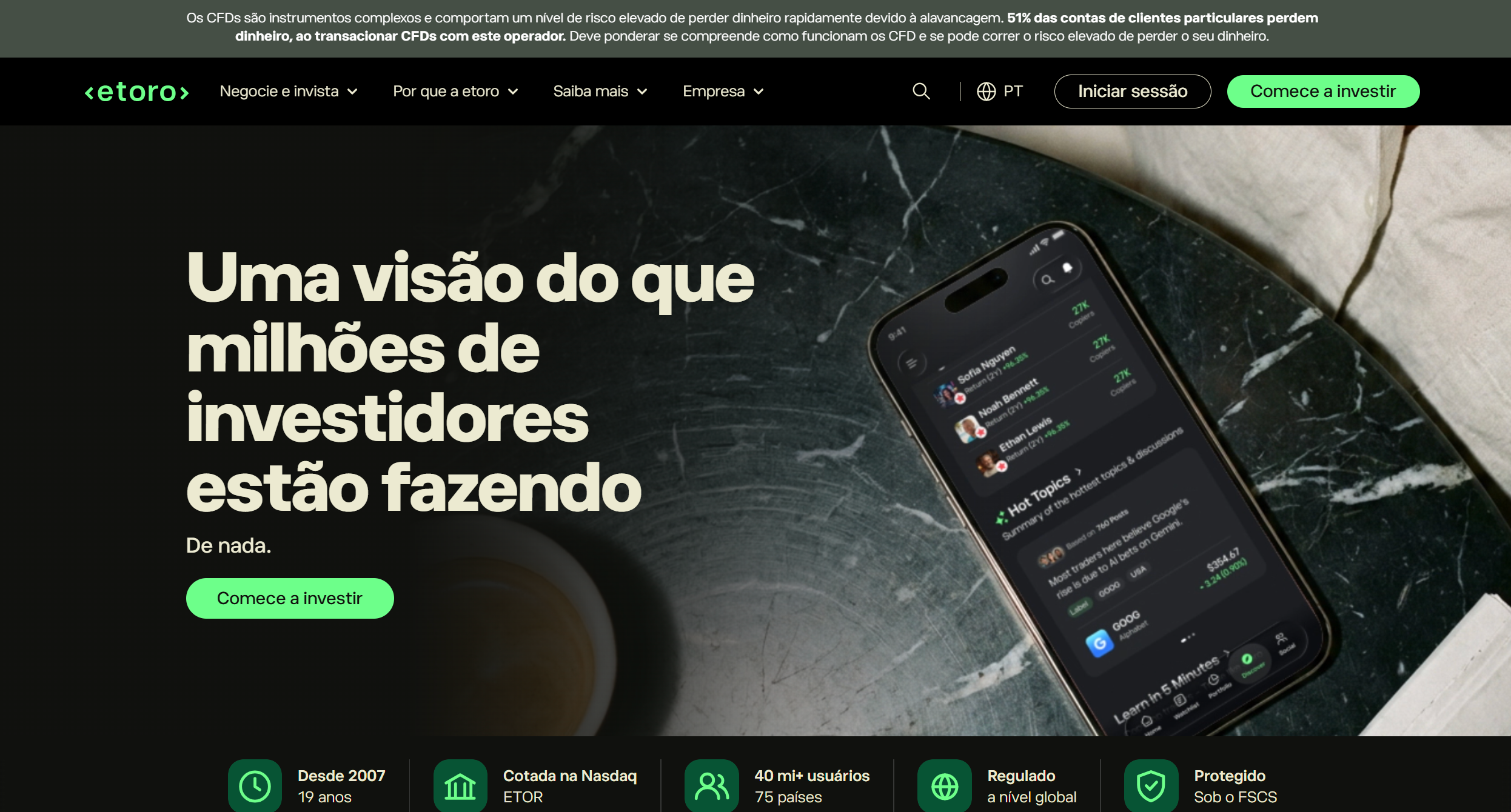
For EU investors, the relevant entity is eToro (Europe) Ltd, regulated by CySEC (Cyprus) and passported across the EU under the freedom to provide services regime, meaning no local branches or offices.
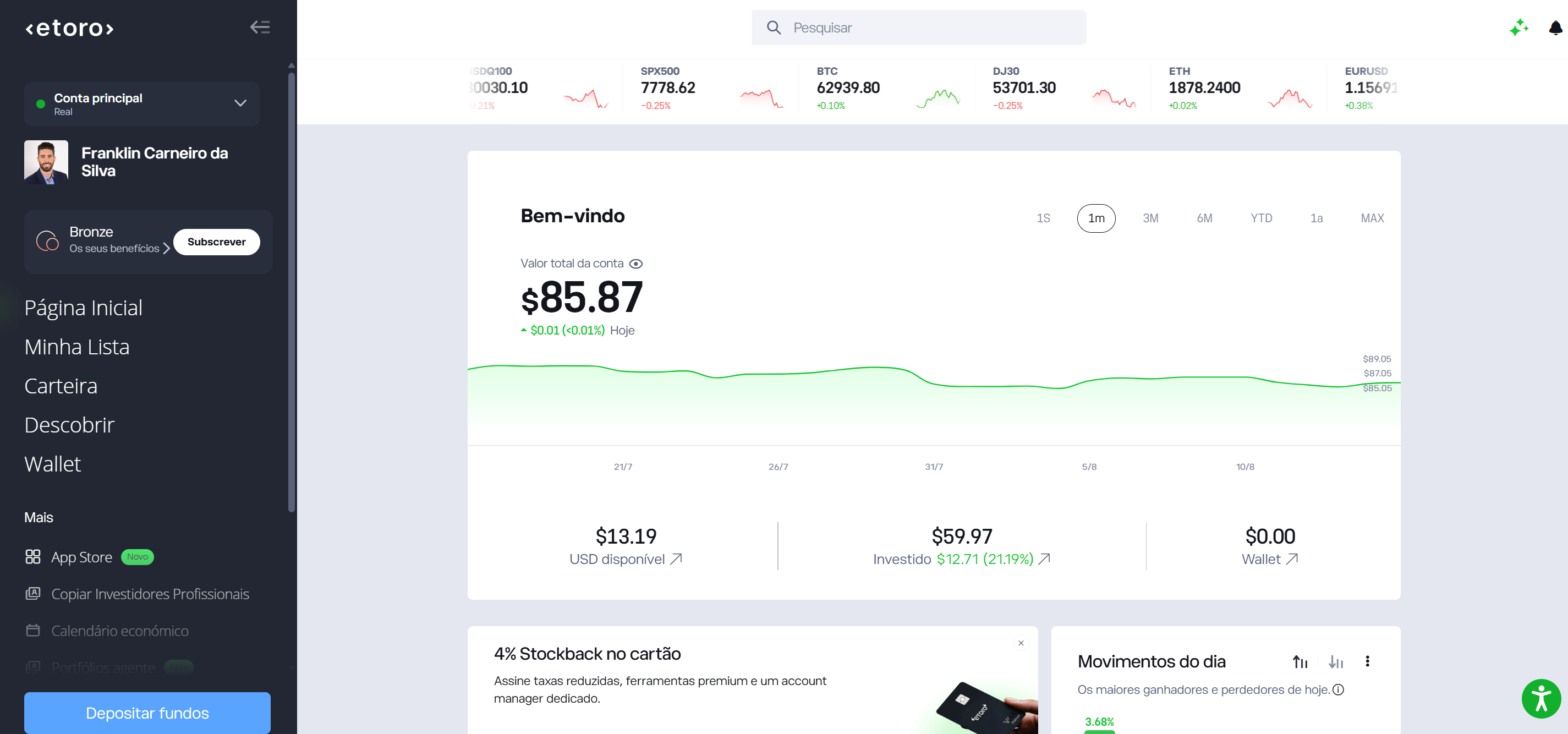
eToro stands out for letting you invest in fractional shares from just $10, in commission-free ETFs and in a wide selection of cryptocurrencies in spot mode (you buy the real coin, not a derivative). After logging in, you find a dashboard with your account value, portfolio, watchlist and access to the Popular Investors:
One thing you should know before going further: beyond traditional investing, eToro offers CFDs, and many ETFs (especially US-domiciled ones), indices, forex and commodities are made available through CFDs, and not the real asset. This information only appears clearly in the order menu, which we consider less than transparent. Read our article on the differences between a CFD and a "real" ETF.
Want to know more about eToro? Read our full eToro Europe review.
eToro pros and cons
Pros
- Copy Trading and a social component that is unique in the market
- Fractional shares from $10
- Low fees on stocks ($1 or $2) and $0 on ETFs
- More than 130 cryptocurrencies in spot mode
- Free demo account with $100,000 in virtual funds
- Interest on uninvested cash (USD only)
- Nasdaq-listed company with a strong financial position
- Private insurance from Lloyd's of London up to €1,000,000 (Platinum clients and above)
Cons
- Trades funded from the EUR account are routed through USD, with a 0.75% conversion whenever the asset is not denominated in euros
- Does not pay interest on euros
- $5 withdrawal fee on USD accounts (free on the EUR account)
- The EUR account cannot fund CFDs, CopyTrader or Smart Portfolios
- Many ETFs, indices and commodities are offered via CFDs, with little transparency
- No phone support and no local offices in most countries
- No tax withholding at source (you have to declare everything yourself)
Regulation and safety
| Feature | XTB | eToro |
|---|---|---|
| Regulators | KNF, FCA, CySEC, DFSA, FSC | CySEC, FCA |
| Local presence | Branches and offices in several European countries | Passported across the EU (no local offices) |
| Investor compensation fund | KDPW (Poland): 100% of the first €3,000 and 90% of the excess, on assets up to €22,000, for a maximum payout of €20,100 | Up to €20,000 (ICF, Cyprus), covering 90% of eligible claims |
| Private insurance | No | Yes, Lloyd's of London up to €1,000,000 (Platinum clients and above) |
| Asset segregation | Yes | Yes |
| Negative balance protection (for CFDs) | Yes | Yes |
| Banking licence | No | No |
| Publicly listed | Yes (Warsaw Stock Exchange) | Yes (Nasdaq: ETOR) |
Both are publicly listed companies, which guarantees more rigorous public scrutiny of their financial reports, and neither has a banking licence.
XTB stands out for its physical presence across Europe: local branches registered with national regulators and offices in several countries give it a proximity to European investors that eToro does not have. Client assets are protected by the KDPW compensation scheme: 100% of the first €3,000 and 90% of anything above that, on covered assets up to €22,000. The maximum any single investor can actually receive is €20,100.
At eToro, EU clients are served by eToro (Europe) Ltd (Cyprus) and assets are protected by the Cypriot investor compensation fund (ICF) up to €20,000. eToro also offers private insurance from Lloyd's of London up to €1,000,000, but only for Platinum clients and above. Note that CySEC is generally considered a less demanding regulator than Poland's KNF or the UK's FCA.
One detail worth knowing about eToro: money held in the EUR local currency account sits with eToro Money Malta Ltd, a payment institution. eToro states that those funds are safeguarded under regulatory standards, but they are not covered by Malta's Depositor Compensation Scheme.
Financial instruments
| Products | XTB | eToro |
|---|---|---|
| Stocks | Yes (6,000+) | Yes (6,000+) |
| ETFs | Yes (1,400+) | Yes (many via CFDs) |
| Fractional shares | Yes | Yes (from $10) |
| Options | Yes (buying calls/puts only) | No |
| Cryptocurrencies | Yes (via CFDs) | Yes (130+, in spot mode) |
| Forex | Yes (via CFDs) | Yes (via CFDs) |
| Indices and commodities | Yes (via CFDs) | Yes (via CFDs) |
| Bonds | No | No |
| Automatic investment plans | Yes (in ETFs) | Yes (Recurring Investments) |
| Copy trading | No | Yes |
The core offer is similar: thousands of real stocks and ETFs, fractional shares and CFDs on forex, indices and commodities. Neither offers bonds or traditional mutual funds.
The big differences are at the edges: XTB offers options (buying calls and puts only) and a larger selection of real ETFs, while eToro offers cryptocurrencies in spot mode (at XTB they only exist via CFDs) and Copy Trading. At eToro, many US ETFs, indices and commodities are made available via CFDs without this being obvious at first glance. At XTB, the separation between real assets and CFDs is clearer on the platform.
Important note: For legal reasons, US-domiciled ETFs cannot be sold directly to retail investors in Europe. On eToro, these ETFs are offered through CFDs, which merely replicate the performance of the original fund. CFDs are complex derivative products, with additional costs (spreads, overnight fees). At XTB, the ETFs available for real investing are UCITS (domiciled in Europe).
Base currency: euros vs dollars
This is one of the most important differences between the two brokers for a euro-based investor.
XTB operates natively in euros. You deposit, invest and withdraw in EUR, and you only pay currency conversion (0.50%) when you buy assets quoted in other currencies, such as US stocks in USD.
eToro operates in dollars (USD). There is now a EUR local currency account (provided by eToro Money Malta) for EU residents, which lets you deposit and withdraw in euros via SEPA with no conversion fee. The mechanics of a trade are worth understanding: when you open a position with funds from your EUR account, those funds are routed through USD in the investment account, whatever the asset's currency. What that costs you depends on the asset. If the asset is denominated in euros, eToro charges no conversion fee at all. If it is denominated in dollars, a 0.75% conversion applies to that trade.
Three limits are worth knowing before you rely on the EUR account. It only funds trades in real stocks, ETFs and cryptoassets: CFDs, CopyTrader and Smart Portfolios can only be funded in USD. Popular Investors cannot trade with EUR funds at all. And positions worth more than $50,000 cannot be closed back to the EUR account, so the proceeds stay in dollars.
In practice, for anyone investing mainly in UCITS ETFs and European stocks in euros, XTB is still simpler: the money never leaves euros. At eToro the FX cost on those same assets is now zero too, but the routing through USD stays, and with it the timing exposure eToro itself warns about, since moves in the USD rate while a euro-denominated order is pending can change the price you end up paying. The gap is narrower than it used to be, and it reopens as soon as you buy US-denominated assets.
Copy Trading: the feature that sets eToro apart
Copy Trading lets you automatically copy the positions of other investors (the "Popular Investors"), from $200 per copied investor. It is the feature that made eToro famous and that XTB does not offer.
It can be interesting for anyone who wants to start without analysing markets on their own, but it carries relevant risks: the tendency to pick investors with extraordinary past returns (survivorship bias), costs accumulated across the various trades (spreads and conversions) and lack of control over the positions taken. Note also that copied positions can only be funded in USD, not from your EUR account. We explain everything in detail in our eToro review.
On XTB's side, the alternative for automating your investing is the ETF Investment Plans: less "social", but more aligned with a long-term strategy in diversified ETFs.
Investment platforms
| Feature | XTB | eToro |
|---|---|---|
| Platforms | xStation 5 (web and desktop) and xStation Mobile | Web version and mobile app (iOS and Android) |
| Ease of use | Customisable, more complete and complex | Simple, with a strong social component |
| Tools | Several technical and fundamental analysis indicators | Social feed, asset statistics, basic technical analysis |
| Charts | Advanced | Intermediate |
| Demo account | Yes | Yes ($100,000 virtual) |
XTB's xStation 5 offers more advanced tools and charts, which appeals to anyone who wants to analyse markets in detail, but can intimidate beginners. eToro bets on the social and community component (news feed, comments from other investors on each asset), with a lighter experience.
For anyone investing every month, both allow automation: XTB with the ETF Investment Plans (from €15) and eToro with Recurring Investments.
Fees
| Fee type | XTB | eToro |
|---|---|---|
| Stocks (EU, US, UK) | 0% commission* | $1 or $2 per trade** |
| ETFs | 0% commission* | $0 |
| Investment plans | €0 commission | $0 commission |
| Cryptocurrencies | Spread (CFDs) | 1% per trade |
| Currency conversion | 0.50% | 0.75% on trades in non-euro assets funded from the EUR account; €0 on euro-denominated assets |
| Withdrawal fee | €0 | €0 from the EUR account, $5 from the USD account |
| Inactivity fee | €10/month after 12 months without activity (and no deposit in the last 90 days) | €0 (abolished in May 2026) |
*Up to €100,000 in monthly trading volume. For investments above this limit, there is a 0.20% commission (€10 minimum).
**The $2 fee applies only to some exchanges (Australia, Hong Kong, Dubai, Abu Dhabi and Tokyo). For most European clients, the majority of exchanges carry a $1 fee per trade (to open and to close the position). Check eToro's website for the current fees.
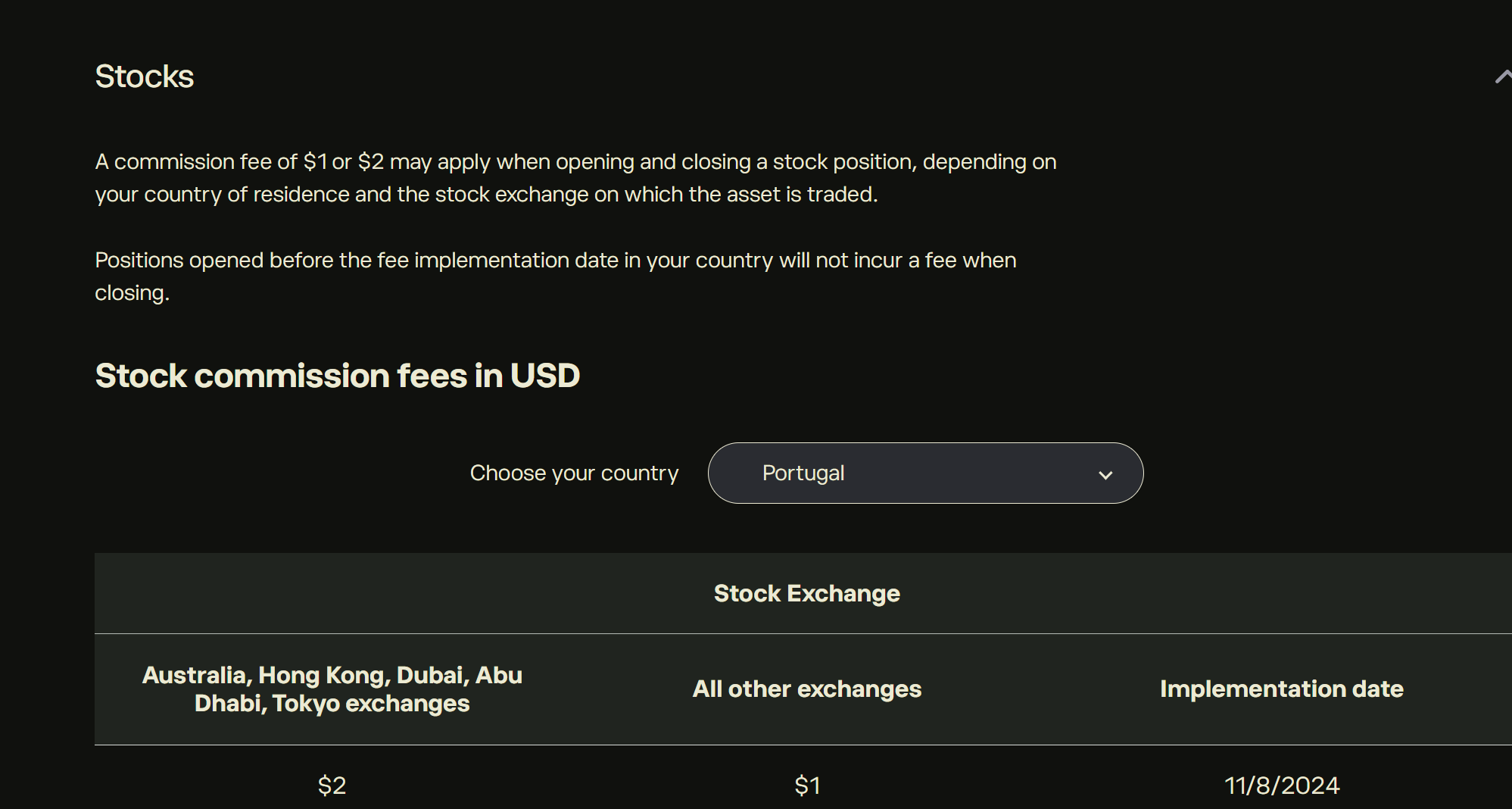
On trading fees, XTB has the edge: 0% on stocks and ETFs for the overwhelming majority of retail investors (few exceed €100,000 in monthly volume), against $1 per stock trade at eToro.
Around the trade the picture is more balanced than it used to be. eToro no longer charges an inactivity fee, withdrawals from the EUR account are free, and euro-denominated assets carry no conversion. The 0.75% conversion still applies whenever you buy in another currency, which is where XTB's 0.50% wins. At XTB there is no withdrawal fee either, but there is a €10 monthly inactivity fee that eToro has now dropped.
Interest on uninvested cash
Both pay interest on uninvested cash, but with very different approaches.
| Feature | XTB | eToro |
|---|---|---|
| Rate | 2.30% for the first 90 days, 0.90% after (subject to change) | 2.75% (total balance from $1 to $50,000) and 3.55% (above $50,000), subject to change |
| Currency | EUR and USD | USD only (EUR balances earn nothing) |
| Tax withheld at source | Yes, in several branch countries | No (you declare it yourself) |
XTB pays interest in euros, which is more practical for a euro-based investor, but the rate drops to 0.90% after the first 90 days. eToro pays higher rates, but only on dollars, with manual activation in the Club Dashboard, and the rate is determined by the total account balance (including the invested amount), although it is only applied to the cash balance in USD.
If interest in euros is your main criterion, brokers like Trade Republic or Trading 212 pay more competitive rates on an ongoing basis.
What about dividends?
If you invest in dividend-paying stocks or ETFs, there is an important difference between owning the real asset and merely having exposure through a CFD.
With real stocks, at both XTB and eToro, you receive the true dividend. In the case of US stocks, the US withholds tax at source before the money reaches your account. Thanks to the tax treaties most European countries have with the US, that rate is typically 15% (instead of 30%), and both brokers handle the necessary paperwork (the W-8BEN form) during account opening.
At eToro, when the position is a CFD (as is the case with many US ETFs), you do not receive a true dividend, but rather an "equivalent payment" credited to your account. On US instruments, these payments can suffer a 30% withholding, instead of the 15% applicable to real stocks. It is one more reason to always confirm, before buying, whether you are acquiring the real asset or a CFD.
Taxes
Here XTB has a practical advantage in the countries where it operates local branches.
At XTB, in branch countries, interest on uninvested cash is paid with local tax already withheld at source, just as it would be at a local bank. In other words, you receive the interest net of tax and, as a rule, have less to handle in your return. Capital gains and dividends remain your responsibility to declare.
At eToro, there is no withholding at all: you are responsible for declaring capital gains, dividends and interest in your annual tax return, as foreign-sourced income. There is also an extra layer of complexity: since the investment account operates in dollars, you will have to convert the amounts into euros in your tax return, using the applicable exchange rate. The broker provides a tax statement that helps with this process.
With both, if you do not declare this income, the risk of a tax discrepancy increases, since tax authorities across Europe receive information from foreign brokers through the Common Reporting Standard (CRS). Tax rules vary from country to country, so if you are unsure about your situation, check with a local tax adviser.
Customer support
XTB
XTB's customer support is frequently highlighted as one of its strong points. It is available in local languages in its branch countries, through live chat, phone and email, with extended hours, and the broker provides dedicated account managers. The existence of local offices reinforces its proximity to European investors.
eToro
eToro's support is available mainly through live chat with human agents. eToro Club members (Silver tier and above) get access to an exclusive WhatsApp line, and high-value accounts have dedicated managers. eToro does not offer phone support for most European investors and has no local offices in most countries.
On this criterion, the advantage clearly goes to XTB.
So, which one should you choose?
The choice between XTB and eToro depends, above all, on your investor profile and what you value in a broker.
XTB is the natural choice for anyone who wants to invest in euros, with no commissions on stocks and ETFs, automate their monthly investing with the Investment Plans and count on customer support in their own language, with branches and offices across Europe. The tax withholding at source on interest in branch countries is one more convenience. In return, the platform can be complex for beginners and cryptocurrencies only exist via CFDs.
eToro is the ideal option for anyone who values the social component and Copy Trading, wants cryptocurrencies in spot mode and prefers a lighter, more community-driven experience. In return, you accept the operational routing through the dollar, the 0.75% conversion on non-euro assets, the fact that copied positions can only be funded in USD, and the less-than-transparent mix of real assets and CFDs.
Whichever you choose, both brokers are regulated in Europe, publicly listed and have a free demo account for you to experiment without risk. The most important thing is to analyse your financial goals and your investing style before making a decision.
If you want to explore other options, read our comparison of the best trading platforms in Europe or our XTB vs Trade Republic, XTB vs DEGIRO and eToro vs DEGIRO comparisons.
Disclaimer: CFDs are complex instruments and come with a high risk of losing money rapidly due to leverage. 77% of retail investor accounts lose money when trading CFDs with this provider (XTB). 51% of retail investor accounts lose money when trading CFDs with this provider (eToro). You should consider whether you understand how CFDs work and whether you can afford to take the high risk of losing your money. Past performance is not indicative of future results. No financial advice or investment recommendations are given. All content in this article is for information and educational purposes only. It is essential that you carry out your own analysis before making any investment. If necessary, you should seek independent financial advice from a qualified professional registered with your national regulator.