Lightyear business account: how to invest your company's spare cash (2026)

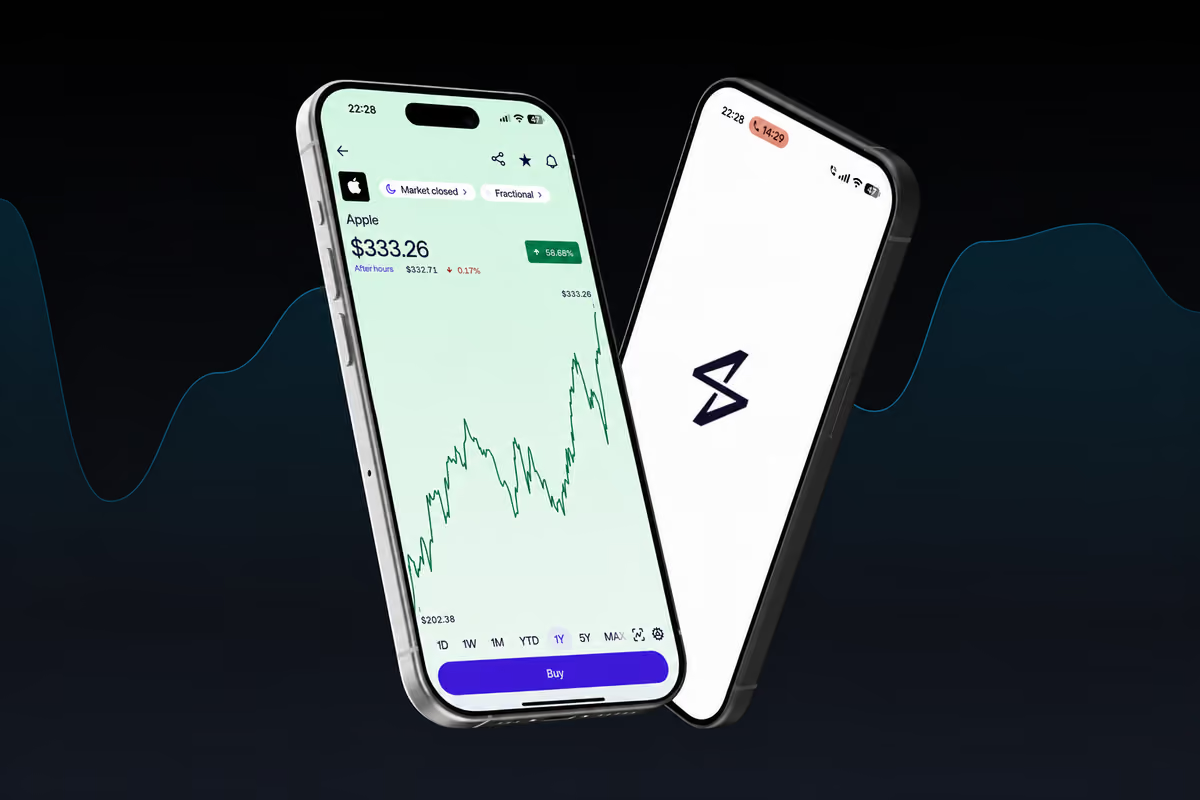


If your company has cash it doesn't need for running costs, it usually sits in a current account earning nothing. You can pay it out as a dividend and invest it yourself, but then you pay tax straight away in some countries. The other option is to invest directly through the company, for example with a Lightyear business account.
How much you gain depends on your country. Estonia and Latvia, for example, only tax company profits when they are paid out, so the money can grow inside the company with no tax along the way. In our Estonian example, €10,000 invested through the company at 6% a year leaves about €1,360 more after 10 years than paying a dividend now (before the LEI and accounting costs).
Best providers for investing through your company
A company can open a securities account with a broker or a bank. These are the most common options in Europe:
- Lightyear: the simplest option for small and medium companies. The business account is free, with no custody or monthly fees and no execution fee on ETFs. Fund manager and currency conversion fees may apply. You can keep a cash buffer in money market funds and order an LEI in the app. With our code INVESTINGINTHEWEBBIZ, a new business account can get €30 to €300 in a fractional share, ETF or money market fund. Terms apply.
- Interactive Brokers: a wider choice for larger amounts, with more than 170 markets in one account. The platform suits more experienced investors. Read our Interactive Brokers review.
- Your business bank: handy if the company already banks there. Trading fees are usually higher than at online brokers, so check the price list before you buy.
- Revolut Business: a business account that pays interest on savings, handy for the cash buffer. Companies can't buy ETFs with it. Business Savings pays a variable rate that depends on your plan and country: in Portugal, for example, it goes from 1% on Basic to 2.25% on Enterprise (Revolut). New business customers get a €200 welcome bonus in most European countries until the end of 2026.
Data as of 24 November 2026 from the providers' price lists and websites. Rates are variable and Lightyear's is after fees. The LEI price is for the first year. The Interactive Brokers fee is for the Fixed plan, and its full interest rate only applies from $100,000 of net assets: smaller accounts get a proportional rate (see our Interactive Brokers fees guide). At Lightyear, fund manager and currency conversion fees may apply. Revolut's rate depends on your plan and country.
Is investing through your company worth it?
It depends on how your country taxes companies. The clearest case is Estonia, where a company only pays tax when it distributes profits.
Say your Estonian company has €10,000 of retained profit that you won't need personally for the next 10 years, and the investment returns 6% a year. In option A, the company pays it out as a dividend now and you invest it yourself. In option B, the company invests it and pays the dividend after 10 years.
Estonia's 22/78 dividend tax means the company pays €22 to the state for every €78 the owner receives (Estonian Tax and Customs Board).
The calculation assumes a 6% annual return and 22% income tax, which is also Estonia's rate on personal investment gains. It leaves out trading and accounting costs. The LEI costs about €450 + VAT over 10 years (€48 in the first year and €45 for each renewal). This is an example: the real return can be higher, lower or negative. Taxes depend on your situation and can change.
Investing through the company leaves €1,357 more. After the LEI cost of about €450 + VAT, the advantage is roughly €800 to €900, depending on whether your company is VAT registered. The gap comes from the company being taxed only once, when it pays out. If you invest personally, you pay tax on the dividend first and again on the gain. The longer the period and the higher the return, the bigger the gap: at 7% over 15 years it would be €3,018.
In other European countries
Latvia works like Estonia: undistributed profits aren't taxed and the 20% corporate tax only applies when profits are paid out (Latvian State Revenue Service). Most other countries tax company profits every year, including interest, dividends and gains from investments. Investing through the company still delays the personal tax on dividends, but the returns are taxed along the way at the corporate rate.
So the maths comes down to two rates in your country: the corporate tax on investment income and the personal tax on dividends and gains. Some countries also have extra rules for companies that mainly hold investments. Ask your accountant to run your numbers before you move money.
Keep the risks in mind. Markets can fall, and if the company needs the money in a downturn, it will have to sell at a loss. Tax rules can change too: Estonia scrapped its lower 14/86 dividend rate in 2025, for example.
Pros
- You only pay personal tax when the company pays you a dividend, so the whole amount stays invested.
- Quick to set up: opening a Lightyear business account takes about 10 minutes.
Cons
- Not a fit if you need the money for personal costs soon, since you'll have to pay it out anyway.
- With small amounts, the LEI and the extra accounting work can cancel out the advantage.
- Not a fit if you plan to close the company soon, since a liquidation payout is taxed too.
Where to put your company's spare cash
Not all company money should go into shares. Keep one to three months of running costs, taxes included, in the current account. Put money you may need in the next 6 to 12 months in a buffer, and invest for the long term only what you won't need for at least 5 years.
The buffer should earn interest and stay easy to reach. Revolut Business Savings pays 1% to 2.25% a year, depending on your plan and country. Lightyear's euro money market fund paid about 2.5% a year after fees in November 2026, but it isn't a deposit and its value can move. You can compare business accounts in our list of the best digital banks for businesses.
For long-term investing, accumulating ETFs suit a company well, because the fund reinvests dividends instead of paying them out. See our list of the best accumulating ETFs.
In the EU, the deposit guarantee also covers company deposits. Revolut Bank UAB deposits are covered by the Lithuanian deposit insurance scheme. €20,000 is the EU minimum for investor protection.
How company investments are taxed in Europe
The rules depend on where your company is tax resident. In Estonia and Latvia, nothing is taxed while the money stays in the company. In most other countries, the company pays corporate tax every year on its investment income and the owner pays tax on dividends when they're paid out.
How to pay a dividend
A dividend normally needs approved annual accounts and a shareholder decision. The payout can't take equity below the legal minimum or leave the company unable to pay its debts. The company then declares and pays any tax due by your country's deadline: in Estonia, that's the 10th of the month after the payout.
What to ask your accountant
Investments appear in the company's balance sheet and annual report, so agree on the setup with your accountant before the first purchase. Ask whether the investment counts as short or long term, at what value the securities go into the year-end balance sheet, which reports they need from the broker and how to book purchases in dollars and US dividends.
LEI code: what it is and how a company gets one
An LEI (Legal Entity Identifier) is a 20-character code that identifies a company in financial transactions. Without one, a bank or broker won't carry out your company's orders for shares and ETFs. You don't need it for a deposit or a money market fund.
The code is valid for one year and then has to be renewed. You can buy it in the Lightyear app when you place your first order: €48 + VAT, then €45 + VAT for each renewal (Lightyear help centre). UK companies pay £42.50 + VAT. You can also get one from an LEI issuer or a registration agent in your country, and some offer multi-year plans. GLEIF lists them by country. One code works with every provider, and you can check an existing code in the GLEIF database.
Lightyear business promo code: up to €300
With our code INVESTINGINTHEWEBBIZ, a new Lightyear business account gets a fractional share, ETF or money market fund worth €30 to €300 (Lightyear offer page). Enter the code when you open the business account, or later under Promotions. Then complete the business verification, get an LEI and deposit at least €1,000 within 45 days.
The business account must be less than 15 days old when you add the code. In 80% of cases the reward is €30 to €50, and 2% of accounts get €151 to €300. You can withdraw it after 6 months. Until then, your net deposits must stay at or above your qualifying deposit plus the reward. UK companies can get up to £300.
Already used a code on your personal account? You can still use one on the business account, as long as you haven't claimed more than one code before. New users also get €10 to €100 on their personal account with our code INVESTINGINTHEWEB. Terms apply.
How to open a Lightyear business account (step by step)
The questionnaire takes about 10 minutes. You don't need to deposit money or buy an LEI to open the account.
Have rough figures for the company's assets, revenue and equity ready, plus a link to its website or social media. The account has to be opened by someone who can legally represent the company, such as a director or board member.
Step 1: Open a personal account
A business account needs a personal Lightyear account first. If you're new, sign up with the code INVESTINGINTHEWEB (INVESTINGINTHEWEBUK in the UK) to get a fractional share or ETF worth €10 to €100 after a deposit of at least €100 within 15 days. Investing involves risk and returns aren't guaranteed. See the terms.
Step 2: Choose "Business account"
Open your profile (top right on the web app), choose "Business account" and start the setup.
You switch between your personal and business accounts from the same menu.

Step 3: Find your company
Enter your company's registration number. In our test, Lightyear pulled the details from the business register and we only had to check and confirm them.
If something is wrong, it has to be fixed in the register, not in Lightyear.

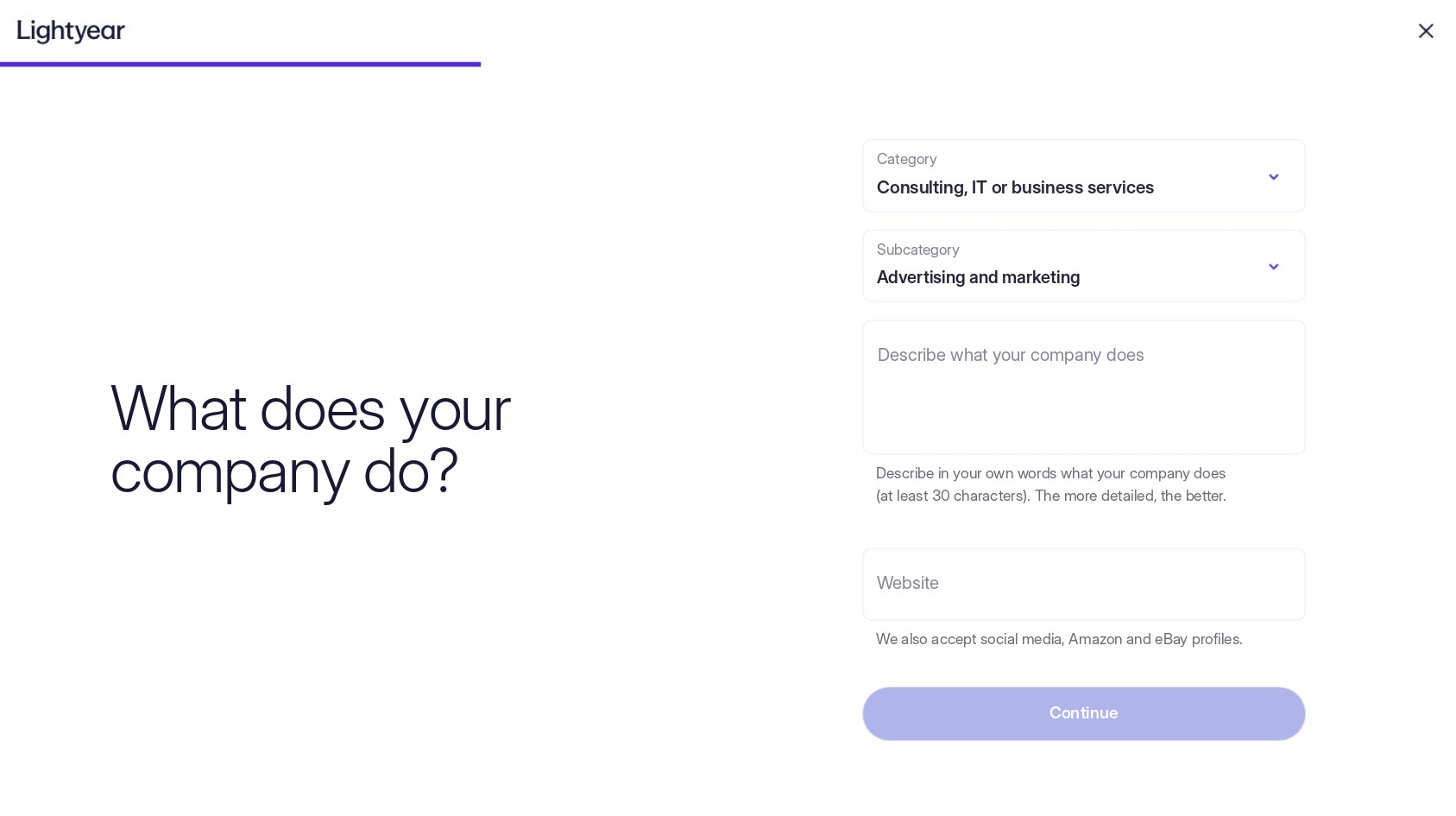
Step 4: Describe what the company does
Choose the industry and write a short description of at least 30 characters. Add a link to the website or social media.
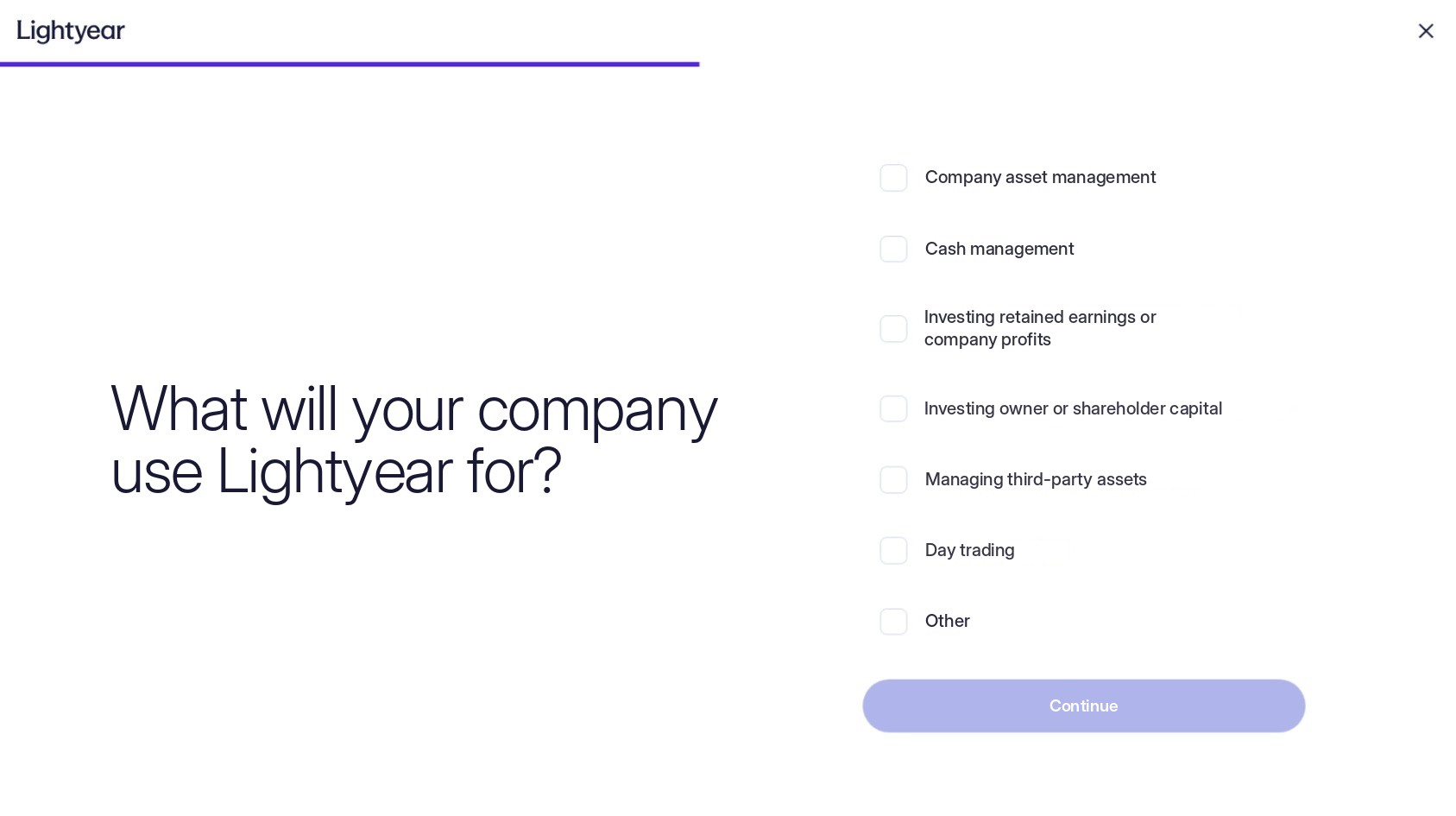
Step 5: Choose the purpose and add financial details
To invest the money the company has earned, choose the option for investing retained earnings or company profits.
Lightyear then asks where the money comes from and for ranges of assets, revenue and equity. Take them from the latest balance sheet or enter an estimate.
Step 6: The account is ready
The app confirmed straight away that the business account was set up, and an email saying it was ready arrived the next day.
Lightyear says onboarding can take a couple of business days. In our test everything was open the same day, but wait for the email before your first deposit to be safe.
The home screen shows a notice about the W-8BEN-E form. Fill it in if you plan to buy US shares, since it lowers the tax withheld on their dividends.

Step 7: Transfer money from the company's bank account
Choose to add money and transfer it from the company's bank account, using exactly the payment reference shown. Lightyear doesn't accept transfers from a personal account.
Later on, Lightyear may ask for proof of where the money comes from, such as 6 months of bank statements and invoices.

Step 8: Open a money market fund
In the portfolio, the money market funds block is on the right. Open it, read the terms and confirm to open the fund.
A money market fund is an investment and, like any investment, it carries risks. The return is variable: at the time of writing (23 November 2026), the euro fund paid 2.49% a year after fees.

The fund page then opens. Enter the amount, continue and confirm the purchase on the summary screen. The money is in the fund straight away.

Step 9: Buy an ETF or a stock
You need an LEI to buy shares and ETFs. If you don't have one yet, register it from the order screen for €48 + VAT. The app says this usually takes up to two business days.

Once the LEI is in place, search for the ETF or stock, enter the amount and confirm the order.
Each company can only have one Lightyear business account. If other people need access, the director can ask customer support to add them. Read more in our Lightyear review.
Frequently asked questions
Can a company invest in shares and ETFs?
Yes. A company can invest its spare cash in shares, ETFs, bonds and funds. It needs a securities account in the company's name and, for exchange-traded securities, an LEI.
Which companies can open a Lightyear business account?
Companies from Austria, Belgium, Cyprus, Estonia, Finland, France, Greece, Hungary, Ireland, Italy, Latvia, Lithuania, Luxembourg, Malta, the Netherlands, Portugal, Slovakia, Slovenia, Spain and the UK. Business accounts aren't available in Bulgaria, Croatia, Denmark, Germany, Norway and Sweden. Most company types are accepted, including private and public limited companies, partnerships and cooperatives. In the UK, only private limited companies registered at Companies House qualify for now. Charities, trusts and foundations aren't accepted (Lightyear).
Can I use a personal and a business promo code?
Yes. If you used a code when you opened your personal account, you can still use a business code, as long as you haven't claimed more than one code before.
Can I move my personal portfolio into the company?
Usually you sell the securities first. The sale is taxed under the personal rules, and you can then lend the cash to the company or pay it in as capital. A contribution in kind is also possible, but it needs its own paperwork and valuation. Discuss the details with your accountant.
Can a sole trader invest through the business?
A sole trader isn't a separate legal entity, so there's no company tax advantage. You invest as a private person.
Can an e-resident's Estonian company open a Lightyear business account?
Yes, Estonian companies are eligible, but the person opening the account must live in a country where Lightyear offers personal accounts. Also check where your company is tax resident: if you run it from another country, that country may tax it, and the Estonian rules on retained profits may not apply. Read more in our guide to bank accounts for e-residents.
Is a money market fund the same as a deposit?
No. A deposit is a loan to the bank, covered by the deposit guarantee up to €100,000. A money market fund is an investment and its value can move. Investor protection (up to €20,000 in the EU) covers you if the broker can't return your assets, but it doesn't make up for a fall in the fund's value.
Do I need a separate holding company to invest?
Not for a normal ETF or share portfolio. A holding company mostly helps when you own larger stakes in other companies or plan to sell your business. In that case, talk to an accountant or tax adviser.
Summary
If your company has money you won't need personally in the next few years, investing through the company can save tax compared with paying it out now, especially in Estonia and Latvia. Elsewhere it depends on your country's rates, so check with your accountant first and get an LEI before you buy shares or ETFs.
For small and medium companies, a Lightyear business account is the simplest choice, and our code INVESTINGINTHEWEBBIZ can add up to €300. Interactive Brokers suits larger amounts, and your own bank is the easy option if you want to stay there. Keep daily cash in the current account, the buffer in a savings account or money market fund and long-term money in ETFs.
This article contains affiliate links: if you open an account through them, we may earn a commission at no extra cost to you. Investing involves risk and returns are not guaranteed. Lightyear Europe AS provides investment services in the EU and Lightyear UK Ltd in the UK. Promotion terms apply. This article is for information only and is not investment, tax or financial advice.