Pepperstone review 2026: a broker for active European traders?

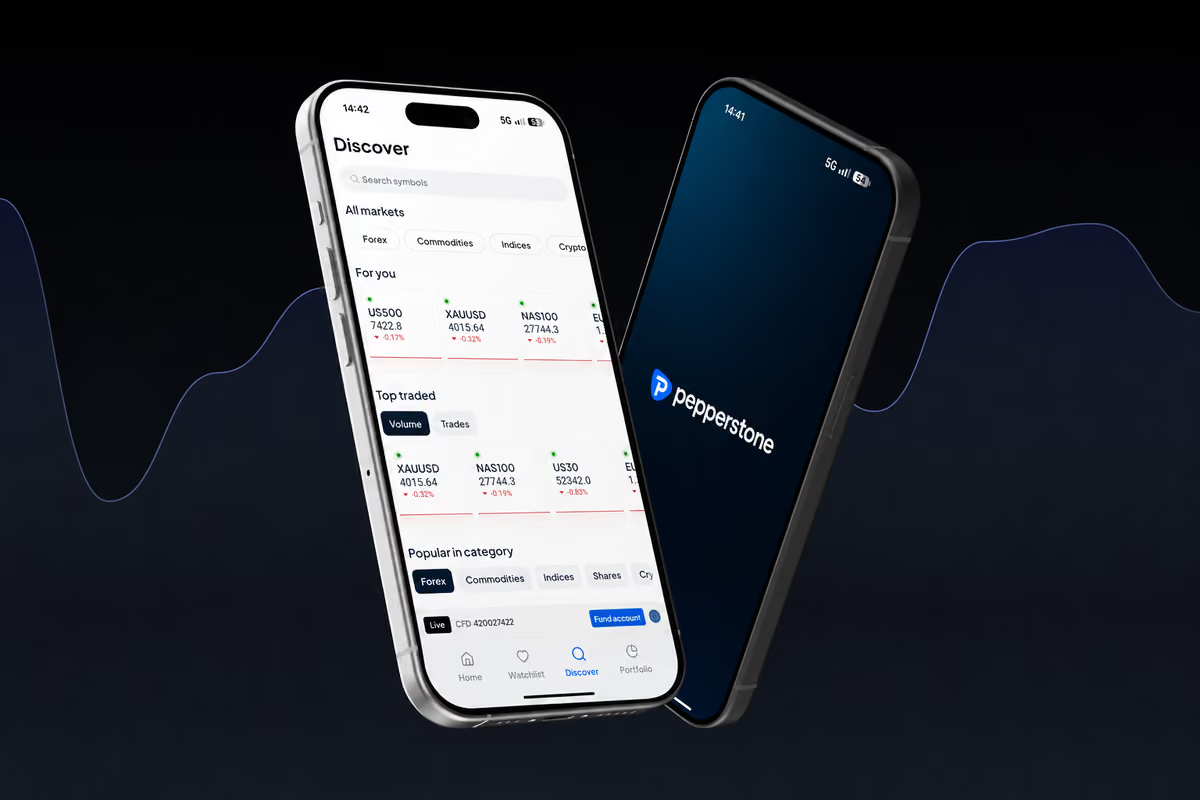



In this review we look at Pepperstone, an Australian-founded broker that serves European clients through a CySEC-regulated Cypriot entity.
The most important thing to establish first: everything Pepperstone offers EU retail clients is a contract for difference (CFD), a leveraged derivative where you never own the underlying share, ETF or currency. That rules it out for long-term investing, and if that is what you are here for, our guide to the best trading platforms in Europe is the right starting point instead. For the narrower group of people who actively trade, Pepperstone offers one of the strongest combinations of raw pricing and platform choice available in the EU.
Our overall take: Pepperstone is an excellent execution venue for experienced, active traders and a poor fit for everyone else. The pricing is genuinely competitive, the regulatory footprint is strong, and the non-trading fee schedule is clean.
⚠️ Risk warning: CFDs are complex instruments and come with a high risk of losing money rapidly due to leverage. 72.9% of retail investor accounts lose money when trading CFDs with this provider. You should consider whether you understand how CFDs work and whether you can afford to take the high risk of losing your money.
Overview
Pepperstone was founded in Melbourne in 2010 by a group of traders who felt existing brokers were too slow and too expensive. It has since grown into one of the larger independent CFD brokers globally, with a stated 830,000+ traders worldwide and monthly trading volume above US$1 trillion (company figures, as at October 2025). The group is led by CEO Tamas Szabo and remains privately held.

European clients are onboarded by a single entity: Pepperstone EU Limited - registered in Cyprus under company number HE 398429, authorised and regulated by the Cyprus Securities and Exchange Commission (CySEC) under licence number 388/20, granted on 3 August 2020. Registered office: 195 Makarios III Avenue, Neocleous House, 3030 Limassol.
Elsewhere in the group, Pepperstone holds licences from the FCA (United Kingdom), BaFin (Germany), ASIC (Australia), the DFSA (Dubai), the CMA (Kenya) and the SCB (Bahamas) - seven regulators in total, three of them tier-one. That matters less than people assume, because as an EU client your counterparty and your protections come from the Cypriot entity alone, but a long multi-jurisdiction record with no revoked licences is still a reasonable signal. If you want the wider picture, see our overview of financial regulators in Europe.
One practical note: Pepperstone's EU service is not offered to residents of Belgium or Spain (nor the United States). Belgium bans the retail marketing of CFDs outright; Spain applies its own restrictions.
Pepperstone's product philosophy is deliberately narrow, and in the opposite direction to a neobroker like Lightyear. It does one thing: leveraged derivatives, executed fast, priced tightly, on whichever platform you already use. There is no share dealing, no ETF investing, no savings plan, no interest on idle cash, and no tax wrapper.
Video summary
Highlights
Pros and cons
Pros
- Raw spreads from 0.0 pips on FX with a transparent, fixed per-lot commission (Razor account)
- The widest platform choice«: MT4, MT5, cTrader, TradingView and a proprietary platform
- Fast execution with deep Tier-1 bank liquidity, and no dealing desk
- Scalping, hedging and fully automated strategies are all permitted
- No inactivity, deposit, withdrawal, admin or market-data fees
- Four base currencies (EUR, USD, GBP, CHF)
- No minimum deposit and a free demo account
- Client money held in segregated accounts at tier-1 banks, with negative balance protection for retail clients
- Volume rebates available through the Active Trader Program
- Long multi-jurisdiction regulatory record with no revoked licences
Cons
- CFDs only. You never own the underlying asset, so it is unsuitable for long-term investing, dividends or tax wrappers
- No interest paid on uninvested cash, unlike most European investing platforms
- Commission applies on the Razor account, and TradingView execution is not available on Standard
- No native copy trading or social feed
- No guaranteed stop-loss orders
- Educational material is thinner than at XTB or eToro
- Not available to residents of Belgium or Spain
- Privately held, with no public financial statements or credit rating
Standard or Razor: which one actually costs less?
This is the single most consequential decision you make at Pepperstone, and the marketing does not make it obvious. Both accounts give you identical instruments, execution and platforms. The only difference is how you pay.
- Standard: Pepperstone adds a 1 pip mark-up to the raw spread. There is no separate commission on FX, indices, commodities or crypto. Share and ETF CFDs are the exception - they carry a commission on both account types.
- Razor: you get the raw spread (from 0.0 pips on FX, from 0.1 on spot gold) and pay a fixed commission on top.

The Razor commission is not the same on every platform, which is a detail most reviews miss and which can quietly change your cost base:
Commission is charged in your account base currency and converted at prevailing exchange rates if your account is not denominated in dollars. On MetaTrader 4 specifically, the full round-turn commission is calculated and charged upfront when the position opens.
The rough rule of thumb: on a EUR/USD standard lot, Standard costs you roughly 1 pip (about $10) all-in, while Razor costs the raw spread (often 0.0 to 0.2 pips, so $0-2) plus $7 - call it $7 to $9. Razor wins for most traders, and wins more the more you trade. Standard only makes sense if you trade in very small sizes, where the fixed commission is proportionally heavier, or if you simply prefer one number to two.
One caveat worth flagging: on the Razor account, positions of 0.01 lots round the commission up to US$0.04 per side, which is proportionally expensive on micro lots.
Platform and features
Platform choice is the clearest reason to pick Pepperstone over a European rival. Rather than pushing everyone onto a proprietary terminal, Pepperstone lets you connect the account to whatever you already know:
- MetaTrader 4 - still the default for anyone running an Expert Advisor or a purchased strategy.
- MetaTrader 5 - more instrument types, more timeframes, a more capable strategy tester.
- cTrader - the best-implemented of the group, with a clean order book, cBots for automation, and the cheapest Razor commission.
- TradingView - native execution, so you can place and manage orders directly from your own charts, indicators and alerts. Razor accounts only.
- The Pepperstone platform and mobile app - the in-house option, aimed at traders who want to get to the market quickly without installing anything.

For context, XTB and Trading 212 support none of MT4, MT5, cTrader or TradingView execution, and Interactive Brokers supports none of them either. If your workflow is built around one of those tools, that alone can decide the question - and it is the main reason Pepperstone appears in our list of the best European brokers for day trading.
Alongside the platforms, retail clients get standard risk-management tooling - stop-losses, trailing stops, take-profits and price alerts - plus an economic calendar and in-house market analysis. What you will not find is a native copy-trading feed or social-trading network of the kind eToro is built around, and there are no guaranteed stop-loss orders, which some competitors do offer.
Products and markets
Pepperstone gives European clients access to roughly 1,475 instruments, all of them CFDs. The breakdown, from Pepperstone's own account documentation (data sourced March 2025), is:

Forex is where Pepperstone is strongest and where its pricing is most competitive. The 93 pairs cover majors, minors and a reasonable set of exotics, with liquidity aggregated from Tier-1 banks and non-bank market makers - see how it compares in our roundup of the best European brokers for forex trading.
What you cannot do here
This section matters more than the list above. On Pepperstone you cannot:
- Buy an actual share or UCITS ETF. The "shares" and "ETFs" in the table are CFDs referencing those instruments - a distinction we unpack in are you really buying an ETF or just trading a CFD?
- Receive real dividends. Share CFD holders receive a cash dividend adjustment instead, which is treated differently for tax in most countries.
- Exercise shareholder rights, transfer holdings to another broker, or hold positions indefinitely without financing costs.
- Earn interest on uninvested cash - a meaningful gap in 2026, when most European brokers pay something on idle balances.
Perpetual CFDs and round-the-clock markets
Pepperstone has been pushing hard into continuous trading. It added 24/7 crypto CFDs and extended-hours US share CFDs, and in 2026 launched Perpetual CFDs - instruments with no expiry, priced through a funding-rate mechanism borrowed from crypto perpetual swaps. The first was SPCX.US-PERP, a synthetic perpetual referencing SpaceX, and in July 2026 the company announced an expansion into gold, silver, Nasdaq, S&P 500, WTI and Brent Crude.
It is a genuinely novel product set for a regulated broker. It is also, for most people, an unnecessary one: perpetuals are a professional risk-transfer tool and the funding mechanism can work steadily against you. Regulators are watching the category closely - ESMA has reminded firms that derivatives marketed as perpetual futures or perpetual contracts are likely to fall within the existing CFD product intervention measures, meaning the same leverage caps, risk warnings, margin close-out and negative balance protection apply. Availability also varies by entity and client eligibility, so check what is actually enabled on your account before assuming access.
Fees and commissions
Pepperstone's headline pricing is competitive and, unusually for the sector, honestly presented. The costs that matter:
Overnight funding is the cost people underestimate
If you hold positions for more than a day or two, financing - not commission - becomes your dominant cost. Pepperstone charges it at 17:00 New York time (23:59 server time), and the mechanics differ by asset class:
- Forex: based on the Tom-Next rate supplied by Pepperstone's liquidity providers, plus an admin fee. Rates move with the underlying market and are shown in the instrument specifications on each platform.
- Indices, shares and ETFs: based on the relevant alternative reference rate, with Pepperstone's charge added at 2.5% per annum (or subtracted, if you are receiving).
That 2.5% annual mark-up is the number to internalise. On a long index CFD held for a month, financing can easily exceed everything you paid in spread and commission combined. CFDs are priced for short holding periods, and the fee structure enforces that whether you intend it or not.
A swap-free option is available in some jurisdictions for clients whose faith prohibits interest. It replaces swaps with a wider spread (a minimum 0.6 pip mark-up on major FX pairs, 1 pip on non-majors) plus an administration fee charged for each 10-day period a position stays open.
At the other end, the Active Trader Program offers commission rebates to high-volume clients. If you are trading meaningful size, it is worth asking what tier you qualify for rather than accepting the standard schedule.
Leverage, margin and risk controls
Retail CFD trading in the EU is governed by product intervention rules that began as temporary ESMA measures in 2018 and were later made permanent at national level - in Pepperstone's case by CySEC. They give you:
- Leverage capped at 30:1 on major currency pairs, 20:1 on non-major pairs, major indices and gold, 10:1 on other commodities and minor indices, 5:1 on individual shares, and 2:1 on cryptocurrencies.
- Negative balance protection, so you cannot lose more than the money in your account.
- A 50% margin close-out rule that automatically closes positions if your account equity falls to half of required margin.
- A ban on monetary and non-monetary incentives to retail clients, and a standardised, firm-specific risk warning.
Experienced clients can apply for professional status, which unlocks far higher leverage but strips away negative balance protection, the margin close-out rule, and access to the Investor Compensation Fund. It is a serious trade-off and should not be treated as an upgrade.
Regulation and safety
Your counterparty as an EU client is Pepperstone EU Limited, supervised by CySEC under licence 388/20 and passported across the EEA under MiFID II. The protections that follow:
- Segregated client money. Funds are held in segregated client bank accounts at regulated European banks, distributed across institutions assessed against Pepperstone's risk criteria, never merged with company money, and not used to hedge trades with other counterparties.
- Investor Compensation Fund. If the firm fails and cannot return client assets, the Cypriot ICF covers 90% of the covered claim up to a maximum of €20,000. This is the EU statutory minimum for investment firms, and well below the €100,000 deposit protection you would get from a licensed bank.
- No third-party payments. Deposits must come from an account in your own name, and withdrawals return to an account in your name - a basic but effective anti-fraud control.
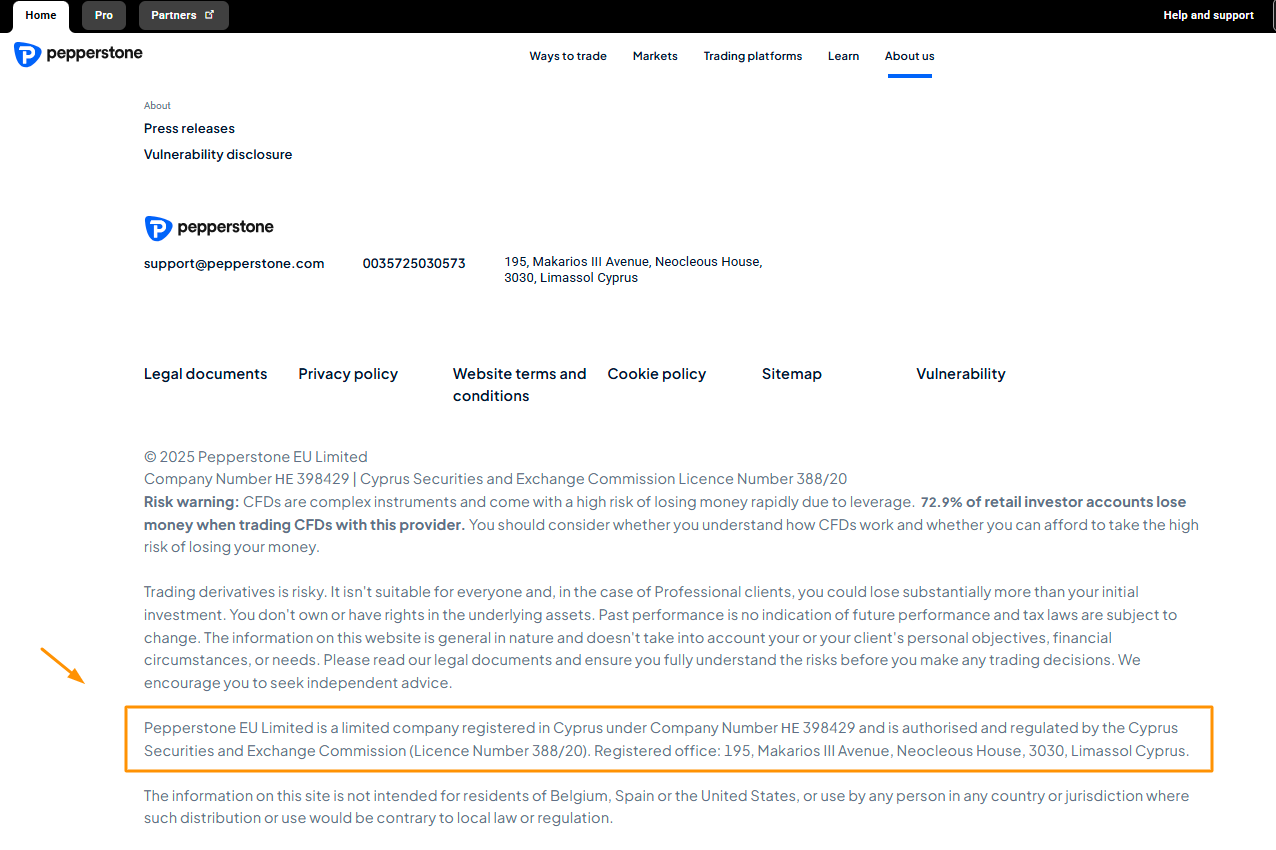
Two things deserve a clear-eyed view:
- First, Pepperstone is privately held, publishes no consolidated financial statements, and carries no public credit rating, so independent assessment of its balance sheet strength is harder than for a listed broker like XTB or Plus500.
- Second, and more importantly, regulation protects you from the firm failing, not from the product. The €20,000 ICF ceiling is irrelevant to the 72.9% of retail accounts that lose money trading normally. That figure is the real risk here, and no compensation scheme addresses it.
At the time of writing we are not aware of any material regulatory action against Pepperstone EU Limited, and it does not appear on ESMA or national regulator warning lists.
Account opening
Onboarding is fully digital and generally quick - registration, a suitability questionnaire, identity verification, then funding. The suitability step is a regulatory requirement for leveraged products and can result in your application being declined if your answers suggest CFDs are inappropriate for you.
There is no minimum deposit and no obligation to fund at all, which means you can open a live account and explore before committing money. A free demo account is available and is genuinely worth using here: the platform choice only pays off once you have found the one that suits you, and testing an automated strategy on a demo server first is basic hygiene.
Check this video to learn how to open a Pepperstone account, step-by-step:
Pepperstone also runs a referral programme from time to time, with terms that vary by country and entity - we track the current details on our Pepperstone referral code page. Note that under the product intervention rules above, CFD providers cannot offer monetary or non-monetary trading incentives to EU retail clients, so what is available in Europe is narrower than elsewhere.
Funding options for European clients are broad and fee-free from Pepperstone's side:
Withdrawals are free and take up to one business day by card or e-wallet, or up to two by bank transfer. Note that cryptocurrency deposits and withdrawals are not available to European clients, and that iDEAL, Bancontact and several other local European payment rails are not supported - SEPA transfer is the standard route.
Check this video to learn how to deposit money on Pepperstone, step-by-step:
Customer support
Support is one of Pepperstone's stronger points. The client service team is available 24 hours a day Monday to Friday and 18 hours a day at weekends, reachable by live chat, email, telephone and WhatsApp. Weekend coverage is unusual and genuinely useful given that crypto CFDs trade continuously.
The limitation for European clients is language. The EU site and support operate in English, Italian, Spanish and French. If you want to be supported in German, Dutch, Portuguese or Polish, you will be working in a second language - a real consideration when you are trying to resolve something urgent on an open position.
Tax considerations for European investors
Pepperstone is a declarative broker: it provides account statements and trade histories, but you are responsible for calculating and reporting your own tax position. It does not produce pre-filled national tax forms.
Two points European traders regularly get wrong:
- CFD gains are often taxed differently from share gains. Depending on your country, CFD profits may be treated as speculative income or capital gains, with different rates and different loss-offset rules than a normal equity portfolio. Several countries also restrict offsetting derivative losses against other income.
- Dividend adjustments are not dividends. The cash adjustment you receive on a long share CFD generally does not qualify for the dividend treatment, credits or exemptions that a real shareholding would attract, and no double-taxation treaty relief applies.
Because CFD taxation varies so much across the EU, this is one of the cases where a conversation with a local accountant genuinely pays for itself before you start trading in size.
Who is Pepperstone for?
Profile 1: the systematic or algorithmic trader
If you run Expert Advisors, cBots or scripted strategies, Pepperstone is close to the obvious European choice. MT4, MT5 and cTrader are all supported natively, scalping and hedging are permitted, execution is fast, and the Razor account gives you a transparent cost model you can actually build into a backtest.
Profile 2: the active FX trader who lives in TradingView
Native TradingView execution is rare among EU-regulated brokers. If your analysis already happens there, being able to route orders without switching windows is a real workflow gain - just remember it requires a Razor account.
Profile 3: the experienced trader hedging a portfolio
If you already hold a long-term portfolio elsewhere and want a separate account to hedge currency or index exposure over short horizons, Pepperstone's pricing and leverage caps make it a reasonable tool for that specific job.
Who Pepperstone is not for
- Long-term investors. If you want to own shares and ETFs, hold them for years, receive dividends and use a tax wrapper, this is the wrong product category entirely - not just the wrong broker.
- Beginners looking for a first investing app. The leverage, the financing costs and the 72.9% loss rate make this a poor place to learn - our beginner's guide to personal finance is a better starting point.
- Anyone who wants interest on uninvested cash, savings plans or fractional share investing.
- Investors who want deposit-level protection on large cash balances.
- Residents of Belgium or Spain, who cannot open an account.
Alternatives to Pepperstone
If Pepperstone is not the right fit, the table below covers the main European alternatives. See also our overview of the best trading platforms in Europe.
Final verdict: is Pepperstone worth it?
Judged as what it is - a specialist CFD broker for active traders - Pepperstone is one of the best options available to European clients. The Razor account is priced at the sharp end of the market, the platform choice is unmatched, execution is fast, the non-trading fee schedule is clean, and the regulatory footprint is solid. For a systematic trader running automated strategies, or an active FX trader who wants raw pricing and their own charting stack, it is a genuinely strong choice.
The honest caveats are structural rather than company-specific. Everything here is leveraged and derivative: you own nothing, financing costs punish long holding periods, there is no interest on idle cash, and EU investor protection stops at €20,000. Pepperstone is privately held and unrated, which limits what you can independently verify about its balance sheet.
If you are an experienced, active trader who has decided CFDs belong in your toolkit, Pepperstone is a credible place to execute. If you are building long-term wealth, use a broker that lets you actually own what you buy.
Disclaimer: This article is for informational and educational purposes only and does not constitute investment advice. CFDs are complex instruments and come with a high risk of losing money rapidly due to leverage. 72.9% of retail investor accounts lose money when trading CFDs with this provider. Fees, spreads and rates are variable and were accurate at the time of writing - always confirm current terms on Pepperstone's website. Do your own research and consider seeking advice from a qualified financial professional before trading. This article contains affiliate links. We may earn a commission at no extra cost to you, but our editorial opinions are our own and are not influenced by Pepperstone.